Key Takeaway
A Hong Kong holding company investing in Chinese mainland needs more than incorporation papers and a registered address. It should be able to show who makes decisions, who controls its bank account, why it owns the Chinese mainland subsidiary, what risks it bears, and how its records support those facts.
This matters most for investors seeking Mainland-Hong Kong tax arrangement benefits on dividends, especially the possible 5% withholding rate.
There is no universal minimum number of Hong Kong employees or square metres of office space. The required substance depends on the company’s functions.
The main caution is that corporate compliance, Hong Kong tax residence, Mainland beneficial ownership, and Hong Kong FSIE economic substance are separate tests.
Substance is not one legal checklist
Foreign investors often ask how many employees a Hong Kong parent needs. That question starts too late. The answer depends on which rule is being tested.
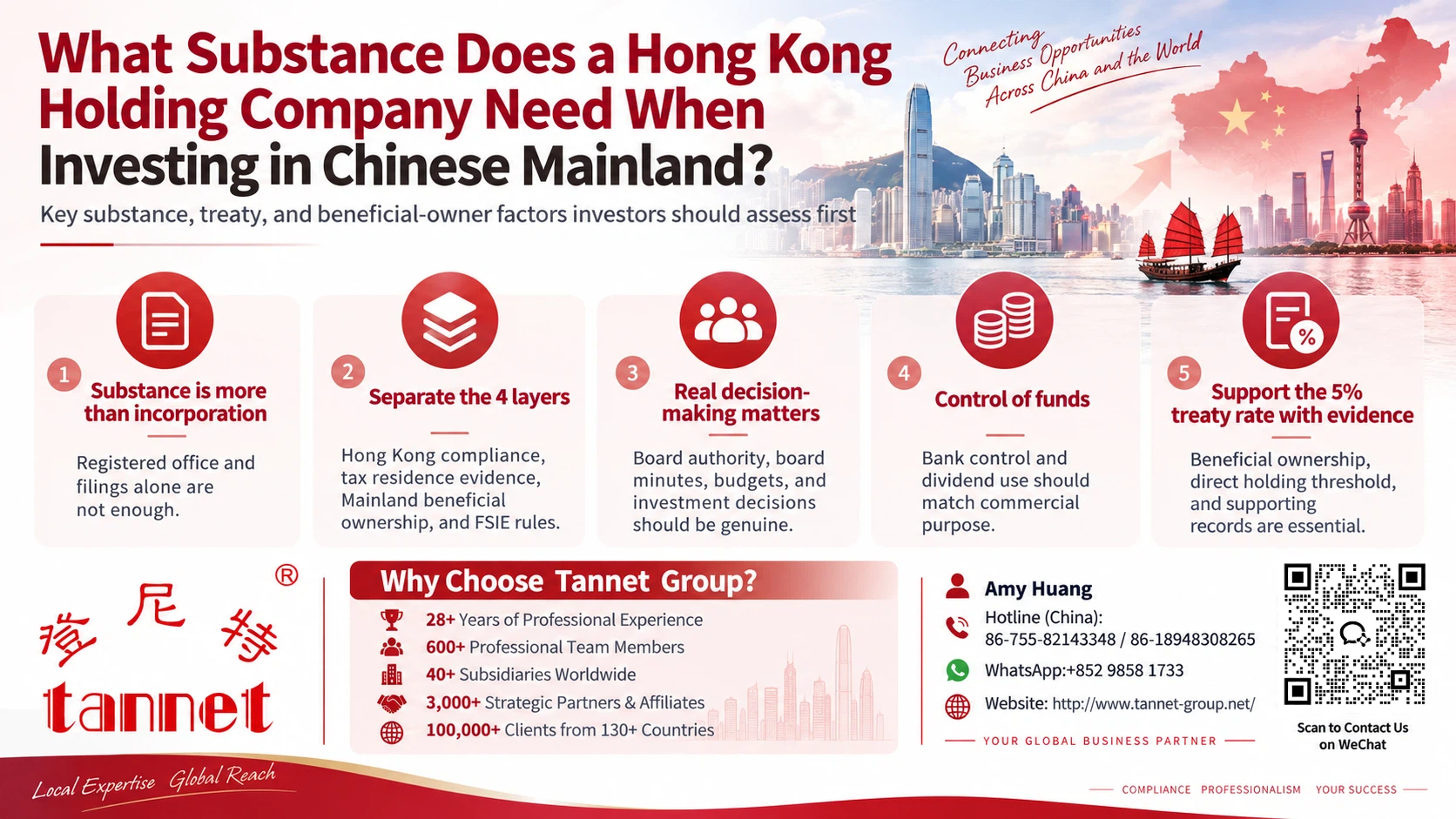
Four layers should be separated:
Hong Kong company-law and filing compliance.
Hong Kong residence evidence for an arrangement claim.
Chinese mainland’s beneficial-owner and anti-abuse analysis.
Hong Kong’s foreign-sourced income exemption, or FSIE, rules where they apply.
Passing one layer does not automatically pass the others. A valid company can fail a treaty claim. A Certificate of Resident Status can be issued, yet Mainland authorities may still reject a reduced rate.
Start with the legal operating baseline
A Hong Kong private company needs a registered office and a company secretary. A non-Hong Kong resident may be a director. A natural-person secretary should ordinarily reside in Hong Kong, while a corporate secretary needs a Hong Kong office or place of business.
Annual returns, business registration, accounting, tax records and the Significant Controllers Register form the legal baseline. They do not, by themselves, prove that the parent manages its Chinese mainland investment.
Define the holding company’s commercial role
The board should approve a role before the Chinese mainland investment. It may own the WFOE, approve capital, supervise management, retain dividends, arrange finance, admit investors or plan an exit.
The company should perform that role. A passive parent of one WFOE may need fewer resources than a regional platform, but decisions made elsewhere cannot be repaired by later Hong Kong paperwork.
Put real decision-making behind board records
Board minutes should record actual questions, information and decisions. Directors should receive budgets, WFOE reports and cash-flow information before approving material actions.
Important decisions may include:
Forming or acquiring the Chinese mainland subsidiary.
Approving capital, budgets and key appointments.
Approving material finance or service arrangements.
Deciding whether dividends are retained, reinvested or distributed.
Approving a sale, restructuring or new investor.
Meetings in Hong Kong can support the facts, but participants still need authority, knowledge and a genuine choice.
Align bank control and money flows
The Hong Kong company should control its funds. Bank mandates and payments should match board authority and approved purposes.
Automatic onward payment of Chinese mainland dividends creates risk. State Taxation Administration Announcement No. 9 of 2018 treats an obligation to pay more than 50% of the income to a third-country resident within 12 months as an adverse beneficial-ownership factor.
Dividends need not stay in Hong Kong. The recipient should, however, control the income and have a commercially explainable payment policy.
Understand the Mainland beneficial-owner test
Under Article 10 of the Mainland-Hong Kong tax arrangement, the Mainland dividend tax may be capped at 5% when the beneficial owner is a Hong Kong company directly owning at least 25% of the payer’s capital. Other qualifying cases are generally capped at 10%.
The 5% rate is not a registration benefit. Announcement No. 9 defines a beneficial owner through ownership and control. Adverse factors include rapid pass-through, non-substantive activity and exemption or very low taxation of the income. Genuine investment-holding management can be substantive when functions and risks support it.
Build the evidence the Mainland rules identify
Announcement No. 9 expressly refers to articles of association, financial statements, fund-flow records, board minutes, board resolutions, human and physical resources, expenditure, functions and risks.
A practical evidence file should contain:
Group charts and the investment mandate.
Director biographies and authority records.
Board packs, minutes and resolutions.
WFOE budgets, reports and capital documents.
Bank mandates, statements and payment approvals.
Contracts, office arrangements and expense records.
Accounts, dividend documents and cash-use evidence.
Documents should be created during normal operations. A folder assembled only when a dividend is declared may reveal gaps rather than repair them.
Obtain residence evidence, but do not overstate it
Hong Kong’s Inland Revenue Department issues a Certificate of Resident Status for DTA or arrangement claims. A Hong Kong-incorporated company may apply using the form designated for the Mainland.
The IRD states that a certificate does not guarantee benefits. For the Mainland arrangement, it generally supports residence for the issued calendar year and the next two years, unless circumstances change. Plan the application before payment and keep Hong Kong and Mainland records consistent.
Follow the Mainland claim procedure
STA Announcement No. 35 of 2019 uses a self-assessment model: judge eligibility, claim the treatment through the filing process, and retain supporting documents for review.
For withholding cases, the non-resident gives the treaty-benefit information report to the withholding agent. Incomplete information causes domestic law to apply. Retain the residence certificate, ownership and dividend records, resolutions, payments and beneficial-owner support for each relevant payment.
Check whether Hong Kong FSIE rules apply
Hong Kong’s FSIE regime is a separate Hong Kong tax analysis. It can apply when an in-scope multinational enterprise entity receives specified foreign-sourced income, including dividends, in Hong Kong.
For a pure equity-holding entity relying on economic substance, IRD guidance requires applicable filing compliance and adequate Hong Kong human resources and premises for managing equity interests.
No headcount or expenditure threshold is prescribed. Outsourcing is possible when activities occur in Hong Kong, the company monitors them, and provider resources and fees are proportionate. The participation exception is a separate route with its own conditions. Review FSIE before funds reach Hong Kong.
Match resources to the actual business model
A pure holding company does not automatically need a large office. A simple parent may rely on informed directors, scheduled reviews, reliable accounts, bank control and monitored Hong Kong support.
A regional platform may need local management, qualified staff, dedicated premises and meaningful expenditure. No single director, employee or lease secures the 5% rate. The complete pattern matters.
Common mistakes
Treating a registered address as tax substance
The address satisfies a corporate requirement. It does not prove that investment management occurs in Hong Kong.
Signing board minutes after decisions were made elsewhere
Minutes should evidence real deliberation. They should not merely ratify instructions from the ultimate owner.
Sending dividends onward automatically
Contractual or factual pass-through can weaken beneficial ownership, especially where more than 50% is paid to a third-country resident within 12 months.
Using the same substance package for every company
A passive equity holder and a regional finance company perform different functions. Their people, costs, controls and evidence should differ.
Assuming a Certificate of Resident Status settles the claim
The certificate proves residence for treaty purposes. Mainland authorities still assess beneficial ownership, the dividend article and anti-abuse rules.
Reviewing substance only when cash is ready to move
Substance is an operating history. Decisions, records and expenditure should exist before the dividend or exit event.
Frequently Asked Questions
Q1. How many Hong Kong employees must a holding company have?
There is no universal statutory number for treaty relief or FSIE adequacy. Staffing must be proportionate to the functions performed. A pure equity holder may use monitored outsourcing, while an active regional platform may need its own qualified employees.
Q2. Does the company need a dedicated physical office?
Not in every case. It needs a Hong Kong registered office, and any premises used for substance should be adequate for the activity. A service office may support a simple model, but an active regional business may require dedicated space.
Q3. Must all directors live in Hong Kong?
No. The Companies Registry confirms that a director need not be a Hong Kong resident. For substance, the more important issue is whether directors have authority, information and genuine participation in decisions.
Q4. Is one board meeting in Hong Kong each year enough?
There is no safe number. Meeting frequency should follow material events and the company’s stated role. Capital, financing, dividends, investor changes and exits should be considered when they arise.
Q5. Does a Hong Kong Certificate of Resident Status guarantee the 5% dividend rate?
No. The IRD expressly says a certificate does not guarantee DTA benefits. The Mainland tax authority still tests direct ownership, beneficial ownership, documentation and anti-abuse conditions.
Q6. Can a company secretary provide the required substance?
A secretary can handle statutory work and a service provider may perform outsourced activities. The board must still direct, monitor and control the work. Outsourcing cannot replace the company’s responsibility.
Q7. Can the Hong Kong company distribute the Chinese mainland dividend to its owner?
Yes, if legally and commercially supportable. However, a pre-arranged or automatic pass-through may affect beneficial-owner analysis. Hong Kong FSIE, destination-country withholding and the owner’s home-country tax should also be reviewed.
Conclusion
The right substance is a consistent operating pattern, not a collection of rented features. The Hong Kong company should have a real investment role, capable decision-makers, control over funds, resources proportionate to its activities and contemporaneous evidence.
Tannet can assist when Hong Kong incorporation, company secretarial maintenance, accounting, Certificate of Resident Status preparation, China WFOE registration, dividend documentation and cross-border compliance need coordinated administration. Legal and tax advisers should confirm treaty, FSIE and home-country positions for the investor’s specific facts.
Official and High-Credibility Sources
Mainland-Hong Kong tax arrangement;
STA Announcement No. 9 of 2018 on beneficial ownership;
STA Announcement No. 35 of 2019 on treaty benefits;
Hong Kong IRD Certificate of Resident Status guidance;
Hong Kong IRD FSIE guidance; Hong Kong Companies Registry director and company secretary guidance; Hong Kong Companies Registry Significant Controllers Register guidance.
Written by: Tannet Business Services Team
Reviewed by: Consultant Amy Huang
First published: 8 Sep. 2026
Last reviewed: 8 Sep. 2026
————————————————Simplifying Business, Empowering Entrepreneurs————————————————