Key Takeaway
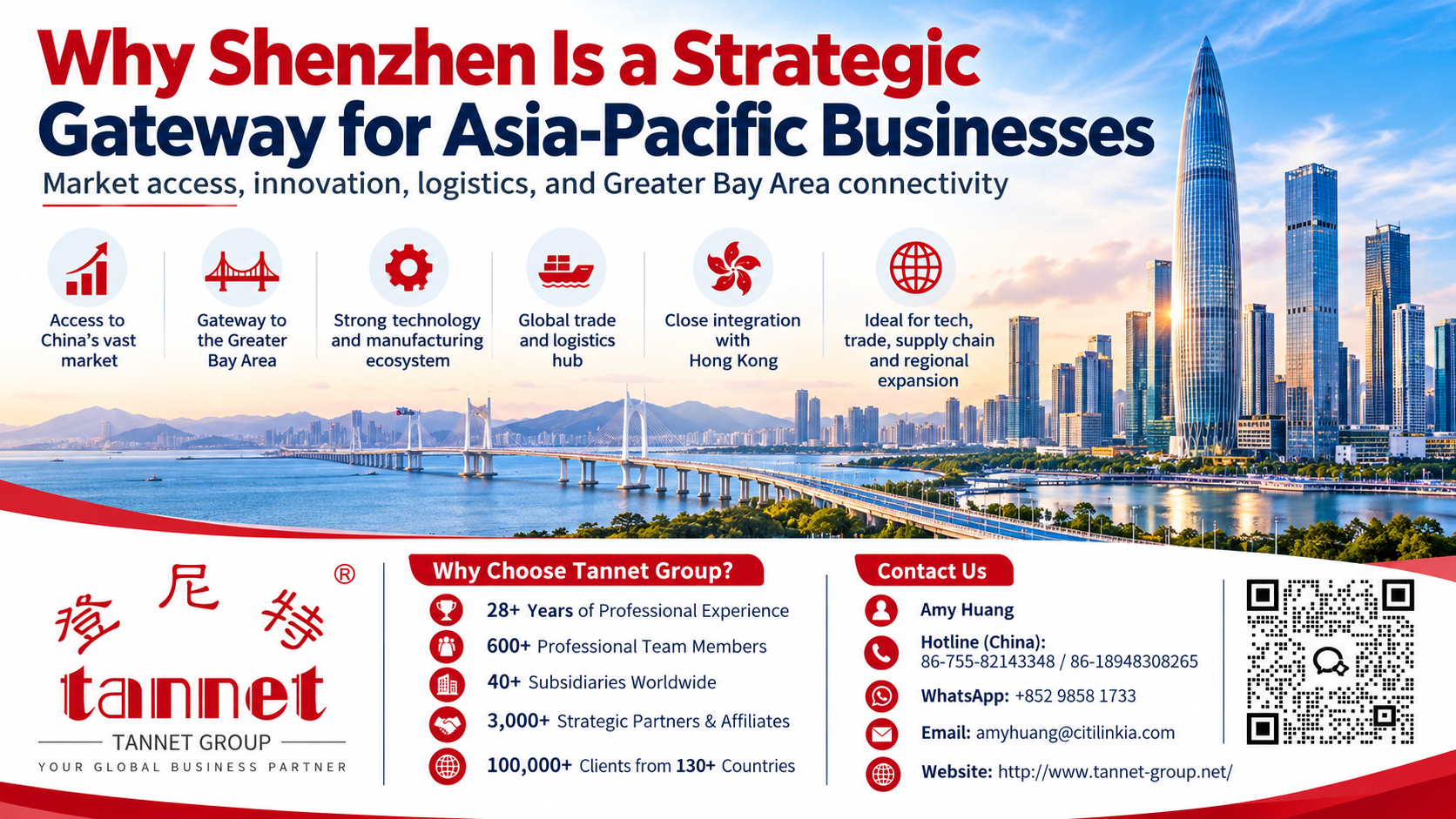
Shenzhen is a strategic gateway for Asia-Pacific businesses because it combines mainland market access, a dense technology and manufacturing ecosystem, large-scale foreign trade, international logistics, and immediate connectivity with Hong Kong. It is most suitable for technology companies, manufacturers, exporters, supply-chain operators, digital businesses, and professional-service groups that need both China operating capacity and regional reach.
The main caution is that Shenzhen is not a legal shortcut into China or Asia.
Companies still need a defined customer base, permitted business scope, licenses, tax and customs planning, data controls, banking, talent, intellectual-property protection, and a structure that reflects real functions.
What a strategic gateway actually means
A gateway is useful when it reduces the distance between a business and several commercial resources. Those resources may include customers, suppliers, engineers, factories, ports, airports, finance, professional advisers, and neighboring markets.
Shenzhen performs this role through combination rather than one advantage. It provides access to China’s large domestic economy. It also sits within the Guangdong-Hong Kong-Macao Greater Bay Area, which links nine Guangdong cities with Hong Kong and Macao.
The city should not be treated as a universal headquarters location. Its value depends on whether the company needs the activities that Shenzhen performs well. A service business with no mainland customers may reach a different conclusion from a hardware company that requires rapid prototyping and supplier coordination.
Scale supports the gateway role
Shenzhen Government Online reported that the city’s GDP reached RMB3.87 trillion in 2025. Strategic emerging industries generated RMB1.67 trillion in added value, equal to 43 percent of the city’s GDP.
Foreign trade reached RMB4.55 trillion in 2025, ranking Shenzhen first among Chinese mainland cities. High-tech products accounted for RMB2.6 trillion, or 57.1 percent of the city’s total foreign trade.
These figures do not prove that every overseas company should enter Shenzhen. They show that the city operates at sufficient scale to support complex cross-border production, distribution, technology, and services activity.
Gateway function one: technology development and commercialization
Shenzhen combines research, engineering, component suppliers, contract manufacturers, product testing, logistics, and commercial customers. This can shorten the distance between an idea, a prototype, a production run, and market feedback.
However, ecosystem proximity does not remove intellectual-property or product-compliance risk. Overseas companies should decide who owns designs, tooling, firmware, data, improvements, and registrations before sharing technical information.
Gateway function two: supply-chain coordination
A Shenzhen operation can coordinate suppliers across the Pearl River Delta. Nearby cities may provide specialized manufacturing, materials, components, packaging, testing, warehousing, or logistics services.
This regional density can support faster supplier visits and shorter problem-solving cycles. It may also create concentration risk. Companies should map critical suppliers, alternative sources, tooling ownership, quality controls, inventory, and recovery routes.
A gateway strategy therefore needs two plans. The first captures speed and ecosystem access. The second protects continuity if one supplier, transport route, facility, or digital system becomes unavailable.
Gateway function three: trade and logistics
Shenzhen’s trade scale is supported by seaports, an international airport, land checkpoints, rail links, expressways, and proximity to Hong Kong. The city can serve shipments moving within China and across Asia-Pacific markets.
Shenzhen Bao’an International Airport handled 66 million passengers and 2.05 million tonnes of cargo and mail in 2025. It operated 104 international and regional passenger and cargo routes, according to Shenzhen Government Online.
Logistics strength is not the same as frictionless movement. Importers and exporters must classify goods, confirm valuation, origin, licensing, product standards, inspection, labeling, tax, and foreign-exchange requirements. Restricted or controlled technology needs additional review.
Gateway function four: access to the Greater Bay Area
The Greater Bay Area covers Hong Kong, Macao, Shenzhen, Guangzhou, and seven other Guangdong municipalities. The official Greater Bay Area portal describes a region of about 56,000 square kilometers with extensive transport and economic links.
For businesses, the region should be viewed as a network of specialized nodes. Shenzhen may support product, engineering, mainland sales, or supply-chain management. Guangzhou may support trade, manufacturing, exhibitions, logistics, or access to the wider South China market.
Dongguan, Foshan, Huizhou, and other cities may support different industrial requirements. The correct location depends on customers, suppliers, premises, skills, regulations, costs, and transport patterns.
Gateway function five: Shenzhen and Hong Kong as complementary nodes
Shenzhen and Hong Kong have different legal, tax, financial, customs, and business systems. Their proximity can be useful when each entity performs genuine functions rather than acting as a paper layer.
A Hong Kong company may support international contracting, treasury, financing, regional holding, dispute resolution, or non-mainland customer relationships. A Shenzhen company may employ mainland staff, sign local contracts, issue Chinese invoices, hold licenses, and operate with mainland customers or suppliers.
The arrangement requires substance. Directors, employees, decision-making, contracts, bank accounts, assets, risks, and transfer pricing should match the stated roles. A Hong Kong entity without real functions may create tax, banking, and governance problems.
Qianhai and other functional areas
Shenzhen contains several functional areas with different policy and industry purposes. These include Qianhai, the Hetao Shenzhen-Hong Kong Science and Technology Innovation Cooperation Zone, Guangming Science City, and the Shenzhen National High-Tech Zone.
Qianhai focuses on Shenzhen-Hong Kong cooperation and modern services. It may be relevant to finance, professional services, logistics, technology services, and cross-border business. Any incentive or reduced tax treatment must be checked against current eligibility rules and the company’s actual activities.
Which businesses may benefit most
Technology and hardware companies
These businesses may value engineering talent, component access, prototyping, testing, manufacturing partners, and rapid product iteration. They should prioritize intellectual property, export controls, data, and product certification.
Manufacturers and supply-chain operators
These companies may use Shenzhen for procurement, quality, supplier management, regional sales, or logistics coordination. They should model concentration, customs, working capital, premises, and business continuity.
Digital and professional-service businesses
These firms may access technology clients and cross-border projects. They must confirm sector licensing, contract structure, invoicing, data flows, staffing, and whether mainland presence is legally and commercially necessary.
Asia-Pacific regional groups
Regional groups may combine Hong Kong international functions with Shenzhen operating capabilities. The structure should follow transaction flows and management responsibilities, not a generic holding-company diagram.
A staged gateway strategy
- Define the target customer, product, revenue model, and reason for choosing Shenzhen.
- Map suppliers, staff, contracts, intellectual property, data, payments, customs, and licenses.
- Compare export, distributor, project, WFOE, Hong Kong, and combined regional models.
- Test customers and counterparties before committing substantial fixed cost.
- Select the location and structure that match real functions, then build the compliance calendar.
Common mistakes
- Calling Shenzhen a regional headquarters without defining its actual functions.
- Forming a WFOE before confirming customers, licenses, and transaction flows.
- Using a Hong Kong company as a paper holding layer without substance.
- Concentrating suppliers without alternative sources or recovery plans.
- Assuming fast logistics removes customs and product-compliance requirements.
- Choosing a special zone for incentives before checking eligibility and operating fit.
Frequently asked questions
Q1. Is Shenzhen suitable only for technology companies?
No. Technology is a major strength, but trade, logistics, manufacturing, professional services, consumer, and regional management activities may also be relevant.
Q2. Does an overseas business need a Shenzhen company to sell into China?
Not always. Export, distributor, licensing, e-commerce, project, and local-entity models should be compared against the activity, customer, tax, and regulatory position.
Q3. Should Hong Kong own the Shenzhen WFOE?
It can be appropriate where Hong Kong performs genuine financing, holding, contracting, treasury, or management functions. Tax treaty access and substance require separate review.
Q4. Is Qianhai automatically more tax-efficient?
No. Preferential treatment has defined industries, conditions, procedures, and effective periods. Eligibility should be confirmed from current official rules.
Q5. Can Shenzhen serve customers across Asia-Pacific?
It can support regional production, sourcing, logistics, and sales, but each destination has its own import, tax, product, data, and distribution rules.
Q6. What should be tested before incorporation?
Test customer demand, permitted activities, licenses, pricing, partner reliability, staffing, banking, tax, customs, data, premises, and working capital.
Q7. What makes a Shenzhen-Hong Kong structure credible?
Each entity should have documented functions, people, decisions, contracts, assets, risks, bank activity, and appropriate intercompany arrangements.
Conclusion
Shenzhen is a strategic gateway when its technology, supply-chain, logistics, and mainland operating capabilities match a company’s commercial model. Tannet can assist overseas businesses with market-entry comparison, company formation, tax registration, accounting, corporate compliance, and cross-border coordination across Shenzhen, Guangzhou, and Hong Kong. The recommended scope should follow the company’s customers, activities, ownership, management, and expansion timetable.
Official Sources
Written by: Tannet Business Services Team
Reviewed by: Consultant Amy Huang
First published: 24 Sep. 2026
Last reviewed: 24 Sep. 2026
————————————————Simplifying Business, Empowering Entrepreneurs————————————————