How Foreign Companies Can Enter the Shenzhen Market
Shenzhen has developed into one of China’s most important business and innovation centres. Located in Guangdong Province and directly adjacent to Hong Kong, the city provides international companies with access to the Guangdong–Hong Kong–Macao Greater Bay Area (GBA), China’s manufacturing ecosystem, technology industries and a large domestic consumer market.
For foreign companies considering expansion into China, entering Shenzhen can take several forms. The appropriate structure depends on the company’s business activities, investment objectives, operational requirements and long-term China strategy.
Why Shenzhen?
Shenzhen is widely known for technology, electronics, advanced manufacturing, cross-border trade and innovation. The city is home to major technology companies as well as extensive networks of manufacturers, suppliers, logistics providers and professional service firms.
Its proximity to Hong Kong is another important advantage. Companies can potentially use Hong Kong and Shenzhen as complementary locations within a broader Greater Bay Area strategy.
Shenzhen is particularly relevant to businesses operating in areas such as:
- Technology and software
- Electronics and hardware
- Advanced manufacturing
- Import and export
- E-commerce
- Professional and business services
- Supply chain and logistics
- Research and development
- Consumer products
However, entering Shenzhen requires more than simply registering a company. Foreign investors should first determine how they intend to operate in China.
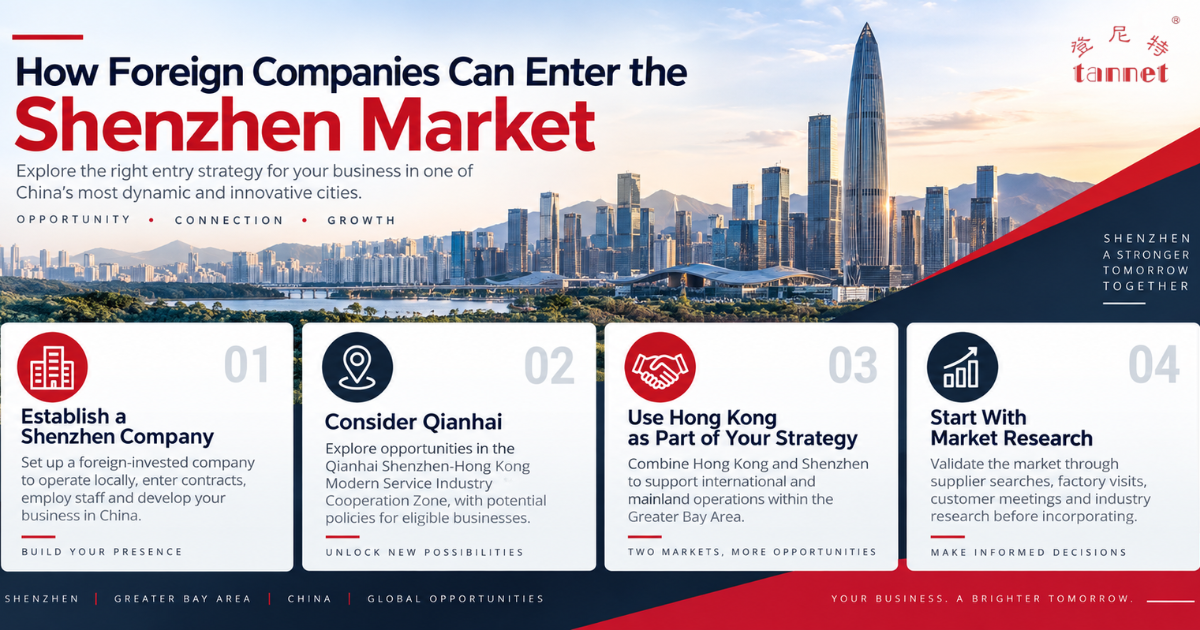
1. Establish a Foreign-Invested Company in Shenzhen
For companies planning substantial operations in China, establishing a locally incorporated company is one of the main market-entry options.
Depending on the proposed activities and applicable foreign investment rules, foreign investors may establish a company with foreign ownership in Shenzhen.
A local company can provide an operational platform for activities such as entering commercial contracts, employing staff, issuing invoices, receiving business income and conducting approved business activities in China.
Before incorporation, investors should determine several important matters, including:
Company name
The proposed Chinese company name must comply with local registration requirements and be approved through the relevant registration process.
Business scope
The business scope should accurately describe the activities the company intends to conduct. This is particularly important because certain activities may require additional licences, permits or regulatory approvals.
Registered capital
Investors should determine an appropriate registered capital amount based on the company’s business model and funding requirements while considering the applicable contribution requirements.
Registered address
A compliant business address is generally required for company registration.
Shareholders and management
The ownership structure, legal representative, directors or executive directors, supervisors and other corporate positions should be planned before filing.
2. Consider Qianhai for Suitable Businesses
Companies evaluating Shenzhen should also consider the Qianhai Shenzhen-Hong Kong Modern Service Industry Cooperation Zone.
Qianhai has been developed as an important platform for cooperation between Shenzhen and Hong Kong and focuses on areas including modern services, financial services, technology, logistics and professional services.
For eligible businesses, Qianhai may provide access to particular policies or incentives. However, companies should not assume that registration in Qianhai automatically provides preferential treatment.
Eligibility depends on factors such as the company’s industry, actual operations and the specific policy involved.
Companies should therefore assess Qianhai based on their real operating model rather than selecting the location purely for potential incentives.
3. Use Hong Kong as Part of a Greater Bay Area Strategy
Another option is to combine Hong Kong and Shenzhen within the same regional business structure.
For example, an international company may maintain a Hong Kong entity for international business functions while establishing a Shenzhen company for mainland China operations.
Depending on the business model, such a structure may help separate international and mainland activities while allowing the company to operate across two major Greater Bay Area business centres.
However, establishing a Hong Kong company alone does not automatically allow a business to conduct regulated or locally licensed activities in mainland China.
The corporate, tax, banking and contractual structure should therefore be planned carefully.
4. Start With Market Research and Business Development
Not every company needs to establish a Shenzhen entity immediately.
Companies that are still assessing the market may begin with:
- Market research
- Supplier identification
- Factory visits
- Business partner searches
- Distributor discussions
- Customer meetings
- Industry exhibitions
- Professional consultations
This approach can help a company understand local demand, competition, pricing, suppliers and regulatory requirements before committing significant resources to a permanent establishment.
For businesses entering China for the first time, a structured market-entry assessment can reduce unnecessary incorporation and operating costs.
5. Understand Industry-Specific Licensing
Company registration does not necessarily mean that a company can immediately conduct every activity stated in its business plan.
Certain sectors may require additional licences, filings or approvals.
Depending on the industry, this can apply to areas such as food, transportation, telecommunications, education, medical services, import and export activities and other regulated businesses.
Foreign investors should therefore confirm whether their proposed activities fall within restricted or regulated sectors before establishing the company.
This is especially important when preparing the business scope.
6. Prepare for Tax, Accounting and Compliance
Once a Shenzhen company is established, ongoing compliance becomes part of normal operations.
Companies may need to manage:
- Accounting and bookkeeping
- Tax registration and filings
- Corporate income tax
- Value-added tax where applicable
- Employee payroll and individual income tax
- Social insurance obligations
- Annual reporting
- Corporate record updates
- Licence renewals where applicable
Foreign investors should include these recurring obligations when calculating the actual cost of operating in Shenzhen.
7. Plan Banking and Cross-Border Funds in Advance
Banking is another important consideration for foreign companies.
Opening a corporate bank account may involve know-your-customer procedures, shareholder and director verification, explanations of the company’s business model and supporting commercial documents.
Businesses involving cross-border transactions should also consider how payments, capital contributions, foreign exchange and profit distributions will be handled.
These issues are better addressed during the market-entry planning stage rather than after incorporation.
Choosing the Right Shenzhen Market-Entry Strategy
There is no single structure suitable for every foreign company.
A technology company establishing a development team in Shenzhen will have different requirements from a trading company sourcing electronics, a manufacturer establishing production operations or an international professional-services company serving Chinese clients.
Before entering Shenzhen, foreign investors should clarify five fundamental questions:
- What activities will the company conduct in China?
- Does the company need a mainland Chinese legal entity?
- Are any licences or industry approvals required?
- Where should the company be registered?
- How will the Shenzhen operation connect with the company’s international structure?
Answering these questions first can make the incorporation and market-entry process considerably more efficient.
Entering Shenzhen With a Clear Strategy
Shenzhen offers international businesses access to one of China’s most dynamic commercial ecosystems, but successful market entry requires more than company registration.
Foreign investors should evaluate their business model, ownership structure, location, licences, tax obligations, banking arrangements and ongoing compliance before beginning operations.
For businesses considering Shenzhen, Hong Kong or the wider Greater Bay Area, TANNET can assist with company incorporation, corporate secretarial support, accounting and tax services, business licensing, trademark registration and other market-entry services.
A properly planned structure can provide a stronger foundation for developing business in Shenzhen and the wider China market.