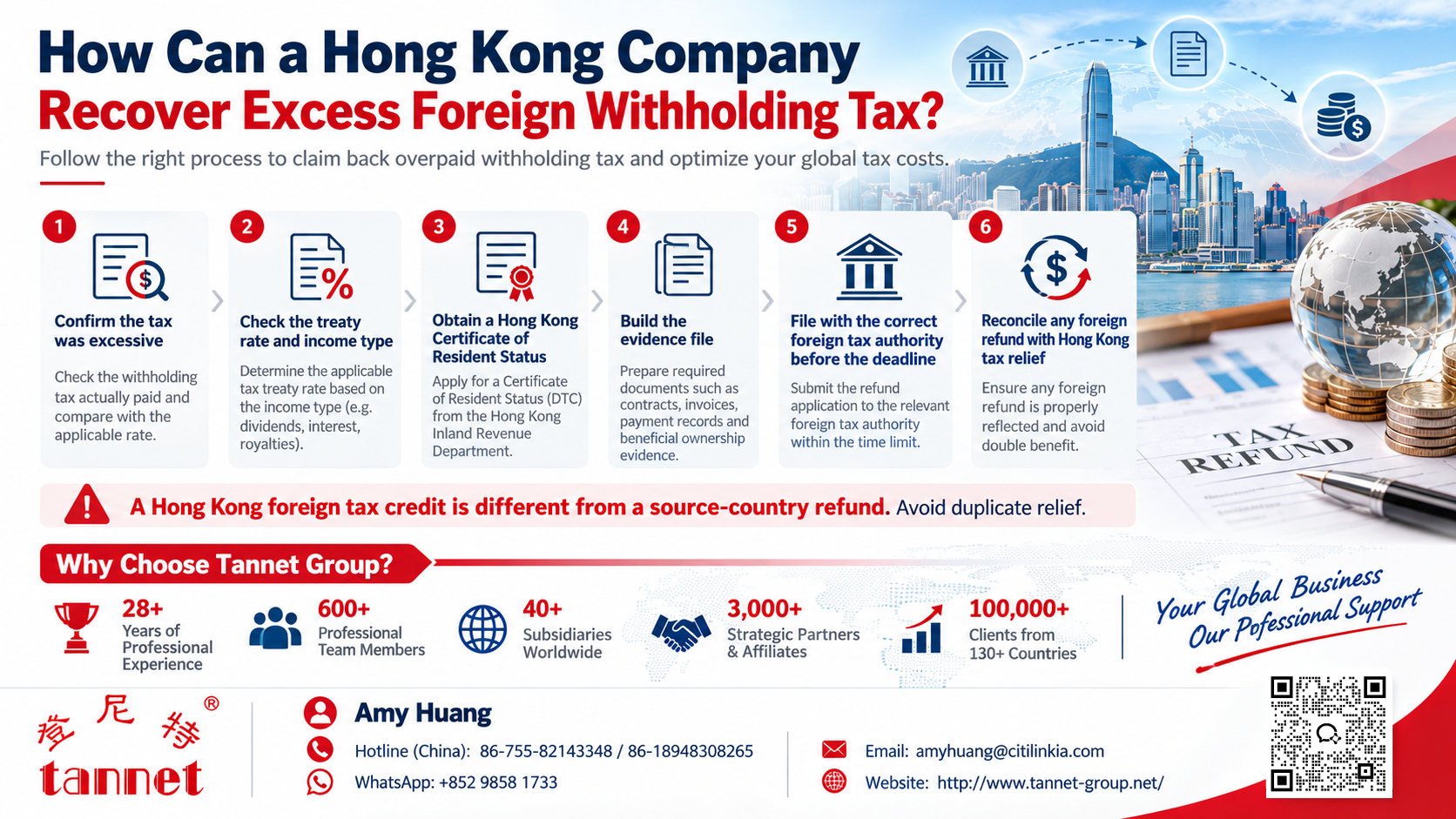
Key Takeaway
A Hong Kong company can usually recover excess foreign withholding tax by claiming a refund from the tax authority in the country where the income arose.
The process is relevant to companies receiving dividends, interest, royalties, service fees or other cross-border income taxed above the applicable treaty rate.
The company must identify the legal basis, secure a Hong Kong Certificate of Resident Status, prove the tax was withheld and remitted, and file before the source country’s deadline.
The critical caution is that a Hong Kong foreign tax credit is different from a source-country refund.
A company should pursue available foreign relief first and prevent duplicate recovery.
Start with the correct recovery route
Foreign withholding tax is normally deducted by the overseas payer before money reaches the Hong Kong company. An excess arises when the deducted amount exceeds the rate permitted by domestic law, an applicable double taxation agreement, or another relief provision.
The first recovery route is relief at source. The payer applies the reduced rate before payment. This protects cash flow and avoids a later refund claim.
The second route is a refund from the source country. It applies when full domestic tax was already deducted even though a lower treaty rate may be available.
The third route is double tax relief in Hong Kong. It may involve a foreign tax credit or, in limited circumstances, a deduction. This route addresses double taxation in Hong Kong. It does not correct an excessive assessment collected by another jurisdiction.
Step 1: confirm that tax was excessive
Compare the amount withheld with the rate legally applicable on the payment date. Begin with the source country’s domestic law. Then review the relevant Hong Kong tax agreement and protocol.
Classify the income correctly. Dividends, interest, royalties, technical fees, services and capital gains may fall under different treaty articles. A commercial label on an invoice is not decisive.
Check whether the treaty was effective for the period. Also verify ownership thresholds, minimum holding periods, permanent establishment rules, beneficial ownership and any principal purpose or anti-abuse test.
Calculate the potential refund payment by payment. Use the gross income, domestic rate, treaty rate, tax actually withheld, currency and payment date. Do not assume every deduction is recoverable.
Step 2: identify the competent refund authority
The refund is generally claimed from the tax authority that received the withholding tax. The payer, withholding agent, custodian or local representative may need to participate.
The procedure varies significantly. Some countries provide online portals. Others require prescribed forms, original tax vouchers, certified translations, electronic signatures or local fiscal representatives.
Germany’s Federal Central Tax Office, for example, operates exemption and refund procedures for withholding taxes and requires electronic applications in relevant cases. Indonesia’s Directorate General of Taxes uses residence documentation within its treaty withholding procedure.
These examples show why a universal refund pack does not work. The legal entitlement may arise from a treaty, but the filing mechanics remain local.
Step 3: obtain Hong Kong residence evidence
The Hong Kong Inland Revenue Department issues a Certificate of Resident Status, or CoR, for claiming benefits under a comprehensive double taxation agreement or arrangement.
The application should identify the treaty partner, claim period and relevant income. A certificate is evidence of residence. It is not a direction requiring the foreign authority to approve a refund.
Apply early. The IRD states a processing target of 21 working days after receiving a properly completed application. Requests for supplementary information can extend the practical timetable.
The foreign authority may request a certificate for the specific calendar year, its own residence form endorsed by the IRD, or both. Confirm its format before filing.
Step 4: build the evidence file
A strong refund claim connects the claimant, payment, tax and treaty condition. The company should normally collect the following documents:
- Hong Kong Certificate of Resident Status for the relevant period.
- Source-country refund form and authorization documents.
- Withholding certificate or official tax voucher.
- Proof that tax was remitted to the foreign authority.
- Contract, invoice, dividend resolution, loan agreement or licence agreement.
- Bank statements showing the gross payment, deduction and net receipt.
- Share register, organization chart and holding-period evidence.
- Beneficial ownership and commercial substance support where required.
- Translation, certification, apostille or electronic verification requested locally.
A bank credit advice may show that money was deducted, but it may not prove that the withholding agent paid the tax to the government. Obtain the formal evidence required by local rules.
Step 5: control the filing deadline
Refund limitation periods differ by jurisdiction and may also depend on the treaty. Some deadlines run from the end of the payment year. Others run from withholding, remittance, assessment or filing.
Create a deadline register as soon as foreign income is expected. Record the statutory deadline, portal access lead time, CoR period, original-document requirement and person responsible.
Do not wait for the Hong Kong profits tax return. A source-country refund period may expire independently of the Hong Kong assessment cycle.
If documents are missing, determine whether a protective filing is permitted. Obtain local advice before relying on an incomplete submission to preserve rights.
Step 6: reconcile refund and Hong Kong tax relief
Hong Kong’s IRD explains in Departmental Interpretation and Practice Notes No. 28 that tax credit relief may be available under an applicable DTA where the same income is taxed in Hong Kong.
The credit is subject to legal limits. Section 50AA of the Inland Revenue Ordinance also requires reasonable steps to minimize foreign tax before relief is claimed in Hong Kong.
This means a company should not claim a Hong Kong credit for tax that could reasonably be recovered overseas and then retain both benefits. If a refund arrives after a Hong Kong credit claim, review whether the Hong Kong position must be adjusted.
Maintain a reconciliation showing foreign tax paid, recoverable tax, refund received, unrecovered tax, Hong Kong assessable income and credit claimed. Finance and tax records should tell the same story.
Step 7: respond to questions and track payment
Foreign tax authorities may ask about residence, beneficial ownership, control of income, employees, directors, office arrangements, transaction purpose or onward payments.
Answer consistently with the CoR application, audited accounts, contracts and banking records. A contradiction can delay the case or trigger a broader treaty-abuse review.
Track the claim reference, submission date, supplementary requests, decision and refund date. Reconcile any interest paid by the authority separately.
If a claim is rejected, identify whether the issue is procedural or substantive. A missing voucher may be repairable. A denial based on beneficial ownership may require legal analysis, review or appeal.
Common mistakes
- Treating the Hong Kong CoR as automatic approval of a foreign refund.
- Using the treaty rate without checking income classification and anti-abuse rules.
- Filing bank statements without an official withholding or remittance certificate.
- Missing a local limitation period while waiting for the Hong Kong tax assessment.
- Applying under the name of a custodian or affiliate instead of the beneficial claimant.
- Claiming a Hong Kong foreign tax credit without pursuing a reasonably available refund.
- Failing to update Hong Kong records after the foreign refund is received.
Frequently asked questions
Q1. Where should a Hong Kong company file the refund claim?
Usually with the tax authority in the jurisdiction that collected the withholding tax. Local forms, portals and representation rules apply.
Q2. Is a Hong Kong CoR enough to obtain the refund?
No. It proves residence for treaty purposes. The source country may also test beneficial ownership, holding periods, income classification and anti-abuse provisions.
Q3. Can the payer correct the withholding instead?
Sometimes. A payer or withholding agent may amend its return or apply relief at source. Confirm the permitted route before filing a separate claim.
Q4. How long does a refund take?
There is no universal period. Timing depends on the country, claim type, evidence quality, filing volume and follow-up questions.
Q5. Can the same CoR support several refund claims?
It may support multiple payments involving the same treaty partner and accepted period. Confirm the foreign authority’s recency and format rules.
Q6. What if the tax voucher is missing?
Ask the payer, custodian or withholding agent for the prescribed evidence. A bank statement alone may not satisfy the authority.
Q7. Can the company claim both a foreign refund and a Hong Kong tax credit?
It must avoid double relief. Any recoverable or refunded amount should be reflected when calculating and updating the Hong Kong claim.
Conclusion
Recovering excess foreign withholding tax requires a country-specific process. The company must establish the correct rate, meet treaty conditions, document actual withholding and submit the local claim on time.
Tannet can assist with claim mapping, Hong Kong CoR applications, document checklists, transaction records and coordination with source-country advisers. Local tax counsel should confirm foreign filing rules, disputed entitlement and appeal options.
Act early.
Written by: Tannet Business Services Team
Reviewed by: Consultant Amy Huang
First published: 13 Oct. 2026
Last reviewed: 13 Oct. 2026
30th Anniversary Offer: To celebrate Tannet’s 30th anniversary, preferential service pricing is now available. Contact Consultant Amy Huang for details.
————————————————Simplifying Business, Empowering Entrepreneurs————————————————