Key Takeaway
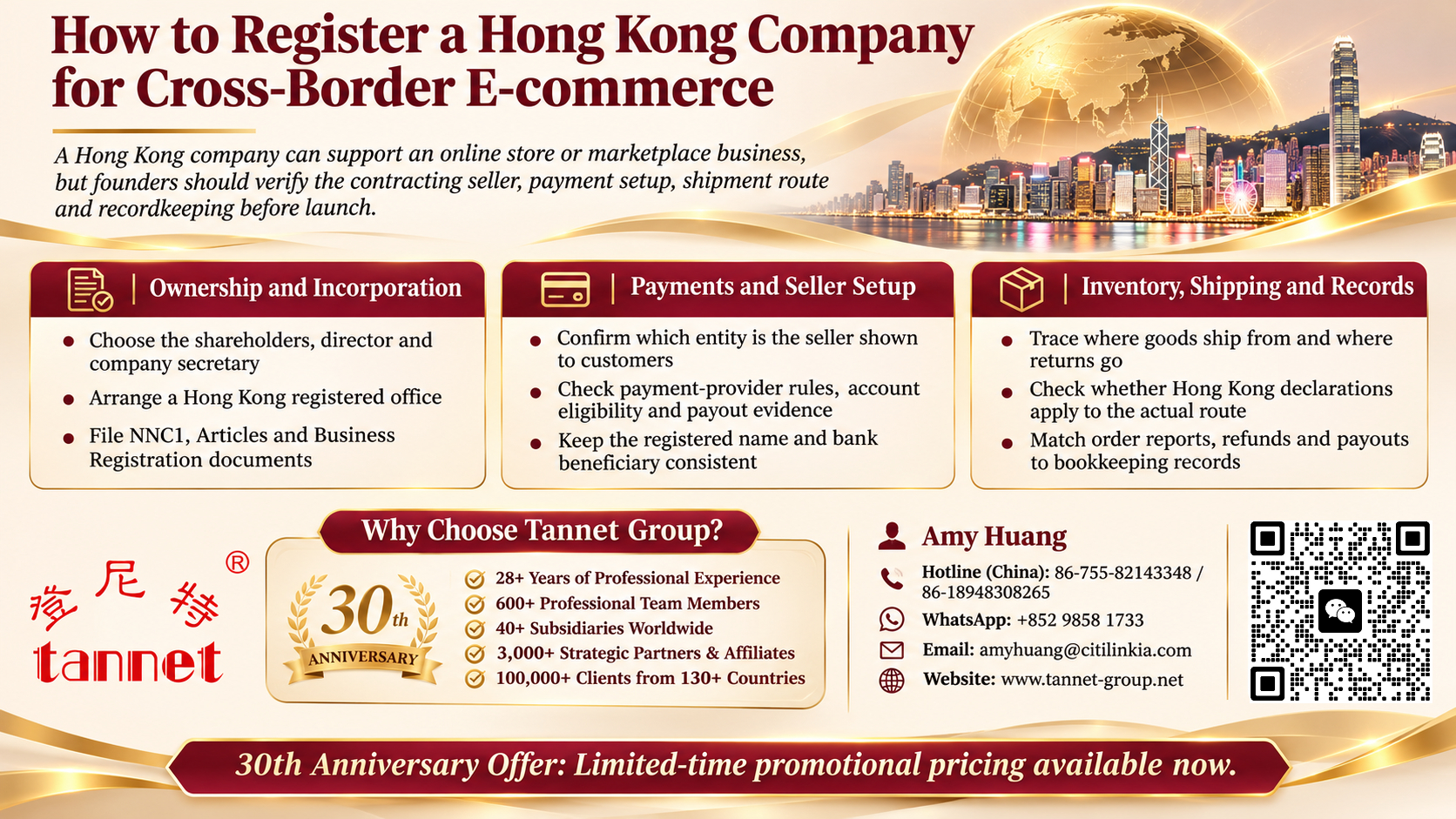
An overseas founder can form a Hong Kong private company limited by shares to sell goods through a marketplace or an independent online store. This structure suits merchants who want one legal entity to contract with suppliers, sell to customers and account for the proceeds.
Before filing, follow one order from checkout to refund. Identify the seller named on the receipt, the beneficiary of the payout and the business that owns the inventory. Check the chosen payment provider’s eligibility rules early. The company needs both a workable payment arrangement and reliable evidence of where its goods travel.
Start with the seller customers will buy from
Picture a cookware brand that sells to Australian households. Its founder owns the website, a factory supplies the pans and a warehouse dispatches orders. Decide whether the Hong Kong company will buy inventory and sell it on its own account or earn commission for arranging sales.
Read the marketplace agreement to see which party contracts with the shopper. On an independent website, check the terms at checkout and the receipt customers receive. Document who authorises refunds, who bears losses on damaged goods and which entity can instruct the warehouse.
If an existing store will move to the new company, ask the platform how to change the seller. Establish a changeover date. An order accepted under the former seller may generate a return weeks after the new company begins trading.
Step 1 Prepare the ownership and officer details
Choose the company name and search the Companies Registry for existing names. Settle the founding shareholders and initial share allocation. If a parent company will hold the shares, check its legal name and the authority of the person signing on its behalf.
A Hong Kong private company needs at least one individual director. A nonresident may serve, and a founder may generally hold all the shares. A sole director must appoint someone else as company secretary. Confirm who can receive urgent instructions when the founder is overseas.
An individual secretary must ordinarily reside in Hong Kong. A corporate secretary needs a registered office or place of business there. The company itself needs a Hong Kong registered office. Arrange for official correspondence to reach someone who can act on it promptly.
Step 2 Incorporate and complete business registration
For a local company limited by shares, the Companies Registry lists the incorporation form NNC1, the Articles of Association and notice IRBR1. Review the signed details before submission. Founders can use the Registry’s electronic service or deliver paper documents.
The one-stop process covers incorporation and business registration. Keep the Certificate of Incorporation, Business Registration Certificate and filed Articles accessible to authorised staff. Copy the exact registered name and Business Registration Number into the company’s onboarding records.
When the company starts business, notify the Inland Revenue Department of the required business particulars within one month. Record the commencement date and actual business activity. Tell your company secretary when trading begins, especially if the first sale occurs well after incorporation.
Step 3 Verify where the proceeds can be paid
Choose a payment provider that supports the business model, products and operating locations. Check the corporate requirements before relying on a particular checkout feature. Ask what evidence the provider accepts for the business address and the person authorised to represent the company.
For example, Shopify Payments publishes specific Hong Kong requirements for corporations. It requests a physical business address in Hong Kong and details about the company and relevant individuals. Its bank instructions specify an eligible HKD current account at a Hong Kong bank with the company as beneficiary.
Other providers publish their own eligibility conditions. When applying for a bank account, explain what you sell, where suppliers are based and how the platform pays you. Hong Kong Monetary Authority guidance describes the information banks may request about ownership, business activities and the intended account.
Give finance staff access to settlement reports. Each report should allow them to trace orders, refunds, deductions and amounts withheld pending release. Save the payout reference that appears on the bank statement before the platform rotates or archives the report.
Step 4 Trace the stock and its returns
Ask the supplier where each product will ship from and who handles clearance. If goods enter a Hong Kong warehouse and later leave for customers abroad, review the inbound and outbound movements. Hong Kong Customs generally requires declarations for applicable goods within 14 days after importation or exportation.
If a supplier in the Chinese Mainland delivers directly to an overseas buyer, retain the waybill showing the actual route. The Hong Kong seller’s invoice alone does not create a Hong Kong goods movement. Check import responsibilities, taxes and product requirements in the destination market.
A customer return can follow a different route from the original sale. A pan shipped directly overseas might come back to a Hong Kong repair centre. Give the returns team instructions for the physical shipment as well as authority to issue the refund.
Step 5 Review what shoppers see and what you retain
Check product descriptions against supplier specifications. Hong Kong Customs enforces the Trade Descriptions Ordinance, including provisions covering false descriptions and misleading omissions. Keep evidence for claims about materials, origin and product performance when those claims appear on your listings.
Explain dispatch location, estimated delivery and return arrangements before checkout. If a buyer must send an item overseas to obtain a refund, show the address or explain the process clearly. Compare website terms with the actual instructions your support team sends.
The Hong Kong Privacy Commissioner’s data protection principles address collection, purpose, security and retention. Identify which customer details the warehouse needs. Restrict access to order exports and tell customers how their information will be used when collecting it.
Set up bookkeeping before the first payout. Match gross sales and refunds to settlement statements, then match net payouts to bank deposits. Retain sufficient business records for profits to be ascertained. The Inland Revenue Department generally requires those records to be kept for at least seven years.
At month end, ask someone outside the fulfilment team to trace one replacement. The file should show why another unit left stock, whether the customer paid again and how the supplier dealt with the defective item.
For a lost parcel, keep the carrier claim alongside the order. Record a reimbursement when supported by the evidence and check whose loss the payment covers before allocating it.
Common mistakes at launch
Using the storefront nickname as the bank beneficiary.
Enter the beneficiary shown on the company’s account records. Keep the brand visible to customers while making the contracting seller identifiable on receipts and in store terms.
Recording the bank deposit as total sales.
A payout may include orders from different days and deduct refunds on earlier sales. Keep an order-level report so a bookkeeper can explain the difference at month end.
Treating overseas customers as proof of offshore profits.
The Inland Revenue Department’s internet business guidance looks at the activities generating profits. Record who negotiates purchases, accepts sales and makes commercial decisions, and where those activities take place.
Frequently asked questions
Q1. Can I register the company before my online store launches?
Yes. Prepare the corporate structure and filings first. Track when the company actually begins business and notify the Inland Revenue Department of the required particulars.
Q2. Can I use one company for a marketplace and my own website?
Generally yes. Check each channel’s terms, identify the contracting seller and give each channel a separate settlement reference in your accounts.
Q3. Will my registered office satisfy payment verification?
Ask the provider which business address it requires and what evidence it accepts. Describe the actual operations and submit documents for the requested address.
Q4. Do goods have to pass through Hong Kong?
A Hong Kong seller can arrange direct overseas delivery. The route determines which customs territories the goods cross. The contracts determine what the seller promises its customer.
Q5. How should we treat a refund after changing sellers?
Link it to the original order. Check which entity owes the refund and which account funded it. Document any settlement between the two businesses.
Q6. When can Tannet assist?
Contact Tannet before forming the company if the store, payment account and inventory currently belong to different parties. Bring a sample order, an ownership outline and the planned delivery route. Tannet can help coordinate incorporation, secretarial appointments and bookkeeping for the transition.
30th Anniversary Offer: Tannet has been established for 28 years, we are offering exclusive limited-time promotional pricing to celebrate Tannet’s 30th anniversary. Slots are limited and available on a first-come, first-served basis. Contact Consultant Amy Huang for details.
Written by: Tannet Business Services Team
Reviewed by: Consultant Amy Huang
First published: 18 Nov. 2026
Last reviewed: 18 Nov. 2026
————————————————Simplifying Business, Empowering Entrepreneurs————————————————