Key Takeaway
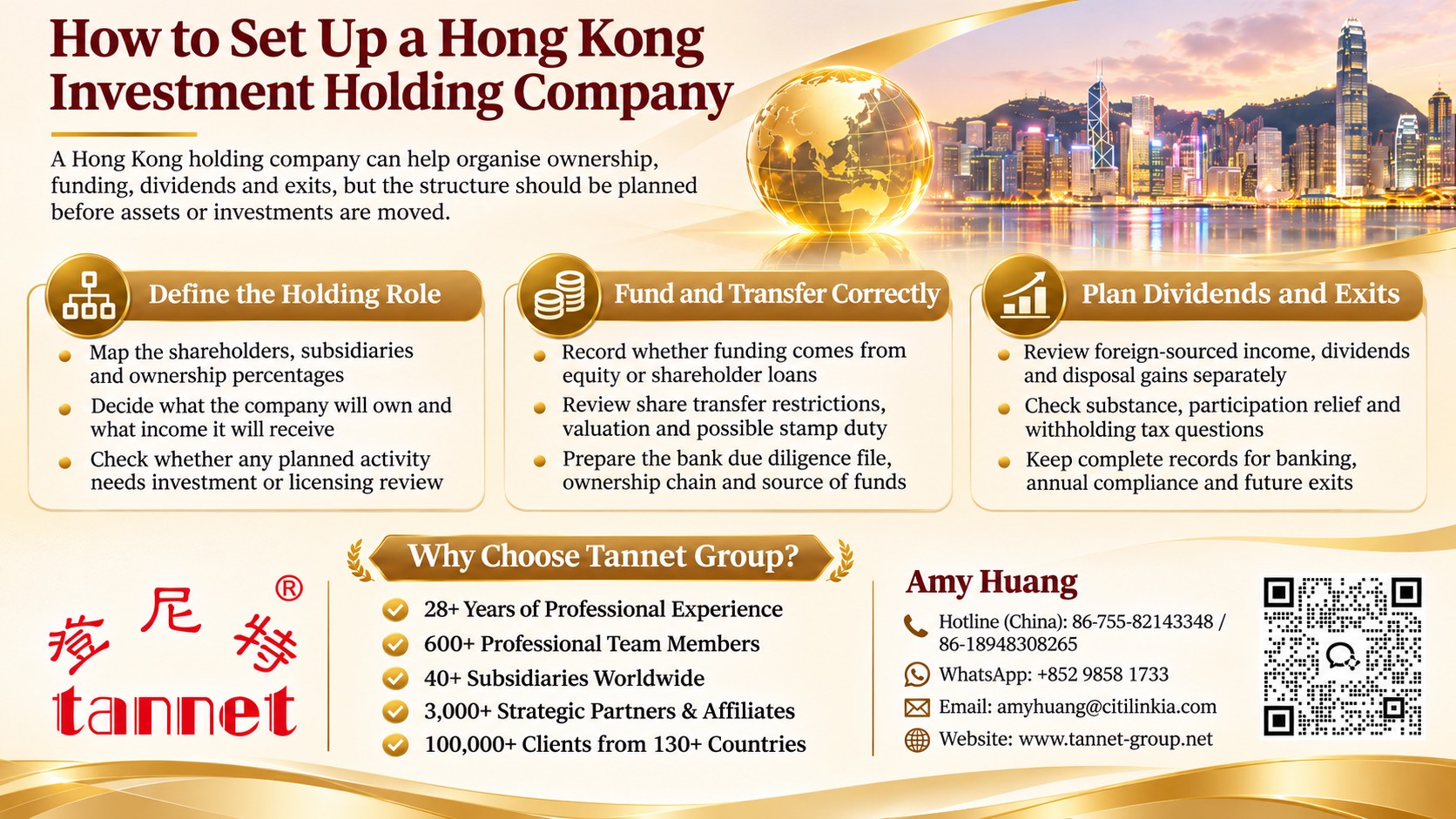
A Hong Kong investment holding company can own shares in subsidiaries or other investments through a separate legal entity. Groups, founders and private investors may use it to organise ownership, raise capital or plan an eventual sale. A private company limited by shares is a common structure. Start by defining what the company will own and how it will earn income.
Appoint a director and qualified company secretary, arrange a Hong Kong registered office and prepare the incorporation filing. Before transferring assets, review banking, the source of funding, foreign withholding and Hong Kong tax. A company’s activities and income determine which tax and licensing rules require attention.
Step 1. Define what the holding company will do
Start with the assets and the decision the new entity needs to support. A group parent can hold operating subsidiaries. A joint venture may need a vehicle for one investment. An owner may want to separate several investments from an operating business.
The holding company may sit above operating subsidiaries or own selected investments directly.
Map the shareholders, subsidiaries and ownership percentages. Identify who can approve an acquisition, dispose of shares or make a distribution. If co-investors will join, agree voting rights, transfer restrictions and exit arrangements. Check how the Articles of Association interact with any shareholders’ agreement.
List expected receipts by category. Dividends and share sale proceeds call for different tax questions from interest, royalties or service income. If the company will also lend, trade or provide services, record that activity before designing its accounting, staffing and governance.
Check whether the proposal involves managing assets for others. The Securities and Futures Commission assesses licensing by the actual activities, clients and circumstances. If the vehicle pools outside capital, manages another entity’s portfolio or offers investment advice, check the regulated activity and any exemption before launch.
Step 2. Incorporate and establish governance
A private company limited by shares generally needs at least one natural-person director, a qualified company secretary and a registered office in Hong Kong. The Companies Registry permits nonresident directors. A sole director cannot serve as secretary of the same company.
Choose a name and prepare Form NNC1, the Articles of Association and Notice to Business Registration Office IRBR1. Verify the founder members, initial shareholdings and director consents. Submit through an accepted electronic or paper channel. Keep the filings and both certificates accessible after approval.
Record investors’ contributions and the rights attached to their shares. Maintain the register of members and, where applicable, the Significant Controllers Register. Assign responsibility for statutory notices, filing changes and keeping the ownership chart current.
Adopt approval procedures for portfolio decisions and related-party transactions. Record who assesses an investment, authorises the transaction and monitors performance. Keep the decision papers, agreements and records of who performed the work. They can support banking and tax reviews later.
Step 3. Fund the company and transfer investments
Decide whether initial funding comes through equity or documented shareholder lending. Record who provides the funds, how the company may use them and any repayment terms. Reconcile receipts to the approvals and agreements. Keep shareholder and company transactions traceable in the ledger.
If the new entity will acquire existing shares, check transfer restrictions, consents, valuation and possible stamp duty or taxes before moving them. Review documents in both the holding and investee jurisdictions. If funds or assets come from the Chinese Mainland, check applicable outbound investment and foreign exchange procedures.
Prepare for bank due diligence. The Hong Kong Monetary Authority explains that banks set their own documentation requirements. A typical file explains the ownership chain, commercial purpose, expected transactions and source of funds. Ask the chosen institution how it verifies controllers and signatories.
Banking and investment approvals can affect when the company can close its first transaction.
Step 4. Analyse dividends, exits and treaty claims separately
Identify the source and nature of each expected receipt. Hong Kong’s foreign-sourced income exemption regime, or FSIE, can apply to specified foreign-sourced income received in Hong Kong by a member of a multinational enterprise group that carries on business there.
Receipt can include remittance to Hong Kong or using the income to settle a debt incurred for a Hong Kong business. Record the accrual date, place of receipt and how the company used the funds. Check the reporting obligations even when an exemption is available.
For pure equity-holding entities, the Inland Revenue Department (IRD) substance test covers statutory filings and adequate Hong Kong people and premises to hold and manage equity interests. Assess the real activities. Lending or service functions can change the classification and the relevant substance analysis.
For qualifying foreign-sourced dividends and equity disposal gains, participation relief may be an alternative. The IRD generally requires a continuous holding of at least 5% for at least 12 months before accrual, an eligible resident or permanent establishment position, and compliance with anti-abuse conditions. These include a qualifying foreign tax condition, limits on deductible dividends and a main-purpose test.
For onshore equity disposal gains, the tax certainty enhancement scheme applies a different framework. It generally requires a qualifying holding of at least 15% for a continuous 24 months before disposal. This elective scheme has specific exclusions. Where the scheme is unavailable, review the ordinary capital versus revenue rules.
Before agreeing to an exit, reconcile the acquisition dates and ownership changes with the share register. If a group reorganisation changed which entity held the shares, check whether the scheme’s aggregation or other special rules are relevant to the proposed sale.
Foreign withholding is a separate question. Check the investee jurisdiction’s domestic law and the applicable treaty. Review residence, beneficial ownership, any minimum holding and anti-abuse rules. A Hong Kong Certificate of Resident Status supports residence when relevant. The treaty partner assesses entitlement to relief.
For a dividend, retain the investee’s approval, the shareholder register and proof of foreign tax where relevant. These records help distinguish the payer’s withholding from the holding company’s Hong Kong calculation. Review each jurisdiction’s procedure before the payment date.
Step 5. Plan the annual compliance cycle
Set the financial year end and assign responsibility for bookkeeping, financial statements, audit and profits tax returns. A private company generally files Form NAR1 within 42 days after its incorporation anniversary, starting after the incorporation year. Check applicable reporting requirements at both entity and group level.
Keep an investment register and supporting decisions. Reconcile dividend vouchers, withholding certificates, capital contributions and disposal proceeds. A holding company can have few transactions and still need a complete record of balances and movements.
Common Mistakes
Using one tax label for every portfolio receipt.
Classify each dividend, loan receipt and gain. Document the source, amount and movement of funds for each.
Transferring shares before checking the transfer terms.
Review approvals, restrictions and tax implications with the relevant advisers before deciding who will sign and when.
Waiting until a dividend to prove substance.
Preserve records of people, decisions, premises and outsourced work while the activities take place.
Frequently Asked Questions
Q1. Can an overseas shareholder own a Hong Kong holding company?
Generally yes. Hong Kong permits nonresidents to incorporate a local company. Check ownership and funding requirements in the shareholder’s jurisdiction as well.
Q2. Does a holding company need a separate incorporation form?
A typical private company limited by shares uses Form NNC1 with the Articles and IRBR1. Check separate rules if the business will undertake regulated activities.
Q3. Can the structure receive dividends before opening a Hong Kong bank account?
Check what the payer and receiving institution allow and how the payment is legally documented. Review Hong Kong tax receipt rules separately from the place where the money is held.
Q4. Does an investment holding company need an audit?
Hong Kong companies generally need audited financial statements. Review the separate statutory dormant company rules before relying on an exception.
Q5. Can an outside provider perform the holding company’s activities?
Hong Kong’s FSIE framework permits qualifying outsourcing. Check where the activities are performed and keep evidence of the company’s oversight and the resources used.
Q6. Can the company use the same tax analysis for a dividend and an exit?
Review each separately. Confirm source, holding period and ownership, and check the applicable exemption or disposal regime before making the decision.
How Tannet Can Assist
Tannet can help prepare the formation file, organise shareholder and banking records, and coordinate with tax or legal advisers before funding, an existing share transfer, a dividend or an exit.
30th Anniversary Offer: Tannet has been established for 28 years, we are offering exclusive limited-time promotional pricing to celebrate Tannet’s 30th anniversary. Slots are limited and available on a first-come, first-served basis. Contact Consultant Amy Huang for details.
Written by: Tannet Business Services Team
Reviewed by: Consultant Amy Huang
First published: 17 Nov. 2026
Last reviewed: 17 Nov. 2026
————————————————Simplifying Business, Empowering Entrepreneurs————————————————