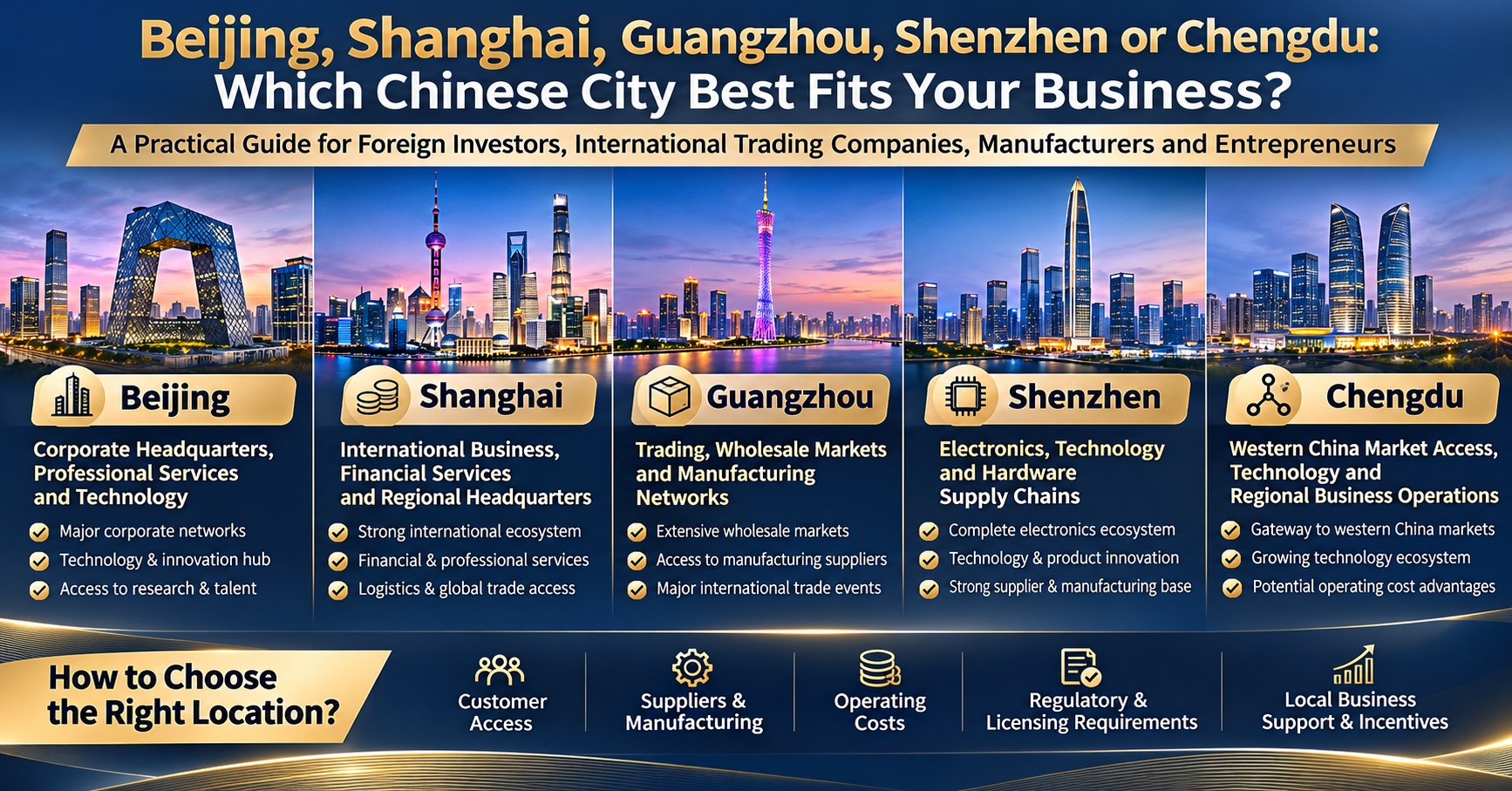
Choosing the right city is one of the most important decisions foreign investors face when entering the Chinese market. With its extensive manufacturing networks, advanced technology ecosystems, major financial centres and rapidly developing regional markets, China offers diverse opportunities for international businesses.
However, not every Chinese city provides the same advantages.
A technology startup developing electronic products may benefit from Shenzhen’s hardware ecosystem, while an international trading company might find Guangzhou’s wholesale networks more suitable. Meanwhile, businesses establishing regional headquarters may prioritise Shanghai or Beijing, depending on their industry, customers and operational requirements.
Understanding the best cities to start a business in China can help foreign entrepreneurs make informed investment decisions, control operating costs and build a foundation for long-term expansion.
This guide compares five major Chinese business destinations: Beijing, Shanghai, Guangzhou, Shenzhen and Chengdu.
1. Beijing: Ideal for Corporate Headquarters, Technology and Professional Services
Beijing is China’s capital and an important centre for government institutions, corporate headquarters, research organisations and technology development.
For foreign investors seeking access to major corporate clients, research institutions and specialised professional services, Beijing offers a well-established business ecosystem.
Key Business Advantages
Corporate Headquarters and Professional Services
Beijing hosts numerous large Chinese enterprises, multinational corporations and professional service providers. Businesses offering management consulting, legal services, enterprise technology and corporate advisory may benefit from proximity to major decision-makers.
Technology and Innovation
The city is home to Zhongguancun, a prominent technology and innovation hub supporting software development, artificial intelligence, research and entrepreneurship.
Research and Talent
Beijing’s universities and research institutions provide access to highly educated professionals, particularly in engineering, scientific research and advanced technology.
Potential Challenges
Commercial rental costs and professional salaries can be substantial in prime business districts. Foreign investors must also assess sector-specific market access restrictions, regulatory approvals and operational requirements.
Best suited for: Corporate headquarters, enterprise technology, professional consulting, research-driven businesses and companies serving major institutional clients.
2. Shanghai: Ideal for International Business, Finance and Regional Headquarters
Shanghai is one of China’s leading international commercial centres, with extensive financial services, logistics infrastructure and multinational business networks.
For foreign investors establishing a regional headquarters or managing cross-border operations, Shanghai is often a strong candidate.
Key Business Advantages
International Business Environment
Shanghai has an established ecosystem of multinational companies, professional advisers, financial institutions and international business service providers.
This environment can support overseas enterprises entering China for the first time.
Financial and Professional Services
Shanghai’s financial sector and corporate service networks make it attractive for businesses involved in financial technology, professional services, international investment and corporate management.
Certain financial activities require specific regulatory approvals and may be subject to foreign investment restrictions.
Logistics and International Trade
Shanghai’s major port, airports and transport connections support import-export businesses, international distribution and supply chain management.
Free Trade Zone Opportunities
Eligible businesses operating within designated areas of the China (Shanghai) Pilot Free Trade Zone may benefit from specific administrative, trade facilitation or regulatory arrangements.
However, free trade zone registration does not automatically grant tax exemptions or unrestricted market access.
Potential Challenges
Office rental, employee compensation and general operating expenses can be relatively high, particularly in central commercial districts.
Best suited for: Multinational headquarters, international trading companies, financial and professional services, regional management offices and global distribution businesses.
3. Guangzhou: Ideal for International Trading, Wholesale and Manufacturing Networks
Guangzhou is a major commercial centre in southern China and an important gateway to the Guangdong manufacturing ecosystem.
The city has longstanding strengths in wholesale trade, international commerce, consumer products and supply chain coordination.
Key Business Advantages
Established Wholesale Markets
Guangzhou is known for extensive wholesale networks covering clothing, textiles, accessories, consumer products, automotive components and other merchandise.
Foreign entrepreneurs sourcing products from China may find these established commercial networks particularly useful.
Access to Manufacturing Suppliers
Guangzhou provides connections to manufacturing centres throughout Guangdong Province, allowing trading companies to coordinate sourcing, production, quality control and logistics.
International Trade Infrastructure
The city hosts the China Import and Export Fair, commonly known as the Canton Fair, which attracts international buyers and suppliers.
Its transport infrastructure also supports domestic distribution and international shipping.
Business Opportunities for SMEs
Compared with some premium commercial districts in Beijing, Shanghai and Shenzhen, selected areas of Guangzhou may offer more manageable premises costs.
Actual expenses depend on district, property type and business requirements.
Potential Challenges
Businesses must evaluate supplier reliability, product certification, customs compliance and export documentation. Certain regulated products may require additional approvals.
Best suited for: Import-export companies, wholesale trading businesses, consumer goods sourcing, procurement offices and manufacturing-related enterprises.
4. Shenzhen: Ideal for Electronics, Technology and Hardware Supply Chains
Shenzhen has developed into a major technology and manufacturing innovation centre, particularly for electronics, telecommunications, hardware development and advanced industrial applications.
Its close integration with the wider Guangdong manufacturing ecosystem makes it attractive for technology-oriented investors.
Key Business Advantages
Electronics and Hardware Ecosystem
Shenzhen offers access to electronic component suppliers, prototype development services, product design companies and manufacturing partners.
Businesses developing consumer electronics, smart devices and industrial hardware may benefit from this concentration of expertise.
Technology and Innovation
The city supports industries such as software, telecommunications, robotics, artificial intelligence and advanced manufacturing.
Product Development and Supply Chain Coordination
For hardware businesses, proximity to component suppliers, engineering teams and production partners can improve communication and shorten certain development processes.
Cross-Border Connectivity
Shenzhen’s proximity to Hong Kong creates opportunities for businesses coordinating operations, sourcing and commercial activities across the two markets.
However, Mainland China and Hong Kong remain separate customs, tax and legal jurisdictions.
Potential Challenges
Competition for specialised talent can be intense, while office space and labour costs in established technology districts may be relatively expensive.
Technology companies must also assess intellectual property protection, data compliance, product standards and applicable licensing requirements.
Best suited for: Electronics businesses, hardware startups, technology companies, product development firms and advanced manufacturing enterprises.
5. Chengdu: Ideal for Western China Market Expansion and Regional Operations
Chengdu is a major commercial and economic centre in western China, offering opportunities for companies seeking to serve inland markets rather than concentrating exclusively on coastal cities.
The city has developed business ecosystems across technology, manufacturing, consumer services and regional logistics.
Key Business Advantages
Access to Western China Markets
Chengdu provides a strategic base for companies targeting customers, distributors and commercial partners across Sichuan and neighbouring western regions.
Technology and Business Services
The city supports software development, information technology services, digital businesses and shared service operations.
Regional Logistics and Manufacturing
Chengdu’s transport networks and industrial infrastructure support distribution, manufacturing coordination and regional supply chain activities.
Potential Operating Cost Advantages
Depending on the district, industry and staffing requirements, Chengdu may offer lower commercial property and labour costs than selected premium coastal business locations.
Potential Challenges
Chengdu may be less suitable for businesses that require frequent access to specific coastal ports, export-focused supplier clusters or international clients concentrated in eastern China.
Investors should evaluate their actual customer geography and logistics requirements before establishing operations.
Best suited for: Regional distribution, software services, western China market development, business support operations and selected manufacturing activities.
6. How to Choose the Best City for Your Business in China
Selecting a business location requires more than comparing economic growth or commercial reputation.
Foreign investors should evaluate the following factors before committing to company registration.
Customer and Market Access
Identify where your target customers, distributors and business partners are located.
For example, a company selling enterprise technology to large institutional clients may prioritise Beijing, while a consumer goods sourcing business may prefer Guangzhou.
Supplier and Manufacturing Proximity
Businesses dependent on physical products should consider the distance between their registered operations, suppliers, production facilities and logistics providers.
For electronics, Shenzhen may offer advantages. For broader consumer goods sourcing, Guangzhou and its surrounding manufacturing networks may be suitable.
Operating and Employment Costs
Compare commercial rent, employee salaries, recruitment costs, utilities, transportation and professional service expenses.
A city with lower office rental costs is not necessarily cheaper overall if it creates additional logistics or staffing expenses.
Foreign Investment and Licensing Requirements
Before establishing a company in China, investors should verify whether their proposed business activities are permitted under the applicable foreign investment rules.
Depending on the industry, additional approvals or licences may be required.
Investors should also consider whether their intended registered address meets local registration requirements.
Local Business Support and Incentives
Some cities and designated development zones offer investment facilitation programmes or incentives for qualifying businesses.
Eligibility depends on factors such as industry, investment scale, operating substance and current local policies.
Investors should never assume that registering in a particular city automatically qualifies a company for financial incentives.
7. Can a Foreign Investor Register a Company in Any Chinese City?
Foreign investors can generally establish companies in many Chinese cities, provided their proposed activities comply with applicable foreign investment and industry regulations.
However, registration eligibility is determined by more than location.
Important considerations include:
-
Whether the proposed industry is restricted or prohibited for foreign investment.
-
Whether the intended business scope requires additional licences.
-
Whether the registered business address satisfies local requirements.
-
Whether the company needs special industry approvals, facilities or qualified personnel.
-
Whether local operational arrangements support the company’s actual business activities.
For many permitted industries, a foreign-invested limited liability company may be an appropriate structure.
However, the optimal legal structure depends on the company’s ownership, activities, regulatory obligations and commercial objectives.
Foreign investors should assess these requirements before signing long-term leases, hiring employees or committing significant capital.
8. How TANNET Supports Foreign Investors Establishing Businesses in China
Choosing the right Chinese city is only the beginning of establishing a successful business presence.
Foreign investors must also navigate company registration, business scope selection, registered address arrangements and local compliance requirements.
TANNET provides corporate and business advisory support for overseas entrepreneurs and international companies planning to enter China.
Our services include China company incorporation, registered address assistance, business location advisory, business scope planning and coordination of relevant corporate setup requirements.
Whether you are considering Beijing for corporate services, Shanghai for international business, Guangzhou for trading, Shenzhen for technology or Chengdu for regional expansion, selecting the appropriate location can help align your company structure with your commercial objectives.
Planning to Start a Business in China?
Contact TANNET to discuss your proposed industry, target market and preferred operating location. Our team can assist you in evaluating suitable company establishment options and understanding the requirements for entering the Chinese market.
📞 Free 1-on-1 Consultation Now,
Official Service Hotline: +86-755-82148419
Cell: +86-13823131503;+60 19-309 2363
WeChat ID: 13823131503;
WhatsApp:+86-13823131503;+60 19-309 2363
Email: mytannet08@gmail.com; susiehu@citilinkia.com