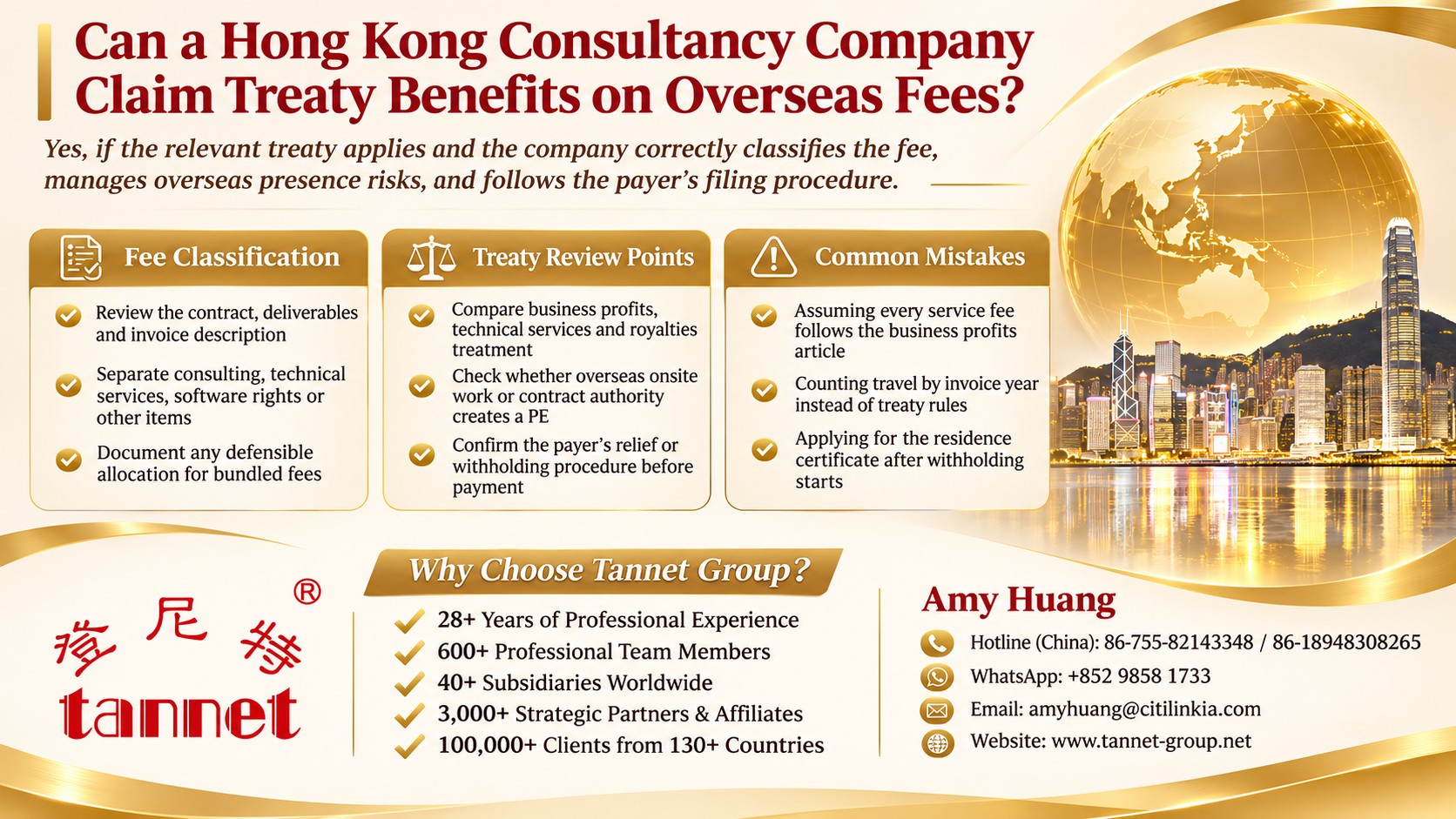
Key Takeaway
Yes. A Hong Kong consultancy company may claim tax treaty benefits on overseas fees if the relevant agreement is effective and the company meets the conditions for the payment. This matters to firms that advise foreign clients online, send consultants abroad or sell services with software or other rights.
Classify the fee before invoicing. Ordinary business profits may receive relief if the company has no permanent establishment in the client’s jurisdiction. A separate technical services or royalties article can allow source taxation. A Hong Kong Certificate of Resident Status supports the claim. Confirm the payer’s filing procedure and assess Hong Kong profits tax separately.
Step 1. Read the contract and classify the payment
Identify the legal supplier, payer and deliverables. Check how the payer’s jurisdiction treats the payment under domestic law. Then read the treaty covering that jurisdiction, the relevant protocol and any changes under the Multilateral Instrument. Confirm when the provisions apply to the tax concerned.
Classify the work by what the customer receives. A strategic review, staff training, a software licence and access to a database can involve different rights or services. If an engagement contains several items, review each one and document any defensible allocation.
The invoice description helps the payer process withholding, but the contract and performance records explain the transaction. Keep the statement of work, licence terms and acceptance evidence together. Make sure the invoice agrees with the signed scope and the work actually delivered.
For a recurring engagement, check whether later statements of work change the treatment. A contract may begin with an advisory report and later expand to staff secondment or a software licence. Review the added deliverables before the next invoice.
Step 2. Compare business profits with technical services
Under the UK–Hong Kong agreement, the UK generally may tax the ordinary business profits of a Hong Kong enterprise if the enterprise operates through a UK permanent establishment, or PE. The UK’s taxing right under that article extends to the profits attributable to the PE.
The Hong Kong–India agreement contains a separate article for fees for technical services. Its definition can include managerial, technical or consultancy services, subject to exclusions. Where the article applies, India can tax qualifying fees that arise there even if the company delivers the work remotely.
For an Indian engagement, check where the fee is deemed to arise, who beneficially owns it and whether the treaty’s technical services provisions apply. If the payment is effectively connected to a local PE, review the treaty’s business profits rules. Apply the relevant domestic law as well.
If the customer receives rights to exploit intellectual property, examine the royalties article. A right to use software or know-how can change the treatment depending on the agreement and the rights granted. Review the substance of the licence and any separate implementation or support services.
Step 3. Test the consultancy’s presence abroad
Check whether the company uses a fixed place of business overseas or operates through a person whose contracting authority may create a PE. Review the team’s access to client premises and the actual role of local employees and agents. Consider applicable exceptions in the treaty.
Under the arrangement with the Chinese Mainland, furnishing services there can create a service PE when activities for the same or a connected project exceed 183 days in any twelve-month period. Consider work performed directly or through employees or other personnel engaged by the company.
Keep a project calendar that records work locations and the relationship between assignments. Ask the project lead to confirm whether phases, extensions or follow-on work are connected. Use the relevant counting rules before drawing a conclusion. Other PE tests may apply even below a service threshold.
If a PE exists, identify the functions, assets and risks connected to it. Reconcile the profit allocation with the company’s accounts and supporting costs. A PE finding may lead to local registration and return obligations alongside any withholding process.
For example, a client may ask consultants to return for implementation after an initial onsite diagnostic visit. Keep the itinerary and contract amendments together. The project record should show whether the second visit continues the earlier work and where the team delivered each phase.
Step 4. Prepare the claim before the payer processes withholding
Check treaty residence for the entity that earns the fees. If another jurisdiction also regards it as resident, apply the treaty’s dual-residence rules.
Ask the payer how it applies treaty relief. It may require a certificate, local forms, a PE declaration or supporting contract details. Confirm the deadline and who submits each item. Some procedures apply relief at payment. Others require a refund claim after tax is withheld.
Review any anti-abuse requirements. Where a principal purpose test applies, document genuine commercial reasons for the arrangement and the functions performed by the company. If the article requires beneficial ownership, check whether the company can retain and use the income under its contracts.
If tax is withheld, obtain evidence that identifies the supplier, period, taxable payment and tax amount. Reconcile it to the ledger. Preserve the refund deadline, the person responsible for the claim and the supporting evidence required by the local authority. Track the claim status with the payer until the tax authority responds.
Step 5. Determine Hong Kong profits tax separately
The IRD’s territorial source guidance focuses on where the operations that earn the profit occur. For service fees, identify where the services giving rise to the payment are performed. An overseas client, foreign currency invoice or overseas account does not determine the result by itself.
For work performed partly in Hong Kong and partly abroad, retain records of the work and the teams involved. The IRD recognises that apportionment can be appropriate for certain service income. Support any allocation with evidence of the actual profit-producing activities.
If both jurisdictions tax the same income, check the treaty’s double taxation relief article and the Hong Kong conditions for a credit. Compare the tax charged with the tax permitted under the treaty. Retain official evidence and check whether a source-jurisdiction refund should be pursued.
If the foreign assessment appears inconsistent with the treaty, check the available local remedies and their time limits. The IRD also explains how a taxpayer may present a case under the treaty’s mutual agreement procedure. Keep the assessment and correspondence available for review.
Common Mistakes
Assuming every service fee follows the business profits article.
Check for technical services, royalties or another specific provision before making a no-PE claim.
Counting travel by invoice or calendar year.
Track work in the jurisdiction and connected projects. Use the period and counting rules in the relevant agreement.
Applying for the certificate after the payer closes its tax cycle.
Confirm the required documents and timing while negotiating the contract, especially if withholding would affect the expected cash receipt.
Frequently Asked Questions
Q1. Can I claim relief if I work entirely from Hong Kong?
Potentially. Check the treaty’s income classification and source rules. An applicable technical services article can permit source taxation even when work is delivered remotely.
Q2. Does a short client visit create a PE?
Review the facts and treaty. Time thresholds may apply to service activities. Use of premises and contracting activity require their own analysis.
Q3. Can I treat software access and consulting as one fee?
Review the rights transferred and the way the services are delivered. If the payment covers different items, document the allocation and confirm the treatment with the payer.
Q4. Does the residence certificate stop withholding automatically?
The certificate supports residence. The payer may still need local declarations or evidence of entitlement. The treaty partner decides whether the claim satisfies its rules.
Q5. What if I have fees from a market without an effective treaty?
Check that market’s domestic tax and filing rules. Review whether any local relief is available and assess the Hong Kong treatment separately.
Q6. Can a foreign withholding amount be credited in Hong Kong?
It depends on the applicable relief provision and whether Hong Kong taxes the same income. Retain proof of the foreign tax and check the credit limit and filing conditions.
How Tannet Can Assist
Tannet can help organise service contracts and delivery records, prepare a Hong Kong residence certificate application and coordinate with tax advisers when bundled fees, overseas onsite work or a withholding refund requires review.
30th Anniversary Offer: Tannet has been established for 28 years, we are offering exclusive limited-time promotional pricing to celebrate Tannet’s 30th anniversary. Slots are limited and available on a first-come, first-served basis. Contact Consultant Amy Huang for details.
Written by: Tannet Business Services Team
Reviewed by: Consultant Amy Huang
First published: 16 Nov. 2026
Last reviewed: 16 Nov. 2026
————————————————Simplifying Business, Empowering Entrepreneurs————————————————