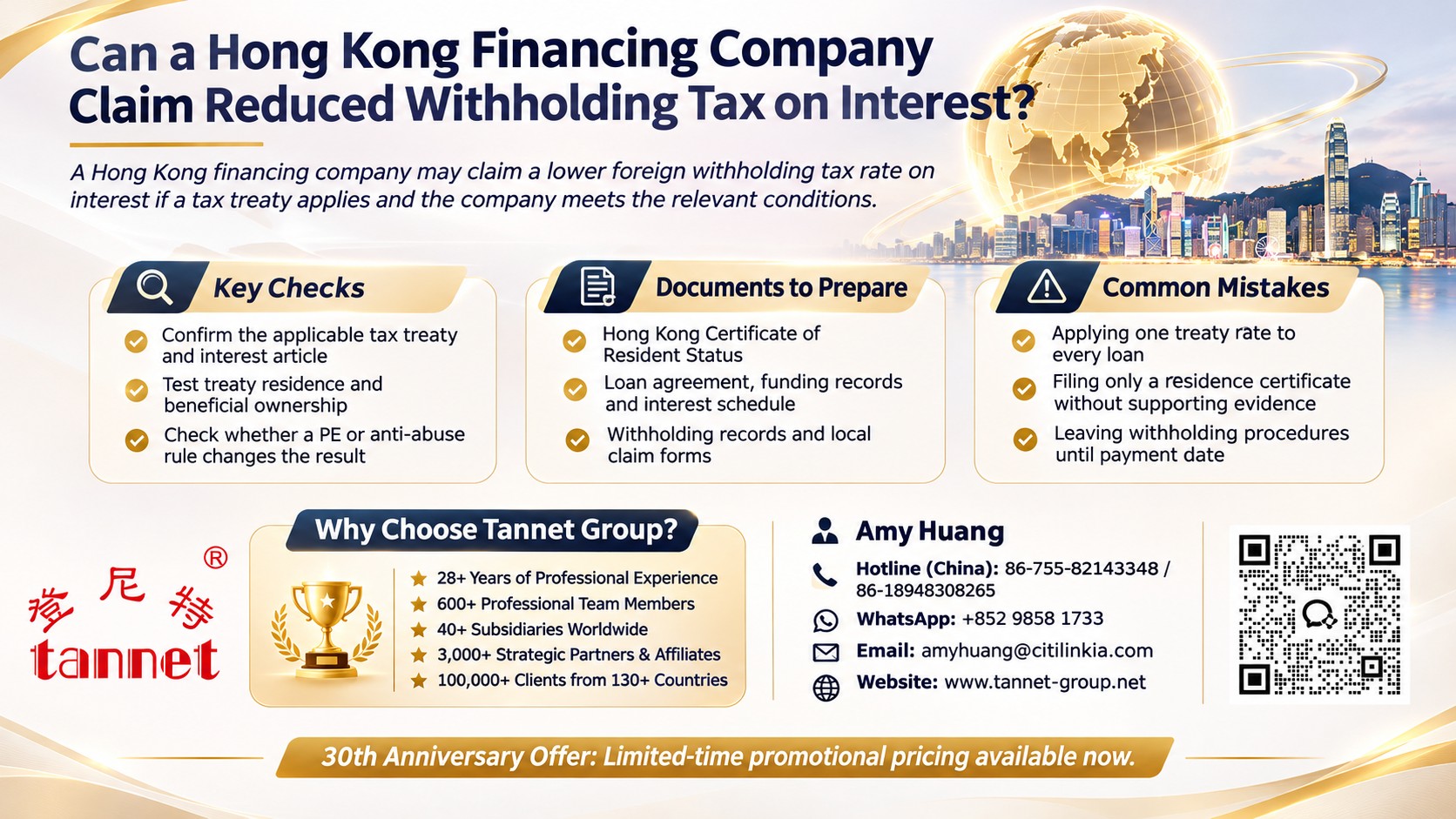
Key Takeaway
Yes. A Hong Kong financing company may claim a lower rate of foreign withholding tax on interest if an effective tax treaty covers the payment and the company meets its conditions. This matters to treasury centres, group lenders and companies that finance overseas operations.
Check treaty residence, beneficial ownership and anti-abuse rules before the first interest payment. A Hong Kong Certificate of Resident Status supports the residence claim. The borrower’s jurisdiction determines the claim procedure. A back-to-back loan, an overseas permanent establishment or interest above an arm’s length amount can change the outcome. Review Hong Kong profits tax separately.
Step 1. Identify the payment and the applicable treaty
Start with the legal lender, the borrower, the debt and the payment date. Review how the source jurisdiction taxes the payment under its domestic law. If domestic law already provides a lower rate or an exemption, check the borrower’s filing route.
Confirm that the relevant treaty applies to the tax and period. Read its interest article, any protocol and changes under the Multilateral Instrument. Treaties can use different rules for banks, government bodies or particular debt instruments. A treasury company should check the category it actually meets.
For example, under the Hong Kong arrangement with the Chinese Mainland, the source-side tax on interest is generally capped at 7% of the gross amount when the beneficial owner is a resident of the other side. Specific exemptions and exceptions can affect the result.
The source of interest can also depend on which establishment bears the debt. Under that arrangement, if a permanent establishment incurred the debt and bears the interest, its location can determine where the interest arises. Check the borrower’s records if a branch handles the financing.
If the loan agreement includes guarantee payments, arrangement charges or default amounts, review each item under local law and the treaty. A single invoice can contain amounts that fall under different provisions. Itemise each payment and retain the contractual basis for each item.
Step 2. Test residence and beneficial ownership
Read the residence article for the lender itself. The Hong Kong Inland Revenue Department, or IRD, bases its certificate decision on the relevant agreement’s definition. If another jurisdiction also treats the lender as resident, apply the treaty’s rules for dual residents before relying on the Hong Kong position.
Beneficial ownership concerns the lender’s rights over the interest. Review whether it can retain, deploy or reinvest the payment and whether a linked contract obliges it to pass the money onward. The borrower’s loan agreement and the lender’s funding agreements both matter.
A Hong Kong company may fund a loan with equity, external borrowing or group funding. Where loans are matched, compare maturity, currency, principal, interest terms, security and payment dates. Record who controls the funds, who can change the terms and who bears default or liquidity risk.
Document the people who approve and monitor the lending. Retain credit papers, approvals and evidence of decisions during the loan term. For a group treasury company, explain why it undertook the transaction and how the arrangement serves the group’s financing needs.
Match the file to the life of the loan. If the company assigns the receivable, refinances it or changes its payment instructions, identify who earns the interest afterwards. Revisit the evidence before applying the earlier treaty treatment to a later payment.
Step 3. Apply the exceptions and anti-abuse rules
Where a principal purpose test applies, a treaty benefit may be denied if securing it was one of the principal purposes of an arrangement, unless granting the benefit accords with the object and purpose of the relevant provisions. Consider the actual reasons for routing the financing through Hong Kong.
Check for a permanent establishment, or PE, in the borrower’s jurisdiction. If the debt claim is effectively connected with the lender’s PE there, the interest article can give way to the treaty’s business profits rules. Review how the lender books, manages and funds the loan.
Related parties should also test the interest amount. Under the arrangement with the Chinese Mainland, the interest article applies only to the arm’s length amount if a special relationship causes the payment to exceed what the parties would otherwise have agreed. The excess can receive different treatment.
Step 4. Prepare the certificate and the local claim
The IRD targets a response within 21 working days of a properly completed application. It may ask for further information.
Agree the claim procedure with the borrower before payment. Depending on the jurisdiction, the payer may apply relief when withholding or the lender may have to file a refund claim. For the Chinese Mainland, State Taxation Administration guidance provides for self-assessment, claiming benefits and retaining supporting documents for inspection.
For withholding at source in the Chinese Mainland, the lender submits the treaty benefits information form to the withholding agent. The lender retains relevant records for follow-up review. If the required form is missing or incomplete, the withholding agent applies domestic rules.
Keep the certificate, loan agreement, interest schedule, payment evidence and withholding records together. If tax was already withheld, confirm the refund deadline and the person entitled to apply. Reconcile the gross interest, tax withheld and net receipt before closing the period.
Step 5. Review Hong Kong profits tax separately
Determine the Hong Kong tax source of the interest under the rules applicable to the lender’s activities. The IRD’s corporate treasury guidance explains when an operations test applies to intra-group financing. A foreign borrower and an overseas bank account provide only part of the evidence.
For foreign-sourced interest received in Hong Kong, check whether the foreign-sourced income exemption regime applies. It can affect a multinational group entity carrying on business in Hong Kong. Where relevant, assess the economic substance requirement and whether any foreign tax credit is available against Hong Kong tax on the same income.
Track both accrual and receipt. For this regime, receipt can include using foreign-sourced interest to settle a debt incurred for a Hong Kong business. Record how the company applied the funds even when the payment never entered a Hong Kong bank account.
Common Mistakes
Applying a treaty rate to every loan.
Confirm the instrument, payer and legal lender for each payment. The same group can have loans covered by different provisions.
Filing only a residence certificate.
Keep documents supporting beneficial ownership and commercial purpose. The source jurisdiction can examine both when considering relief.
Leaving withholding terms until payment.
Agree who supplies the forms, remits tax and files any refund request. Review the loan’s tax and gross-up clauses before disbursement.
Frequently Asked Questions
Q1. Can a newly incorporated Hong Kong lender apply for a certificate?
Yes, if it meets the applicable treaty residence definition. Prepare the loan and funding records early so the borrower can assess the separate conditions for relief.
Q2. Can my company claim relief on interest from a related company?
Potentially. Check residence, beneficial ownership, anti-abuse rules and the arm’s length amount. Document how the lender set the rate and assessed credit risk.
Q3. Does back-to-back funding automatically prevent relief?
Review the actual agreements and cash flows. A contractual obligation to pass the interest onward raises a beneficial ownership question. Who controls the income and bears the risks also matters.
Q4. What if the borrower already withheld tax at the domestic rate?
Ask for official evidence of the withholding. Check whether a refund procedure applies, which party must file and whether the residence certificate covers the payment period.
Q5. Can the same certificate cover interest from different jurisdictions?
The IRD generally issues certificates for a specific treaty partner and year. Check the coverage and any special administrative arrangements before reusing a certificate.
For the Chinese Mainland, the IRD describes a general rule covering the stated calendar year and the next two calendar years, subject to changes in circumstances.
Q6. Does treaty relief make the interest exempt from Hong Kong profits tax?
Hong Kong tax follows its own source, deeming and exemption rules. If both jurisdictions tax the same interest, review any available credit and the supporting evidence it requires.
How Tannet Can Assist
Tannet can help prepare a residence certificate application, organise loan and funding records, and coordinate with tax advisers where a related-party loan, an overseas withholding claim or a Hong Kong profits tax position needs review.
30th Anniversary Offer: Tannet has been established for 28 years, we are offering exclusive limited-time promotional pricing to celebrate Tannet’s 30th anniversary. Slots are limited and available on a first-come, first-served basis. Contact Consultant Amy Huang for details.
Written by: Tannet Business Services Team
Reviewed by: Consultant Amy Huang
First published: 13 Nov. 2026
Last reviewed: 13 Nov. 2026
————————————————Simplifying Business, Empowering Entrepreneurs————————————————