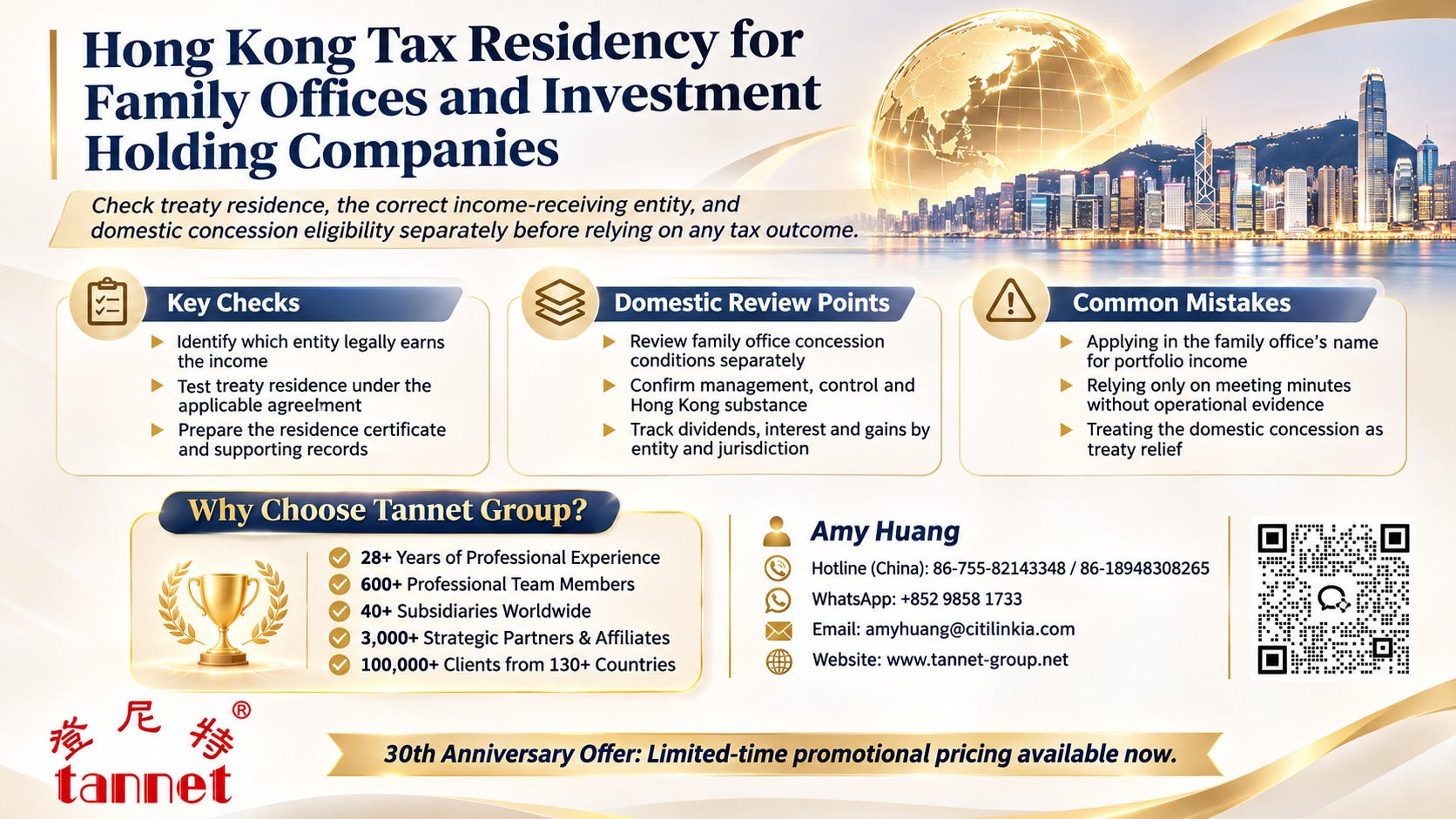
Key Takeaway
Hong Kong tax residency for a family office or investment holding company depends on the purpose of the assessment and the entity involved. For treaty relief, test the entity receiving the income against the residence article of the applicable agreement. A Hong Kong Certificate of Resident Status can support that entity’s claim.
This matters to families that separate investment management from asset ownership, especially where directors or assets are overseas. Hong Kong’s family office tax concession has its own ownership, management and substance conditions. Check treaty residence, access to relief and eligibility for the domestic concession separately before relying on any tax outcome.
Step 1. Identify which entity earns the income
Start with an entity chart. Identify the family office that manages the portfolio, the investment vehicle that owns the assets and a special purpose entity that holds an investment. Where a trust or partnership sits in the structure, identify how the treaty treats it.
Follow each payment to the legal recipient. A management fee paid to the family office is a different income stream from dividends paid to the holding company. Interest may belong to another vehicle that provided the financing. The entity that earns the income is the starting point for a treaty claim.
Check the share register, investment documents, bank statements and management agreement against the entity chart. Resolve discrepancies before filing. Where one entity receives cash on behalf of another, record the capacity in which it acts and confirm who can claim under the relevant treaty.
If the structure includes a trust, check whether the trustee, trust or beneficiary is relevant under the treaty and local procedures. Gather the trust deed and distribution records where they help identify entitlement. The answer can differ across jurisdictions and income streams.
Step 2. Apply the treaty’s residence definition
The Hong Kong Inland Revenue Department, or IRD, assesses applications for a Certificate of Resident Status using the applicable agreement’s definition. A Hong Kong incorporated company can meet the local definition under many treaties. For an overseas incorporated entity, the wording and management facts can be decisive.
Under the UK–Hong Kong agreement, a company incorporated outside Hong Kong may qualify as a Hong Kong resident if it is centrally managed and controlled there. The arrangement with the Chinese Mainland uses a normal management or control test for companies incorporated outside Hong Kong.
If both jurisdictions treat the company as resident, apply the relevant corporate tie-breaker. The arrangement with the Chinese Mainland provides for consultation between the competent authorities, which consider effective management, incorporation or constitution and other relevant factors. Address dual residence before claiming relief.
Document who actually makes investment, financing and risk decisions. Keep investment committee papers, written approvals and delegations. If directors meet in Hong Kong while another team approves deals abroad, record how authority works in practice and assess which facts matter under the relevant test.
Step 3. Prepare the residence certificate and treaty claim
Identify the income recipient, the jurisdiction and the period. Confirm which supporting documents the payer or custodian needs before the distribution or interest payment.
A certificate supports the entity’s residence claim. The treaty partner can assess beneficial ownership, applicable holding conditions and anti-abuse provisions. When a holding vehicle distributes cash to its owners, review whether an agreement restricts its ability to retain or use the original income.
A financial institution may also request a tax residence self-certification under the Common Reporting Standard. The IRD describes this as part of financial account reporting. Reconcile the information across filings and explain differences in legal definitions, reporting periods or entities covered.
Prepare an income schedule by asset and jurisdiction. Include the payer, legal owner, payment date and withholding evidence. For dividends, record the ownership percentage and holding period where the treaty makes either relevant. For a claim involving interest, retain the loan terms and payment trail.
Step 4. Assess the Hong Kong family office concession separately
The domestic concession applies to qualifying profits of a family-owned investment holding vehicle, or FIHV, and qualifying family-owned special purpose entities. The IRD’s published framework requires the FIHV to be managed by an eligible single family office and to meet its own eligibility conditions.
Check family beneficial ownership, the minimum level of specified assets managed by the eligible office, and whether the FIHV is normally managed or controlled in Hong Kong during the basis period. Confirm the office’s own eligibility and the scope of services it provides.
The vehicle must carry out core income-generating activities in Hong Kong. The published rules require at least two qualified full-time employees and minimum local operating expenditure. Qualifying outsourcing to the eligible office is permitted. Keep records showing who performs the work and how staff and expenditure relate to the vehicle.
Where the office serves several investment vehicles, record how it allocates staff time and expenditure. Retain investment proposals, approvals and monitoring reports for each vehicle. These records show which activities took place in Hong Kong during the review period.
Map investment profits to qualifying transactions and check the rules on incidental transactions. Under the published framework, the vehicle makes a written, irrevocable election. The concession concerns qualifying investment profits. Review the family office’s own service income separately.
Hong Kong’s 2026 amendment bill proposes expanding the investment scope and changing the treatment of incidental transactions. Check the Legislative Council’s bill status and the IRD’s filing guidance for the relevant year before relying on transitional treatment.
Step 5. Review foreign-sourced income outside the concession
For an ordinary holding company, check Hong Kong’s foreign-sourced income exemption regime where relevant. Identify the multinational group status, the income category and when the income is received in Hong Kong. Dividends, interest and disposal gains can have different exemption conditions.
A company that only holds equity and earns dividends, equity disposal gains and incidental income may meet the pure equity-holding definition. A vehicle with lending activities needs a separate review. Check the nature of the income and the underlying assets before applying the simplified substance test.
Track dividends, interest and gains separately in the ledger. Reconcile each category to broker statements before filing.
Common Mistakes
Applying in the family office’s name for portfolio income.
Confirm who legally receives the income and whether the treaty recognises that entity. Align the application with the investment records.
Relying on meeting minutes alone.
Keep records of actual approvals, investment analysis and oversight. Minutes should reflect who exercised authority and how the decision was reached.
Treating the concession as treaty relief.
Maintain separate evidence for the domestic election, the residence certificate and the foreign tax claim. Each decision follows its own rules.
Frequently Asked Questions
Q1. Can an overseas-incorporated vehicle qualify as Hong Kong treaty resident?
Potentially. Read the applicable residence article and document how the entity is managed or controlled. Check dual residence if another jurisdiction also treats it as resident.
Q2. Can a family office’s certificate cover all investment vehicles?
Match the certificate to the entity claiming relief. Separate companies generally need their own residence analysis and proof for the applicable jurisdiction and period.
Q3. Can we qualify for the concession if the family lives abroad?
Review the vehicle and office against the statutory ownership, management and activity conditions. Identify where the portfolio decisions and core work take place. The family members’ addresses are only part of the facts.
Q4. Does the concession cover a family office’s management fees?
The concession applies to qualifying profits of the investment vehicle and eligible family-owned special purpose entities. The office should assess its own fees under the applicable Hong Kong tax rules.
Q5. Can a holding company outsource its investment work?
The published FIHV rules permit outsourcing of core activities to an eligible single family office subject to conditions. Keep the management mandate, evidence of work performed and records of the resources used in Hong Kong.
Q6. Is a Hong Kong registered address enough for a foreign tax claim?
Check the treaty definition, the claimant’s identity and the conditions for the income. A registered address can help identify the company. The source authority may also review beneficial ownership and anti-abuse requirements.
How Tannet Can Assist
Tannet can help map the family office and investment entities, organise governance and income records, and coordinate with tax advisers on residence certificates, foreign withholding claims or a review of domestic concession eligibility.
30th Anniversary Offer: Tannet has been established for 28 years, we are offering exclusive limited-time promotional pricing to celebrate Tannet’s 30th anniversary. Slots are limited and available on a first-come, first-served basis. Contact Consultant Amy Huang for details.
Written by: Tannet Business Services Team
Reviewed by: Consultant Amy Huang
First published: 13 Nov. 2026
Last reviewed: 13 Nov. 2026
————————————————Simplifying Business, Empowering Entrepreneurs————————————————