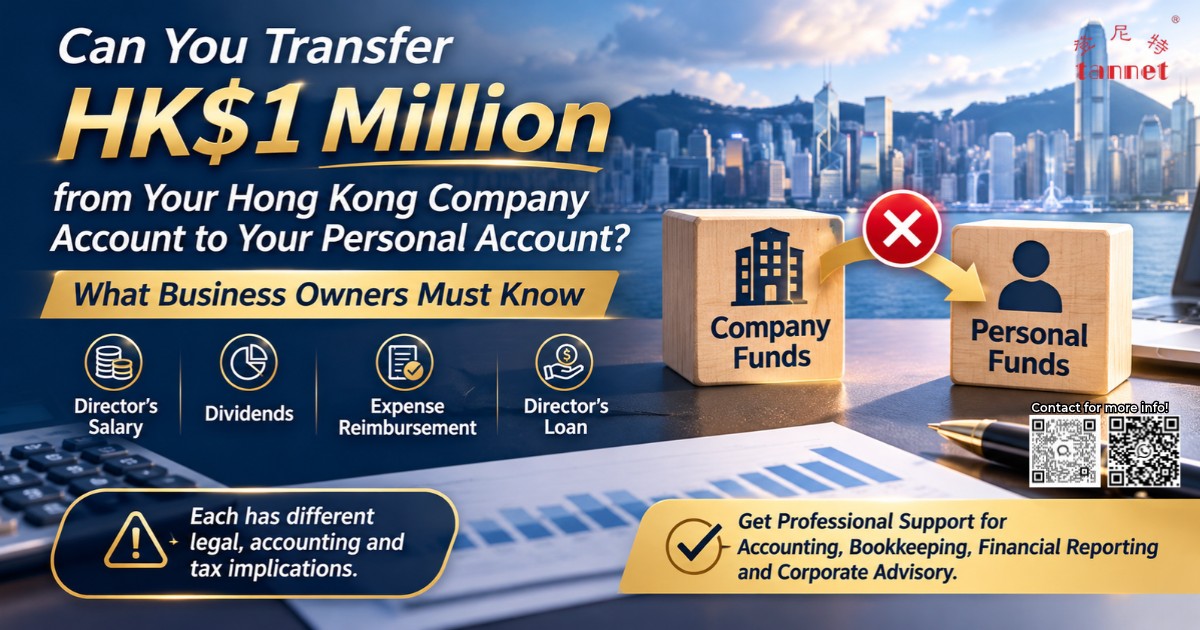
Imagine you are the sole shareholder and director of a Hong Kong company. Your business has accumulated HK$1 million in its corporate bank account, and you want to transfer the entire amount into your personal account.
Since you own 100% of the company, surely the money belongs to you?
Not necessarily.
One of the most common financial management mistakes among Hong Kong business owners is treating company funds as personal money. Even if you are the sole shareholder and director, your company is a separate legal entity. Its bank balance does not automatically become your personal wealth.
Under Hong Kong’s Companies Ordinance (Cap. 622), company distributions and certain transactions involving directors are subject to specific legal requirements.
Before making a large withdrawal, it is important to understand the available payment methods, their documentation requirements and potential tax implications.
1. Why Must You Separate Company Money from Personal Money?
A Hong Kong limited company has its own legal identity, separate from its shareholders and directors.
This means that money deposited into the company’s corporate bank account belongs to the company, not directly to its shareholders or directors.
Transferring company funds into a personal account without identifying the purpose can create accounting and compliance problems.
For example, if a director transfers HK$500,000 to a personal bank account without supporting documentation, the accountant may not be able to determine whether the transaction represents:
- Director’s remuneration.
- Dividend distribution.
- Reimbursement of business expenses.
- A loan from the company to the director.
Each category has different accounting, legal and tax treatment.
Therefore, every withdrawal should have a clear business or legal basis and be properly recorded in the company’s accounting records.
2. Four Ways to Withdraw Money from Hong Kong Company
There are several legitimate ways for business owners to receive money from their companies. However, the correct method depends on the purpose of the payment and the company’s financial position.
A. Director’s Salary or Remuneration
A director who actively manages the company’s operations may receive a salary or director’s remuneration.
For example, a director responsible for business development, management and daily operations may receive monthly remuneration.
The company should maintain appropriate supporting documents, such as:
- Employment or service agreements, where applicable.
- Board or other required corporate approvals.
- Payroll records.
- Payment records.
Director’s remuneration is generally subject to Hong Kong Salaries Tax reporting requirements. Whether the company can claim a corresponding profits tax deduction depends on the nature of the payment and applicable tax rules.
B. Dividend Distribution
If the company has generated profits, shareholders may receive dividends.
However, having HK$1 million in the corporate bank account does not automatically mean that HK$1 million can be distributed as dividends.
Under Section 297 of the Hong Kong Companies Ordinance, a company may only make a distribution out of profits available for distribution.
These are generally calculated based on accumulated realised profits, less accumulated realised losses, subject to the statutory requirements.
For example, a company may have HK$1 million in its bank account but also have outstanding liabilities, accumulated losses or other financial obligations.
Its available distributable profits may therefore be substantially lower than its bank balance.
Dividend distributions should be supported by appropriate financial records, relevant financial information and corporate approvals in accordance with the company’s articles and applicable requirements.
C. Business Expense Reimbursement
Sometimes, directors pay for legitimate business expenses using their personal funds.
Examples include:
- Business travel expenses.
- Client entertainment expenses.
- Office supplies.
- Business-related software subscriptions.
- Approved operational expenses.
The company can reimburse these expenses when they are genuinely incurred for business purposes.
However, supporting documents such as receipts, invoices and payment records should be retained.
Personal purchases should never be disguised as business expenses simply to move company funds into a personal account.
D. Director’s Loan
A director may also receive money from the company in the form of a loan.
However, this is an area requiring particular attention.
Sections 500–504 of the Companies Ordinance regulate loans and similar transactions involving directors and connected entities. The general prohibition and applicable exceptions depend on the company structure and circumstances.
Certain transactions may require prescribed approval from shareholders, while statutory exceptions may apply in qualifying circumstances.
A board resolution alone should not be assumed to satisfy every statutory approval requirement.
Before arranging a director’s loan, the company should assess the applicable legal provisions, shareholder approval requirements, company articles and documentation.
A proper loan agreement should generally specify:
- Loan amount.
- Purpose of the loan.
- Interest arrangements, if applicable.
- Repayment schedule.
- Relevant approval and authorisation.
The transaction should also be properly reflected in the company’s accounting records and financial statements.
3. What Happens If You Withdraw Company Money Without Proper Documentation?
Undocumented withdrawals can create problems during bookkeeping, financial reporting and annual audits.
Some common consequences include:
Incorrect accounting classification: The accountant may need to investigate whether the withdrawal represents remuneration, a dividend, reimbursement or a loan.
Unexplained director’s loan balances: Money transferred to a director without an appropriate classification may remain recorded as an amount recoverable from the director.
Corporate compliance concerns: Transactions involving directors may be subject to statutory restrictions, disclosure requirements or approval procedures.
Tax reporting issues: Misclassified payments may result in incorrect tax computations or reporting.
Banking and due diligence concerns: Unclear financial transactions may raise questions when the company undergoes banking reviews, financing applications or investor due diligence.
The larger the transaction, the more important it becomes to establish a clear audit trail.
4. What Should You Check Before Transferring HK$1 Million?
Before making a substantial withdrawal from your Hong Kong company account, consider these five questions:
- What is the purpose of the withdrawal? Determine whether the payment is remuneration, dividends, expense reimbursement or a loan.
- Does the company have sufficient distributable profits? If the payment is a dividend, review the company’s financial position rather than relying solely on its bank balance.
- Are the required approvals in place? Check the Companies Ordinance, the company’s articles and applicable corporate approval procedures.
- Is the transaction properly documented? Maintain relevant resolutions, agreements, invoices, receipts and payment records.
- Has the accounting and tax treatment been assessed? Ensure that the transaction is correctly reflected in the company’s books and relevant tax filings.
Taking these steps before transferring funds can help prevent unnecessary compliance and accounting complications.
5. How Can Professional Accounting Support Help?
Managing a Hong Kong company involves more than receiving payments and paying business expenses.
Business owners must maintain accurate financial records, monitor company liabilities, prepare financial statements and ensure that transactions are properly classified.
Professional accounting and corporate advisory support can help businesses:
- Maintain accurate bookkeeping and transaction records.
- Monitor director’s loan accounts and shareholder transactions.
- Review available profits before dividend distributions.
- Prepare financial statements and accounting reports.
- Identify potential compliance and tax reporting issues.
- Maintain proper supporting documentation for financial transactions.
At TANNET, we assist businesses with accounting, bookkeeping, financial reporting and corporate advisory services in Hong Kong.
Whether you are operating a newly incorporated company or managing an established business, having proper financial management procedures can help you make informed decisions while maintaining corporate compliance.
Conclusion
Owning 100% of a Hong Kong company does not mean you can freely transfer its money into your personal account whenever you want.
Every withdrawal should have a legitimate purpose, an appropriate legal basis and proper accounting documentation.
Before transferring HK$1 million—or even a smaller amount—understand whether the payment should be treated as salary, dividends, expense reimbursement or a director’s loan.
Need help managing your Hong Kong company’s financial records and director transactions? Contact TANNET for professional accounting, bookkeeping and corporate advisory support.
📞 Free 1-on-1 Consultation Now,
Official Service Hotline: +86-755-82148419
Cell: +86-13823131503;+60 19-309 2363
WeChat ID: 13823131503;
WhatsApp:+86-13823131503;+60 19-309 2363
Email: mytannet08@gmail.com; susiehu@citilinkia.com