Many international businesses establish Hong Kong companies to manage overseas investments, trading operations and regional subsidiaries. However, when related companies within the same corporate group conduct business with one another, there is an important tax compliance requirement that should not be overlooked: transfer pricing.
For example, imagine a Hong Kong holding company providing management services to its subsidiary in Malaysia. The Hong Kong company charges the subsidiary HK$300,000 annually.
Who determines whether this amount is reasonable? Can the parent company simply decide the service fee?
Not necessarily. Under Hong Kong’s transfer pricing rules, transactions between associated enterprises must generally follow the arm’s length principle. Businesses may also have to prepare Hong Kong transfer pricing documentation to demonstrate that their arrangements comply with the requirements of the Inland Revenue Department (IRD).
Understanding these obligations is essential for Hong Kong companies operating across multiple jurisdictions.
1. What Is Transfer Pricing and Why Does It Matter?
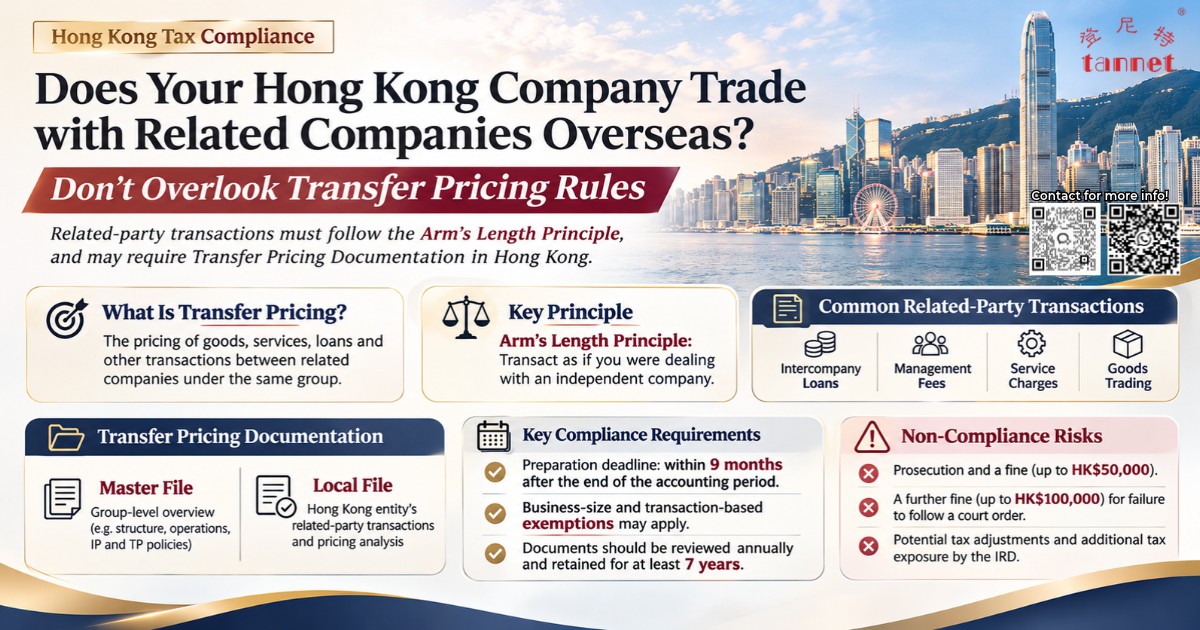
Transfer pricing refers to the pricing of goods, services, loans, intellectual property and other transactions between related companies within the same corporate group.
These transactions are commonly known as controlled transactions.
For example:
- A Hong Kong parent company sells products to its overseas subsidiary.
- A Hong Kong company provides administrative services to its Malaysian affiliate.
- An overseas holding company lends money to its Hong Kong subsidiary.
- A Hong Kong company charges management or consultancy fees to related entities.
Although these arrangements are commercially common, their pricing can affect how profits are distributed across different tax jurisdictions.
If related companies deliberately set prices that are significantly different from what independent businesses would agree to, profits could be shifted to jurisdictions with more favourable tax treatment.
This is why Hong Kong’s transfer pricing framework requires qualifying related-party transactions to comply with the arm’s length principle.
2. What Is the Arm’s Length Principle?
The arm’s length principle means that transactions between associated enterprises should be priced under conditions comparable to those that would have been agreed between independent parties in similar circumstances.
In simple terms, related companies should conduct business as if they were dealing with unrelated companies.
Consider an example:
A Hong Kong company provides management and administrative services to its overseas subsidiary.
If an independent service provider would normally charge HK$100,000 for comparable services, charging HK$500,000 without commercial justification could raise transfer pricing concerns.
The company should be able to explain how the service fee was determined, what services were provided and why the pricing is commercially reasonable.
The same principle applies to intercompany loans, goods trading, royalties and other controlled transactions.
3. Which Transactions Should Business Owners Pay Attention To?
International business groups should review their related-party transactions regularly.
Common examples include:
Intercompany loans
When a Hong Kong company lends money to an overseas subsidiary, the interest rate and loan conditions should reflect commercially reasonable terms, taking into account factors such as creditworthiness, loan duration and currency.
Management and administrative fees
If a parent company charges its overseas subsidiaries for management, finance, HR or administrative support, it should maintain evidence of the services provided and the basis for calculating the fees.
Intercompany service charges
Companies providing IT support, marketing, consultancy or other services to related entities should consider whether the charges reflect the actual services and economic benefits received.
Goods trading
When a Hong Kong trading company purchases products from a related manufacturer overseas and subsequently sells them to another group entity, the purchase and selling prices should be commercially justifiable.
Without appropriate documentation, businesses may face difficulties explaining their pricing arrangements during a tax review.
4. When Do You Need a Master File and Local File?
Hong Kong’s transfer pricing documentation requirements generally apply to qualifying Hong Kong entities belonging to groups in the extended sense that conduct transactions with associated entities.
The two main documents are:
Master File
The Master File provides an overview of the multinational group’s global business operations, including:
- Group organisational structure.
- Main business activities and operations.
- Intellectual property and intangible assets.
- Intercompany financial arrangements.
- Group financial and tax positions.
It helps the IRD understand how the group operates and how its transfer pricing policies are established.
Local File
The Local File focuses on the Hong Kong entity’s own related-party transactions.
It generally includes:
- Details of material controlled transactions.
- Information about associated enterprises involved.
- Transaction amounts and contractual arrangements.
- Functional and economic analysis.
- Transfer pricing methods and supporting analysis.
Together, these documents help demonstrate whether the group’s pricing arrangements follow the arm’s length principle.
5. What Are the Exemptions and Preparation Deadlines?
Not every Hong Kong company is required to prepare both documents.
Under the IRD’s current requirements, a Hong Kong entity may qualify for a business-size exemption if it satisfies any two of the following three conditions for the relevant accounting period:
- Annual revenue does not exceed HK$400 million.
- Total assets do not exceed HK$300 million.
- Average number of employees does not exceed 100.
There are also transaction-based exemptions.
The prescribed thresholds for different categories of controlled transactions are:
- Transfers of properties (excluding financial assets and intangibles): HK$220 million.
- Transactions involving financial assets: HK$110 million.
- Transfers of intangible assets: HK$110 million.
- Other transactions: HK$44 million.
These thresholds are assessed by transaction category. If a category exceeds its prescribed threshold, the relevant transactions generally need to be covered in the Local File, subject to other applicable exemptions.
Specified domestic transactions may also qualify for exemption.
For entities required to prepare the Master File and Local File, the documents must be prepared within nine months after the end of the relevant accounting period.
They must also be reviewed and updated annually and retained for at least seven years.
Importantly, these documents are generally not submitted together with the annual profits tax return. However, the company must make the relevant declarations, and the IRD may request the documents during a compliance review.
6. What Happens If Your Company Fails to Comply?
Ignoring transfer pricing requirements can expose businesses to financial and regulatory risks.
Under section 80(2Q) of Hong Kong’s Inland Revenue Ordinance, failure to comply with the Master File and Local File preparation requirements without reasonable excuse may result in prosecution and a fine at level 5, currently HK$50,000.
The court may also order the company to complete the outstanding documentation within a specified period. Failure to comply with the court order may result in a further fine at level 6, currently HK$100,000.
Separately, where transfer pricing arrangements result in incorrect tax reporting, the IRD may make tax adjustments and impose additional tax under applicable provisions, depending on the circumstances and the company’s reasonable efforts to determine arm’s length pricing.
The consequences can extend beyond financial penalties. Inadequate documentation may also make it more difficult to defend the company’s tax position during an investigation.
7. How Can Businesses Prepare for Transfer Pricing Compliance?
Business owners should not wait until receiving an IRD enquiry before reviewing their related-party transactions.
A practical approach includes:
- Identify all associated enterprises and related-party transactions.
- Review intercompany agreements, loans, service arrangements and trading contracts.
- Assess whether transaction pricing follows the arm’s length principle.
- Determine whether the company qualifies for any documentation exemptions.
- Prepare the relevant Master File and Local File where required.
- Review and update documentation annually and retain supporting records.
For multinational groups, coordination between finance, accounting and tax teams across different jurisdictions is particularly important.
How TANNET Can Support Your Hong Kong Company’s Tax Compliance
Managing cross-border business operations involves more than company registration and annual accounting. Businesses must also consider how related-party transactions are structured, priced and documented.
TANNET provides corporate and professional support to businesses operating in Hong Kong and internationally, including:
- Transfer pricing advisory and documentation support.
- Accounting and financial reporting.
- Hong Kong tax compliance and filing support.
- Cross-border corporate structuring and advisory.
- International company establishment and corporate services.
Whether your Hong Kong company provides management services, trades with overseas subsidiaries or manages intercompany financing, understanding your transfer pricing obligations can help reduce compliance risks and support sustainable international operations.
Planning to expand your business internationally? Contact TANNET to review your Hong Kong company’s corporate, accounting and cross-border tax compliance requirements.
📞 Free 1-on-1 Consultation Now,
Official Service Hotline: +86-755-82148419
Cell: +86-13823131503;+60 19-309 2363
WeChat ID: 13823131503;
WhatsApp:+86-13823131503;+60 19-309 2363
Email: mytannet08@gmail.com; susiehu@citilinkia.com