Key Takeaway
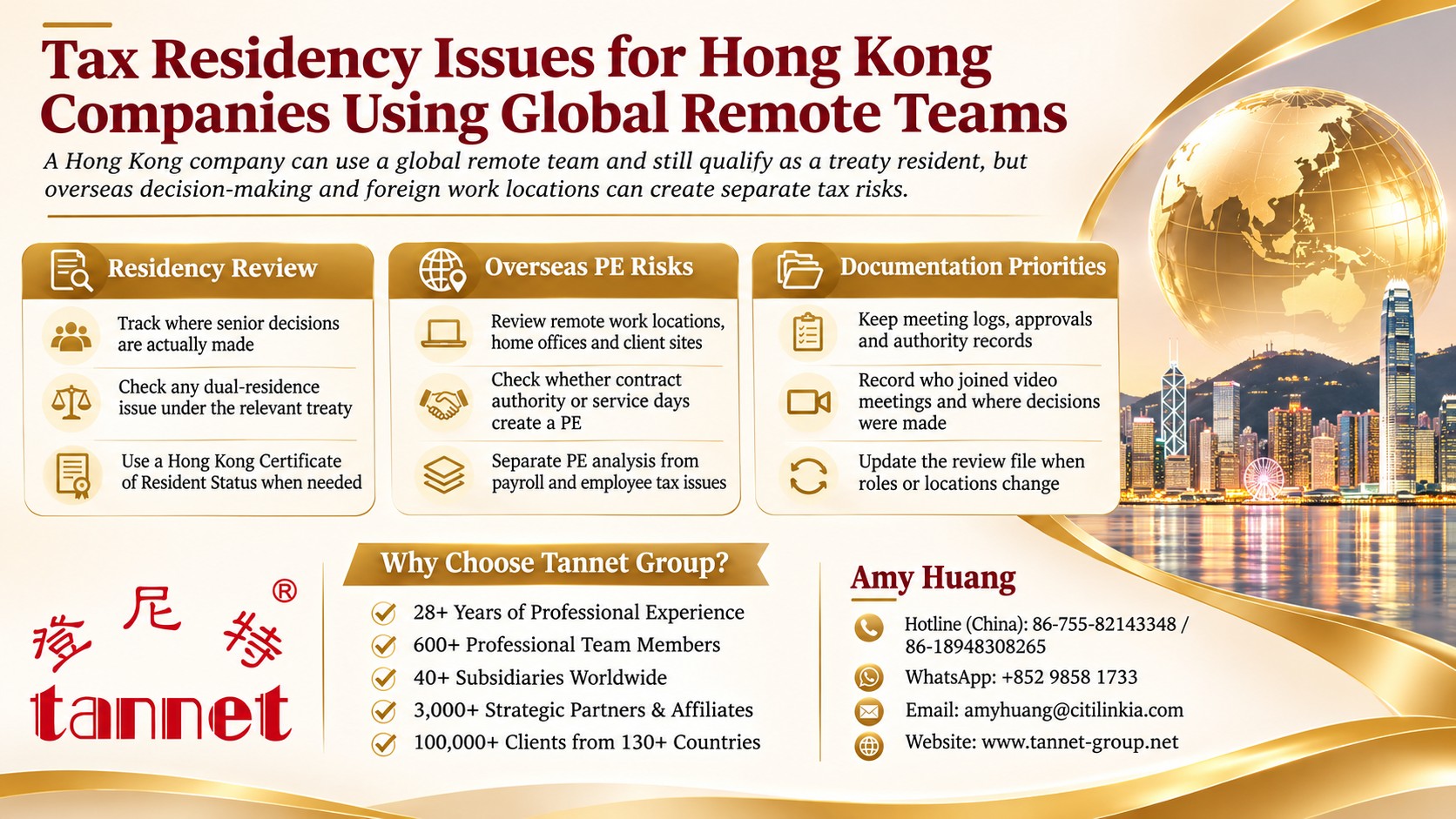
A Hong Kong company can use a global remote team and still qualify as a Hong Kong resident under an applicable tax treaty. Hiring abroad can create separate tax obligations where people work. This matters to founders, directors and finance teams that move decision-making or customer delivery across borders.
Review where senior decisions are made, how the treaty resolves any dual residence and whether the company has a permanent establishment abroad. Check payroll and employee tax separately. A Hong Kong Certificate of Resident Status supports a specific treaty claim. The company should document actual decision-making, working locations and authority to negotiate or conclude contracts.
Step 1. Identify where the company is resident
Start with the Hong Kong company and the jurisdictions where its directors or executives work. Read each jurisdiction’s domestic residence rules. An overseas authority may examine management or control carried out from a director’s home, even when the company continues to be incorporated in Hong Kong.
Next, read the residence article of the applicable treaty. The UK–Hong Kong agreement includes Hong Kong incorporation in its Hong Kong corporate residence definition. The agreement has a separate rule for companies that meet both parties’ residence definitions.
The UK–Hong Kong agreement looks to the place of effective management for a dual resident company. If there is doubt, the competent authorities seek agreement. The arrangement with the Chinese Mainland calls for the competent authorities to consider effective management, incorporation or constitution and other relevant facts.
If both authorities assert residence, retain their correspondence and check the applicable treaty procedure. The resolution can affect which jurisdiction treats the company as resident for treaty purposes.
Map the decisions that matter to the business. Identify who approves budgets, strategy, financing and material contracts. Record who has discretion and where that discretion is exercised. For video meetings, record where participants joined from and who actually made the decision.
For example, a developer working abroad may have no authority over company strategy. A founder who relocates and continues approving investment, hiring and contracts may present a different residence question. Assess that change when it happens and retain the records for the relevant period.
If a founder moves midyear, build a timeline showing when authority shifted and where it was exercised before and after the move. Use travel records and approval logs to explain any difference between the written delegation and actual practice.
Step 2. Screen for a permanent establishment abroad
A permanent establishment, or PE, is a taxable business presence under the relevant treaty. Review foreign offices, coworking space, home offices and client premises used by the company. Consider continuity, how the premises are used and whether they are available to the company for its business.
The OECD’s 2025 Model Tax Convention commentary update gives guidance on cross-border home working. In the specific home-office context, working at a location for less than half of total working time for the enterprise over a twelve-month period beginning or ending in the fiscal year concerned generally weighs against treating it as an enterprise place of business.
At or above that level, examine the facts, including whether there is a commercial reason for the work to take place in that jurisdiction. For example, regular local delivery to customers may matter. Apply the signed treaty and applicable local interpretation to the facts of each case.
Also review the people who win work or bind the company. A dependent agent who habitually concludes contracts may create a PE under some treaties. Other treaty texts can also capture someone who habitually plays the principal role leading to contracts that the company routinely concludes without material changes.
Some agreements have a separate service PE rule. Track workdays and connected projects where the relevant treaty uses a time threshold. Review what contractors and employer-of-record staff actually do for the company, including who directs their work and whether they act on its behalf.
For a foreign sales lead, review how quotes and contract terms are approved. If the sales lead settles the key terms and head office routinely accepts them, check the agency language in the applicable treaty. Retain examples of how deals were approved.
Step 3. Review payroll and profits tax separately
Check employer registration, payroll withholding and social security in each country where someone works. Review whether the engagement is employment or independent contracting under local rules. An employer of record can handle agreed payroll work, while the Hong Kong company still needs to assess its own tax position.
Hong Kong employer reporting can require attention to remuneration paid outside Hong Kong. Review the IRD’s employer guidance and the employee’s specific circumstances. Employee tax exemptions depend on the applicable rules and facts, including the employment and where duties are performed.
Review the source of corporate profits separately. Hong Kong’s territorial analysis looks at the operations that produced the profits and where they took place. For a service business with delivery split across countries, document what each team does and which activities earn the revenue.
If a foreign PE exists, assess which profits are attributable to it under the agreement. Review the functions performed, assets used and risks assumed. Maintain supporting accounts and consider how the foreign return relates to the Hong Kong profits tax position.
Step 4. Build a review file and apply for proof when needed
Maintain a country register covering each worker’s role, approved location, duration, access to premises and contracting authority. Update it when someone relocates, changes duties or starts meeting clients. Link these changes to project records and board approvals.
Assign a reviewer and set triggers for reassessment. A second senior executive moving overseas, regular access to client premises or new authority to negotiate terms may warrant an updated review before implementation.
If a payer requests proof of Hong Kong treaty residence, identify the relevant jurisdiction, period and company. The IRD can request further information.
Keep management records and overseas work evidence alongside the certificate. The certificate supports the residence claim. The treaty partner decides whether the facts meet the conditions for the requested benefit. Review the file again if the company’s leadership or operating model changes.
Common Mistakes
Recording the venue while overlooking who decides.
A Hong Kong meeting address has limited value if approvals were settled elsewhere. Keep decision papers, communications and evidence of who exercised authority.
Using one day count for every question.
A treaty service PE test, an employee tax exemption and the home-office commentary serve different purposes. Record the dates in enough detail to apply each relevant rule.
Reviewing only permanent hires.
Include contractors, secondees and staff supplied by an employer of record. Their activities, authority and degree of independence can affect the company’s analysis.
Frequently Asked Questions
Q1. Will one overseas remote employee change our corporate residence?
Review the worker’s authority and role. Routine delivery generally raises different questions from exercising senior management and control. Check the host jurisdiction’s domestic rules and any applicable treaty.
Q2. Can a founder manage the company abroad and still obtain a certificate?
It depends on the treaty definition and any dual-residence issue. Document where decisions are really made and check how the treaty attributes residence before using a certificate to claim relief.
Q3. Does an overseas home office automatically create a PE?
The answer depends on the applicable treaty and the facts. Review how often the company uses the location for business and whether the person’s presence there serves a commercial purpose.
Q4. Does paying staff from Hong Kong settle payroll duties?
Check employer and employee obligations where the work is performed. Review how local rules treat the employment relationship and assess Hong Kong reporting separately.
Q5. Can a foreign contractor create a PE?
Potentially. Review the premises, the contractor’s independence and authority, and any service PE rule that applies to personnel engaged by the company. The contract and actual conduct both matter.
Q6. Does overseas delivery make all company profits offshore?
Identify the activities that produced each income stream and where they took place. A single engagement may involve work in several locations. Retain records that show each location’s role.
How Tannet Can Assist
Tannet can help organise management and workforce records, prepare a Hong Kong residence certificate application and coordinate with local tax advisers when a director relocates, a remote team gains sales authority or delivery expands into another jurisdiction.
30th Anniversary Offer: Tannet has been established for 28 years, we are offering exclusive limited-time promotional pricing to celebrate Tannet’s 30th anniversary. Slots are limited and available on a first-come, first-served basis. Contact Consultant Amy Huang for details.
Written by: Tannet Business Services Team
Reviewed by: Consultant Amy Huang
First published: 16 Nov. 2026
Last reviewed: 16 Nov. 2026
————————————————Simplifying Business, Empowering Entrepreneurs————————————————