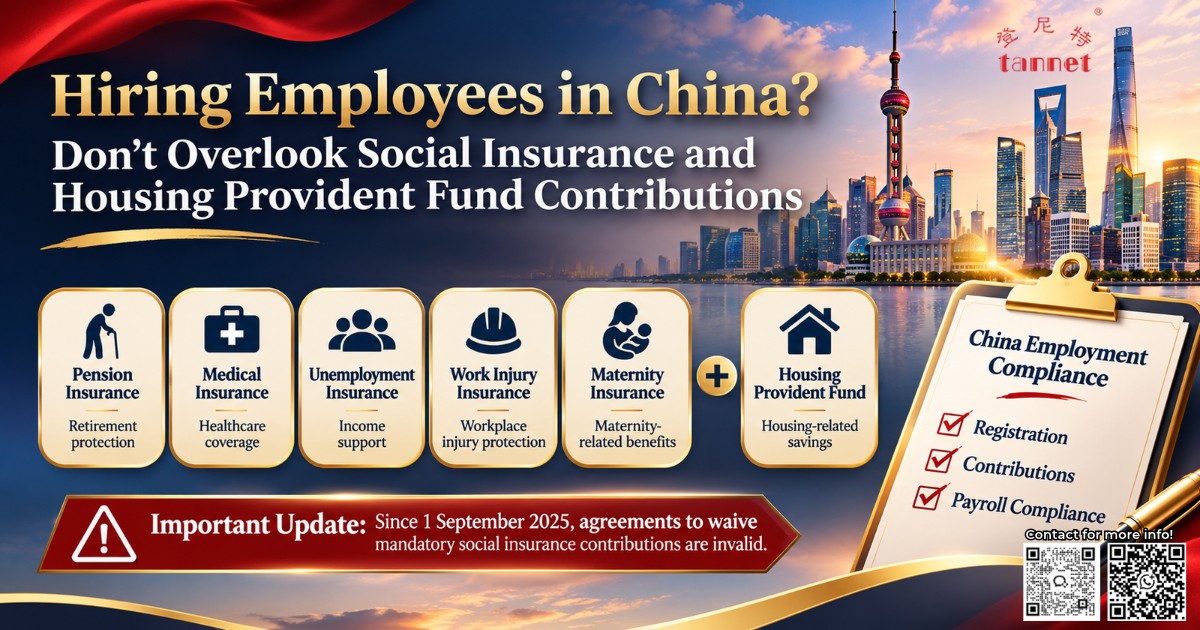
Setting up a company in China and hiring local employees involves more than preparing employment contracts and paying monthly salaries. Employers must also understand China’s statutory social insurance and housing provident fund requirements.
For foreign-invested enterprises (FIEs), overseas companies with China subsidiaries and SMEs expanding into the Chinese market, overlooking these obligations can result in financial penalties, employee disputes and compliance risks.
Understanding China’s Social Insurance and Housing Provident Fund Obligations is therefore essential for businesses employing staff in Mainland China.
1. What Are China’s Five Types of Social Insurance?
China’s social security system consists of five main types of statutory insurance, commonly referred to as the five social insurances:
- Basic Pension Insurance: Provides retirement benefits to eligible employees.
- Basic Medical Insurance: Helps cover eligible medical expenses.
- Unemployment Insurance: Provides financial support to eligible employees who become unemployed.
- Work Injury Insurance: Covers qualifying medical expenses and compensation arising from work-related injuries or occupational illnesses.
- Maternity Insurance: Supports eligible maternity-related benefits. In many localities, maternity insurance is integrated with basic medical insurance administration.
Both employers and employees generally contribute to pension, medical and unemployment insurance. Employers are responsible for work injury insurance and the employer-side maternity insurance obligations, subject to applicable local arrangements.
Contribution rates and calculation bases vary depending on the city or province. Employers must therefore check the applicable local requirements rather than assume that one national contribution rate applies throughout China.
2. What Is the Housing Provident Fund?
In addition to the five social insurances, employers generally have a separate obligation to contribute to China’s Housing Provident Fund.
The Housing Provident Fund is a compulsory housing-related savings scheme designed to support eligible employees with housing expenses.
Both employers and employees make contributions to individual housing provident fund accounts. Eligible employees may use the accumulated funds for permitted housing-related purposes, including purchasing a home, repaying housing loans and qualifying rental expenses.
The contribution percentage and calculation base are determined under applicable regulations and local policies.
Foreign-invested enterprises are not exempt simply because their shareholders or investors are overseas. They must comply with the applicable housing provident fund registration and contribution requirements.
3. Are Foreign-Invested Companies Required to Make These Contributions?
Yes. Foreign-invested enterprises operating in Mainland China are generally subject to the same statutory social insurance and housing provident fund obligations as domestic employers.
A foreign shareholder, overseas parent company or foreign management team does not remove these responsibilities.
When hiring employees, companies should establish the necessary registrations with the relevant local authorities and ensure that employee contributions are calculated and paid correctly.
Employers should pay particular attention to:
- Registering employees with the relevant social insurance authorities.
- Opening and maintaining housing provident fund accounts where required.
- Calculating contributions using the correct local contribution bases.
- Withholding the employee’s applicable portion from payroll.
- Paying the employer’s and employee’s contributions within the prescribed deadlines.
Companies employing staff in different Chinese cities should also review local registration and contribution arrangements, as requirements may differ between jurisdictions.
4. Do Foreign Employees Working in China Need Social Insurance?
Foreign nationals legally employed in China may also be subject to China’s social insurance system.
Under China’s Interim Measures for the Participation in Social Insurance by Foreigners Employed in China, foreign employees are generally required to participate in the relevant insurance schemes, with contributions shared between employers and employees as applicable.
However, exemptions may apply where China has entered into bilateral or multilateral social security agreements with the foreign employee’s home country.
The applicability of these agreements depends on factors such as nationality, employment status, applicable insurance coverage and the specific provisions of the relevant agreement.
Housing provident fund treatment for foreign employees should also be checked against the applicable local regulations and administrative practice.
Foreign-invested companies hiring overseas management personnel or specialists should therefore assess their employees’ individual circumstances instead of assuming that all foreign nationals are automatically exempt.
5. What Happens If a Company Fails to Make the Required Contributions?
Failing to make statutory contributions, underpaying them or using incorrect contribution bases can create significant compliance exposure.
Potential consequences include:
Outstanding contribution payments: Authorities may require employers to settle unpaid or insufficient contributions.
Late payment charges and administrative penalties: Under the Social Insurance Law, overdue social insurance contributions may attract late payment charges of 0.05% per day. Further administrative fines may apply if the employer fails to comply with the payment order.
Employee labour disputes: Employees may pursue claims relating to unpaid statutory contributions and their employment rights.
Statutory economic compensation: An important development took effect on 1 September 2025. Under Article 19 of the Supreme People’s Court’s Interpretation (II) on Labour Dispute Cases, agreements between employers and employees to waive social insurance contributions are invalid. Where an employer fails to make the required contributions, an employee may seek to terminate the employment contract and claim statutory economic compensation under applicable law.
Importantly, paying employees an additional cash allowance instead of making legally required social insurance contributions does not automatically satisfy the employer’s obligations.
Companies should not rely on employee consent or informal payroll arrangements as a substitute for statutory compliance.
6. How Can Businesses Maintain China Employment Compliance?
Businesses operating in China should establish a structured HR and payroll compliance process from the beginning.
Consider implementing the following measures:
- Review employment contracts and employee registration records.
- Verify applicable social insurance and housing provident fund contribution rates.
- Reconcile payroll calculations against statutory contribution bases.
- Ensure monthly payments are made within the required deadlines.
- Review the compliance status of foreign employees and cross-border personnel.
- Conduct periodic internal reviews to identify historical underpayments.
For foreign investors, these procedures are particularly important when establishing a new China subsidiary or expanding employee headcount across multiple locations.
Conclusion
Hiring employees in China creates statutory responsibilities that extend beyond salary payments. Social insurance and housing provident fund contributions are important components of employment compliance, and foreign-invested enterprises must take them seriously.
Understanding local contribution requirements, maintaining accurate payroll records and making timely payments can help businesses reduce compliance risks and avoid unnecessary employment disputes.
Planning to hire employees in Mainland China?
TANNET provides payroll administration, HR compliance coordination, accounting and corporate advisory support to help businesses manage their China operations and employment-related responsibilities.
Contact TANNET to discuss your China business compliance requirements.
📞 Free 1-on-1 Consultation Now,
Official Service Hotline: +86-755-82148419
Cell: +86-13823131503;+60 19-309 2363
WeChat ID: 13823131503;
WhatsApp:+86-13823131503;+60 19-309 2363
Email: mytannet08@gmail.com; susiehu@citilinkia.com