China remains an important destination for international businesses seeking access to manufacturing capabilities, sophisticated supply chains, digital infrastructure and one of the world’s largest consumer markets. As investors prepare their expansion strategies for 2027, choosing the right industry in China can significantly influence their long-term commercial success.
However, identifying the best industries to invest in China 2027 requires more than following market trends. Foreign investors must consider market demand, competition, foreign investment restrictions, company registration requirements and industry-specific licensing obligations.
Whether you are an overseas entrepreneur planning your first China company or an established business exploring regional expansion, understanding the opportunities and regulatory considerations across different industries is essential.
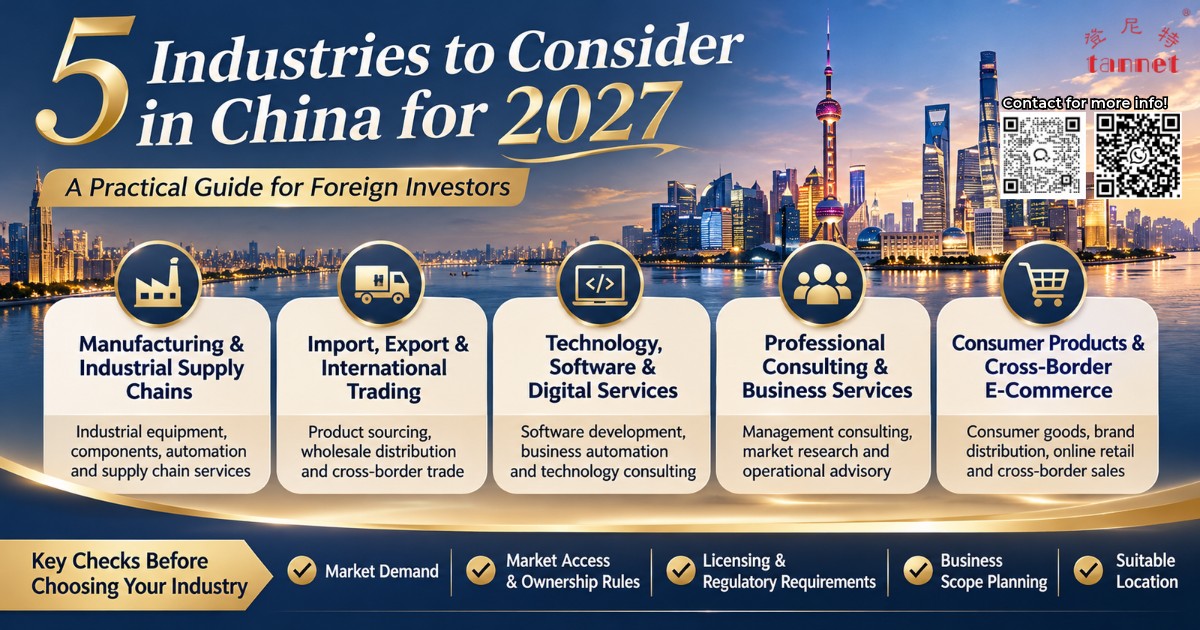
Here are five industries worth evaluating before entering the Chinese market in 2027.
1. Manufacturing and Industrial Supply Chains
China continues to play a central role in global manufacturing, supported by extensive supplier networks, industrial infrastructure and specialized production clusters.
For international investors, opportunities may exist in advanced manufacturing, industrial components, machinery, automation equipment and supply chain services.
Potential business opportunities include:
- Industrial machinery and equipment manufacturing.
- Electronic components and specialized industrial products.
- Manufacturing support and quality control services.
- Industrial automation and production technology.
- Supply chain management and procurement services.
Foreign companies may establish manufacturing operations, sourcing offices or supply chain management businesses depending on their commercial objectives.
However, investors should assess factory location, production costs, environmental approvals, industrial land requirements and applicable manufacturing permits.
Certain activities may also be subject to sector-specific foreign investment restrictions or additional regulatory supervision.
Investor consideration: Before selecting a manufacturing location, compare local industrial clusters, supplier availability, logistics infrastructure and government support policies.
2. Import, Export and International Trading
International trading remains a practical business model for overseas entrepreneurs seeking to connect Chinese suppliers with international markets.
China’s extensive manufacturing ecosystem creates opportunities for businesses involved in sourcing, procurement, wholesale distribution and cross-border trade.
Potential business opportunities include:
- Exporting Chinese-manufactured products to overseas markets.
- Importing international products for distribution in China.
- Wholesale trading of industrial and consumer goods.
- Procurement and supplier management services.
- International supply chain coordination.
Foreign investors may consider establishing a foreign-invested trading company to conduct permitted commercial activities.
However, company incorporation alone does not automatically authorize every type of import or export transaction.
Businesses must evaluate customs registration, applicable trade controls, product classifications, inspection requirements and any special permits associated with regulated goods.
For example, importing food, cosmetics, medical devices or certain electronic products may involve additional regulatory obligations.
Investor consideration: Evaluate product demand, import duties, customs compliance, distribution channels and supplier reliability before launching a trading business.
3. Technology, Software and Digital Services
China’s digital economy continues to create opportunities for companies providing software, enterprise technology and digital business solutions.
International businesses with specialized technical expertise may find opportunities in enterprise software, industrial digitalization, business automation and technology consulting.
Potential business opportunities include:
- Enterprise software development.
- Business process automation solutions.
- Industrial software and digital transformation consulting.
- Technology research and development.
- Software implementation and technical support.
However, foreign investors should distinguish between general software development and regulated internet-based services.
Certain telecommunications, online platform, digital content and data-related activities may be subject to foreign ownership restrictions, licensing requirements or cybersecurity and data protection obligations.
For example, providing software development services is not necessarily regulated in the same way as operating a commercial online platform or telecommunications service.
Investors must also evaluate intellectual property protection, data processing arrangements and the appropriate business scope.
Investor consideration: Clearly define whether your company will develop software, provide technical consulting, operate an online platform or deliver regulated digital services. Different business models may trigger different regulatory requirements.
4. Professional Consulting and Business Services
Professional and business support services may offer opportunities for overseas entrepreneurs with specialized industry knowledge or established international client networks.
As companies manage cross-border operations, demand may arise for specialized advisory, operational support and business coordination services.
Potential business opportunities include:
- Management and business consulting.
- Market research and business development.
- International procurement consulting.
- Supply chain and operational advisory.
- Marketing strategy and commercial consulting.
For some foreign investors, consulting businesses may require less initial infrastructure than manufacturing operations.
However, not all consulting activities are treated equally under Chinese regulations.
General management consulting may be distinguishable from regulated professional services such as legal practice, statutory auditing, certain financial advisory activities and other licensed professions.
Foreign investors should ensure that their proposed business activities accurately reflect the services they intend to provide.
Investor consideration: Identify whether the proposed consulting services fall within ordinary commercial advisory activities or require professional qualifications, regulatory approvals or specialized licenses.
5. Consumer Products and Cross-Border E-Commerce
China’s large consumer market and developed digital retail ecosystem make consumer products and e-commerce worth evaluating for international brands.
Opportunities may exist for businesses offering differentiated products, international brands or specialized consumer goods.
Potential business opportunities include:
- Consumer goods distribution.
- International brand development.
- Online retail and digital commerce.
- Cross-border e-commerce.
- Product sourcing and private-label development.
However, foreign investors should distinguish between domestic retail operations, cross-border e-commerce and operating an online marketplace.
Each model may involve different registration, tax, customs, platform compliance and licensing considerations.
Businesses dealing with regulated products, including food, health-related goods, cosmetics and medical devices, may face additional product registration, filing, labeling or import requirements.
Foreign brands should also evaluate consumer preferences, pricing strategies, marketing costs and competition from established domestic businesses.
Investor consideration: Before entering the consumer market, validate demand through market research and assess whether domestic distribution, cross-border e-commerce or a combination of both is commercially appropriate.
How to Choose the Right Industry Before Registering a Company in China
Selecting an attractive industry is only the first step. Foreign investors should complete a structured feasibility assessment before committing capital.
Step 1: Evaluate Market Demand and Competition
Assess whether there is sufficient demand for your products or services.
Review customer segments, market size, purchasing behavior, pricing expectations and existing competitors.
A rapidly expanding industry does not necessarily guarantee profitability for a new foreign-owned business.
Step 2: Check Foreign Investment Market Access
China maintains a foreign investment negative list identifying sectors where foreign investment is prohibited or subject to restrictions.
Activities outside the applicable negative list generally receive national treatment for market access, subject to other applicable laws and regulations.
Investors should review the latest applicable negative list, including any relevant free trade zone provisions, and determine whether their proposed activities are open to foreign investment.
An industry may offer substantial commercial potential while still imposing ownership restrictions or regulatory conditions.
Step 3: Identify Licensing and Regulatory Requirements
Different business activities may require different permits, registrations or approvals.
For example:
- Manufacturing may require environmental and production-related approvals.
- Trading may involve customs registration and product-specific permits.
- Digital platforms may require telecommunications or internet-related licenses.
- Regulated professional services may require professional qualifications.
- Consumer products may require product compliance, labeling or market-entry approvals.
The exact requirements depend on the activities, products, operating model and location.
Step 4: Choose the Appropriate Chinese City
Location selection can affect operating expenses, recruitment, supplier access and customer reach.
For example, Shanghai may be attractive for international commercial operations, Shenzhen for electronics and technology-related supply chains, Guangzhou for trading and manufacturing networks, and Suzhou for industrial manufacturing activities.
However, the most suitable location depends on the company’s industry, customers, suppliers and operational needs.
Investors should compare cities based on commercial feasibility rather than reputation alone.
Step 5: Define the Business Scope Before Incorporation
A company’s registered business scope should accurately reflect its intended activities.
An incomplete or unsuitable business scope may create complications when applying for industry licenses, conducting regulated activities or expanding operations.
Foreign investors should therefore evaluate their planned activities and regulatory requirements before finalizing company registration documents.
Can Foreign Investors Own 100% of a Company in China?
Foreign investors can establish wholly foreign-owned companies in many industries permitted under China’s foreign investment framework.
However, 100% foreign ownership is not universally permitted across all business activities.
Some sectors remain restricted or prohibited, while certain activities require additional regulatory approvals even when foreign ownership is allowed.
Investors should distinguish between three separate questions:
- Is foreign investment permitted in the proposed industry?
- Can the company be wholly foreign-owned?
- What licenses or approvals are required to operate legally?
These questions should be resolved before incorporation rather than after the company has been registered.
Is 2027 a Good Time to Start a Business in China?
China may present opportunities for international businesses with a clear commercial strategy, competitive offering and realistic understanding of the regulatory environment.
Manufacturing, international trading, technology services, professional consulting and consumer-related businesses are five areas worth researching.
Nevertheless, investment decisions should be based on verified market conditions, current regulations and financial feasibility rather than general industry popularity.
The best industry to invest in China in 2027 is not necessarily the fastest-growing sector. It is the industry that aligns with your business capabilities, market demand and legal operating requirements.
Plan Your China Business Expansion with TANNET
Entering the Chinese market involves important decisions concerning industry selection, company structure, business scope, location and regulatory compliance.
TANNET provides China market-entry advisory, company incorporation assistance, business scope planning and licensing consultation to support overseas entrepreneurs and international companies.
Whether you are considering a manufacturing operation, trading company, consulting business or technology venture, our team can help you evaluate the relevant incorporation and compliance requirements.
Contact TANNET to discuss your proposed business activities and explore a suitable pathway for establishing your company in China.