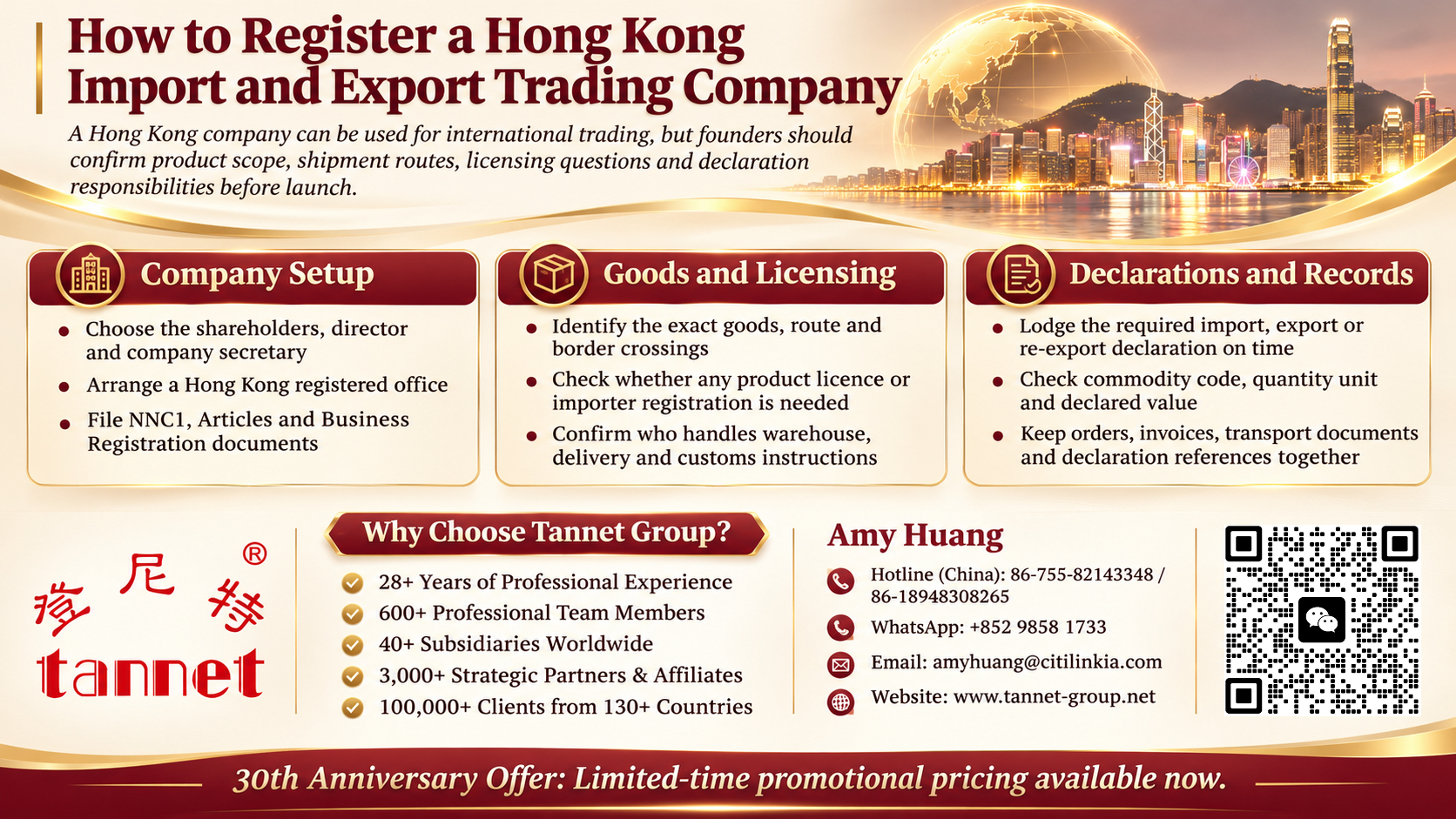
Key Takeaway
A founder can register a Hong Kong private company limited by shares to buy and sell goods internationally. This structure suits wholesalers, sourcing teams and online merchants that want a Hong Kong entity to sign contracts and invoice customers.
Before committing to a delivery date, identify the goods, their physical route and the person responsible for each border crossing. Most products can enter or leave Hong Kong without a product licence. Controlled goods require a separate review. A trader importing or exporting goods generally has 14 days after the movement to lodge the applicable declaration, unless an exemption applies.
Start with one real order
Take a proposed order and draw its route from the supplier to the final customer. Mark every place where the goods will be unloaded, stored or processed. Then write down which entity buys the goods, which entity sells them and who arranges carriage.
Consider a Hong Kong wholesaler that buys notebooks from a factory in the Chinese Mainland. If a truck delivers the notebooks to a Hong Kong warehouse, the team must assess the inbound movement. An onward shipment from the warehouse to Australia creates a second movement to assess.
If the same factory delivers directly to Australia, the Hong Kong sales invoice alone does not create a Hong Kong goods import or export. Keep the transport evidence. The parties still need to check the requirements at the places of departure and arrival.
Step 1 Choose the owners and appoint officers
Agree who will subscribe for shares and who will act as director. For a local private company, Hong Kong requires at least one individual director. A nonresident may serve. A person founding the business alone can generally own all the shares and serve as its sole director.
Choose a company secretary and a Hong Kong registered office. An individual secretary must ordinarily reside in Hong Kong. A corporate secretary must have its registered office or place of business there. A sole director needs someone else to serve as secretary.
Give the secretary an address for urgent correspondence. The registered office receives formal notices. Your warehouse manager may need a different contact for deliveries, inspection requests and queries about goods held before release.
Step 2 File the incorporation documents
Search the proposed name in the Companies Registry and review its naming rules. Agree the initial share allocation before signing. If an overseas parent subscribes, confirm who can sign for it and make sure the parent’s legal name matches its corporate records.
For a company limited by shares, the Companies Registry identifies Form NNC1, the Articles of Association and notice IRBR1 as the incorporation documents. Apply electronically or on paper. Compare the directors, secretary, registered office and initial shareholdings in the completed application with the founders’ instructions.
On incorporation, retain the Certificate of Incorporation and Business Registration Certificate with the filed papers. Give the person who prepares contracts the registered name. The Inland Revenue Department also requires a new local company to notify business particulars within one month after commencing business.
Step 3 Check what the company will ship
The Trade and Industry Department explains that Hong Kong operates as a free port. Licensing applies to particular goods and activities. Start with the manufacturer’s product description, composition and intended use. A catalogue heading such as “accessories” gives a poor basis for deciding which rules apply.
A trader bringing food into Hong Kong in the course of a food importation business generally needs food importer registration unless an exemption applies. The Centre for Food Safety also publishes product guides. For example, chilled chicken involves consignment licensing and health certification requirements.
For equipment potentially covered by strategic trade controls, send the technical specifications and proposed destination to the appropriate specialist or the Trade and Industry Department. Obtain the applicable authority before shipment. A routine customs commodity code alone cannot settle every licensing question.
If a range includes alcoholic drinks, check the particular product against Customs guidance on dutiable commodities. The rules depend on the goods and activity. Record the conclusion for each product line before the sales team confirms the order with the buyer.
Step 4 Prepare the first declaration
Hong Kong Customs requires an accurate electronic declaration for each applicable import, export or re-export. Its published deadline runs from the actual importation or exportation. Give the filing contact the movement date even when the invoice was issued in an earlier month.
Use the Hong Kong commodity classification effective on the shipment date. The Census and Statistics Department publishes the local list and a search facility. Check the prescribed quantity unit as well as the code. A packing list in cartons may need supporting figures in pieces or kilograms.
Record origin separately from the country of consignment. Obtain production information from the supplier if they differ. When overseas goods enter a Hong Kong warehouse and leave unchanged, check the re-export reporting requirements and retain the inbound documents with the outbound file.
Agree whether the forwarder will lodge the declaration for the importer or exporter. Obtain written confirmation of the service and the submission reference. A booking confirmation or carrier manifest proves a different event and gives your accounts team insufficient evidence of declaration filing.
Check valuation with the bookkeeper. The Census and Statistics Department specifies a CIF value for imports and an FOB value for exports. If the supplier invoices goods separately from freight, identify which transport and insurance amounts belong in the declared value. Keep the calculation so another employee can readily reproduce it.
Step 5 Connect the shipment to the accounts
Set up a folder for each order. Keep the purchase order, supplier invoice, sales invoice, packing list, transport document and declaration reference together. Add any product approval used for that consignment. Use the same order reference in your inventory and accounting records.
Suppose a supplier ships an order in two batches. Record what arrived on each date and which items remain with the supplier. This allows the bookkeeper to explain a partial payment and the filing team to work from actual movements.
Plan for the bank’s questions about suppliers, customers and expected payments. Hong Kong Monetary Authority guidance explains that banks assess applicants according to their own policies. A sample order with matching documents gives the bank a clearer picture than a broad description such as international trade.
Common mistakes before the first sale
Using a general trading description for every product.
Ask the supplier for enough detail to distinguish goods made from different materials or designed for different uses. Review the evidence again when the supplier substitutes a model.
Waiting for the declaration deadline to check licences.
Some permissions must be in place before the goods move. Add a release instruction to the purchase order stating who will confirm the required approvals.
Assuming the buyer handled a border crossing.
Ask the buyer which entity its broker named as importer and obtain the relevant record. Resolve conflicting instructions before the logistics team books another shipment.
Frequently asked questions
Q1. Do I need a general import and export licence to form the company?
Most ordinary goods can be traded without a general product licence. Identify the specific goods and activity to establish any licensing, importer registration or permit requirements.
Q2. Can my overseas supplier’s commodity code go straight onto the Hong Kong declaration?
Check the Hong Kong classification and reporting unit first. Local subdivisions can differ even when two jurisdictions use the same international Harmonized System heading.
Q3. Does a small courier parcel need a declaration?
Commercial goods sent by courier can require a declaration. Check the precise conditions of any claimed exemption and establish who will file for the shipment.
Q4. Is a Hong Kong registered office enough to store imported food?
A registered office fulfils a company administration function. Check food storage conditions, premises requirements and the operator’s permissions for the actual facility that will receive the goods.
Q5. Does routing goods through Hong Kong change their origin?
Simple routing or storage generally preserves their existing origin. Assess any processing against the origin rules relevant to the declaration or preferential treatment claimed.
Q6. What should I bring to a first consultation with Tannet?
Bring an ownership outline, one supplier specification, a draft order and the planned transport route. Identify any product whose licensing position is still open. Tannet can coordinate incorporation, accounting setup and referrals for product or customs advice around that shipment.
30th Anniversary Offer: Tannet has been established for 28 years, we are offering exclusive limited-time promotional pricing to celebrate Tannet’s 30th anniversary. Slots are limited and available on a first-come, first-served basis. Contact Consultant Amy Huang for details.
Written by: Tannet Business Services Team
Reviewed by: Consultant Amy Huang
First published: 18 Nov. 2026
Last reviewed: 18 Nov. 2026
————————————————Simplifying Business, Empowering Entrepreneurs————————————————