Key Takeaway
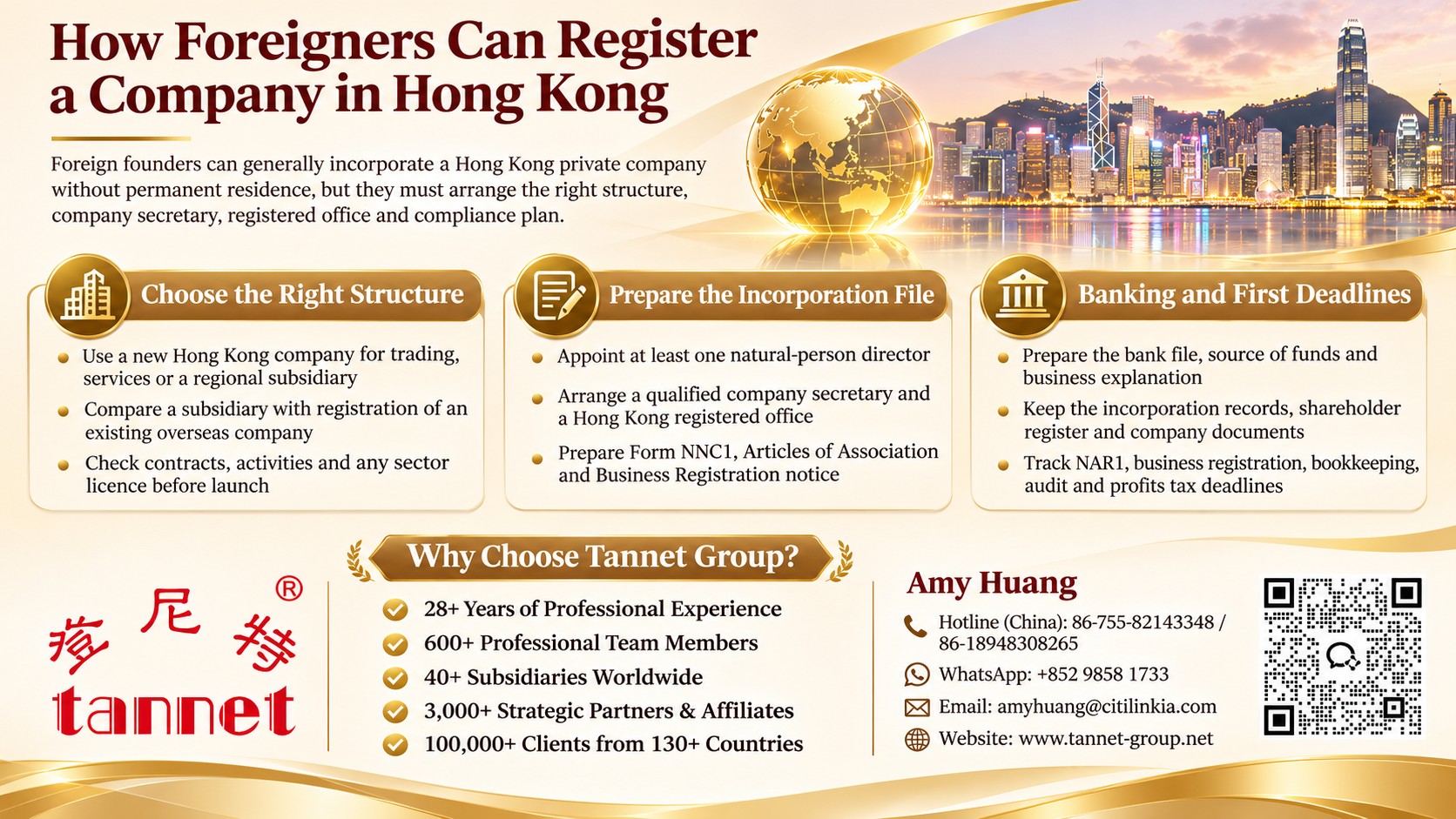
A foreign founder can generally register a Hong Kong private company limited by shares without Hong Kong permanent residence. This route can suit founders who want a new legal entity for trading, services or a regional subsidiary. The company needs a natural-person director, a qualified company secretary and a Hong Kong registered office.
Prepare the incorporation form, Articles of Association and Business Registration notice. Decide how the company will receive funds, document business activity and meet its reporting obligations. A bank assesses account opening separately. If you intend to work in Hong Kong or already operate through an overseas company, check the applicable immigration or registration route before launch.
Step 1. Choose the right legal structure
A local private company limited by shares is a new legal entity. Consider it if the founder or overseas parent wants a Hong Kong entity to enter contracts and own assets. Decide whether the shareholder will be an individual, a parent company or several investors.
If an existing overseas company establishes a place of business in Hong Kong, it generally must register as a non-Hong Kong company within one month. This route registers the existing entity. Compare who signs contracts, holds assets and bears liabilities before deciding whether to form a subsidiary.
If a group already has customers, check whether their contracts allow assignment to a new entity. Review insurance, supplier terms and the names on open invoices. The answer can affect when the new company can take over an engagement.
Map the proposed activities, territories and legal counterparties. If the company will provide services, trade or undertake regulated activities, identify which entity will sign the first contract. Review sector licences before committing to business activities that depend on approval.
Step 2. Document ownership and appoint officers
A foreign individual can generally hold all the shares and serve as the sole director of a Hong Kong private company. At least one director must be a natural person. The Companies Registry permits a nonresident to serve as a director.
Appoint a qualified company secretary. An individual secretary must ordinarily reside in Hong Kong. A corporate secretary must have its registered office or place of business in Hong Kong. The sole director cannot also be company secretary of the same company.
Arrange a Hong Kong registered office for receiving statutory notices. Identify the actual operating address and use it where the bank or an authority requests it. Confirm who can receive mail and how they will escalate a notice with a deadline.
If you appoint a service provider, verify the exact entity taking the appointment. Check the Companies Registry’s public register if the provider needs a trust or company service provider licence. Agree how the company will retrieve its records if the relationship ends.
If a foreign company will hold the shares, prepare its constitutional documents, ownership chart and authorisation for the signatory. Check whether the receiving party needs certification or translation. Confirm that the ownership chart identifies the people who ultimately control the group.
Step 3. Prepare and file the incorporation documents
Search the Companies Register for the proposed name. If the business will rely on a brand, check trademark availability separately. Confirm the spelling of names, addresses and proposed share details across the filing documents.
For a local company limited by shares, prepare Form NNC1, the Articles of Association and Notice to Business Registration Office IRBR1. Use the Companies Registry’s electronic filing service or an accepted paper channel. Confirm who signs on behalf of each founder member.
Follow the form instructions for first director particulars. The Registry’s electronic guidance calls for Hong Kong identity card details or, in their absence, passport particulars. It also gives instructions for directors who hold neither document. Bank identity checks follow their own procedures.
Complete the required director consents. A first director who can use the separate consent route must deliver Form NNC3 within 15 days after incorporation. Keep the filing acknowledgement and check it against the corporate records.
Once approved, retain the Certificate of Incorporation, Business Registration Certificate, filed form and Articles. Set up the register of members and the Significant Controllers Register where applicable. Keep the ownership records current when issuing or transferring shares.
Step 4. Prepare the bank application and launch plan
The Hong Kong Monetary Authority explains that banks set their own account-opening requirements. Ask how the bank verifies directors, beneficial owners and signatories. Confirm whether remote verification is available for the company and whether anyone must attend in person.
Explain what the company does, where it operates and who pays it. A service company might supply a statement of work and customer information. A trader might provide supplier evidence and describe how orders, shipping and settlements will work. Keep projections consistent with the contracts and business plan.
Record who will fund the first payment and whether it is equity, a loan or customer revenue. Keep the relevant agreements and verify that the receiving account belongs to the correct entity. Set a launch date that allows time for payment arrangements and any sector licence.
Keep a copy of the bank application and update it when ownership or expected transactions change. If the company operates across borders, explain which activities occur in each location and who is authorised to approve account transactions.
Step 5. Set the first reporting deadlines
Start bookkeeping with the company’s first transactions. Record founder-funded purchases and initial share contributions separately. Save statements and contracts while they are accessible. Appoint someone to reconcile balances and track the company’s financial year end.
A local private company generally files Form NAR1 within 42 days after each incorporation anniversary, beginning after the incorporation year. Track Business Registration renewal, accounts, audit and Profits Tax Return obligations as separate items. Check statutory requirements even when the company has little activity.
The Inland Revenue Department generally issues a new company’s first Profits Tax Return around 18 months after incorporation, although timing can vary. Monitor official mail. Check the notice carefully for the filing deadline.
The IRD generally requires notification within four months after the relevant basis period ends when the company is chargeable and has received no return. Record the deadline with the person who prepares its tax filings.
Review where the company earns its profits and where management or staff work. Hong Kong’s profits tax source test depends on the activities that earn the profit. Also check reporting or taxable presence in the jurisdictions where the founder and team operate.
Common Mistakes
Assuming the founder needs a resident director.
A nonresident can generally serve. Focus on the actual company secretary and registered office requirements.
Treating the certificate as evidence of banking approval.
Confirm account onboarding and the ability to receive and send the intended payments before committing to settlement dates.
Overlooking operations outside Hong Kong.
Record where contracts are negotiated, services are performed and decisions are made. Review those facts for home-country and Hong Kong tax purposes.
Frequently Asked Questions
Q1. Can a foreigner register a Hong Kong company without a local shareholder?
Generally yes. A local private company can be wholly foreign owned. Check any business-specific licensing or ownership restrictions before launch.
Q2. Can I incorporate without visiting Hong Kong?
The Companies Registry accepts electronic and paper submissions. Confirm identity checks and signing arrangements. Ask the bank separately whether any participant needs to visit.
Q3. Can I use my home address overseas?
The registered office must be in Hong Kong. Give the bank the actual operating address where requested and explain the role of each location.
Q4. Does a company registration give me the right to work in Hong Kong?
Apply the Immigration Department’s entry and work rules to your role. Incorporation by itself confers no permission to take up work.
Q5. Does foreign customer income qualify for offshore treatment automatically?
Review the operations that produced the income and where they took place. Retain records that support the position and consider any applicable special tax provisions.
Q6. Can the company obtain a Certificate of Resident Status?
It can apply for proof of residence under an applicable treaty or arrangement if it meets that agreement’s definition. The treaty partner assesses the conditions for relief.
How Tannet Can Assist
Tannet can help review the proposed ownership, prepare incorporation and company secretary arrangements, and organise the bank file. If the project involves an overseas parent, several jurisdictions or a work permission question, Tannet can coordinate with relevant advisers.
30th Anniversary Offer: Tannet has been established for 28 years, we are offering exclusive limited-time promotional pricing to celebrate Tannet’s 30th anniversary. Slots are limited and available on a first-come, first-served basis. Contact Consultant Amy Huang for details.
Written by: Tannet Business Services Team
Reviewed by: Consultant Amy Huang
First published: 17 Nov. 2026
Last reviewed: 17 Nov. 2026
————————————————Simplifying Business, Empowering Entrepreneurs————————————————