China remains an attractive destination for international entrepreneurs seeking access to manufacturing networks, established supply chains, a large consumer market, and international trading opportunities. However, before establishing a company, one of the most important questions foreign investors must answer is: How much does it actually cost to start a business in China?
The cost of starting a business in China involves much more than company registration fees. Foreign investors must consider registered capital commitments, office arrangements, accounting services, tax compliance, employee salaries, and ongoing operating expenses.
Understanding these financial obligations before incorporation can help investors avoid unexpected costs, maintain sufficient working capital, and establish a more sustainable business operation.
1. Company Incorporation Costs in China
The first expense foreign investors should consider is the cost of registering a legal business entity.
Many international entrepreneurs establish a foreign-invested limited liability company, which can generally operate independently, enter commercial contracts, hire employees, and conduct approved business activities.
The total company incorporation cost in China depends on several factors, including:
- The city and district where the company will be registered.
- The proposed business activities and business scope.
- Whether special industry approvals or licences are required.
- The complexity of the shareholder structure.
- Document preparation, translation, notarisation, and authentication requirements.
- Professional incorporation and corporate advisory services.
Government registration charges may be relatively modest, but the complete setup budget can be higher once professional assistance, documentation, and other administrative requirements are included.
Foreign corporate shareholders may also need to prepare additional incorporation documents, depending on their jurisdiction and the applicable verification requirements.
Important: Registering a company does not automatically authorise every commercial activity. Certain industries require additional licences or approvals before operations can begin.
2. Registered Capital Is Not the Same as a Registration Fee
One of the most common misunderstandings among first-time foreign investors concerns registered capital.
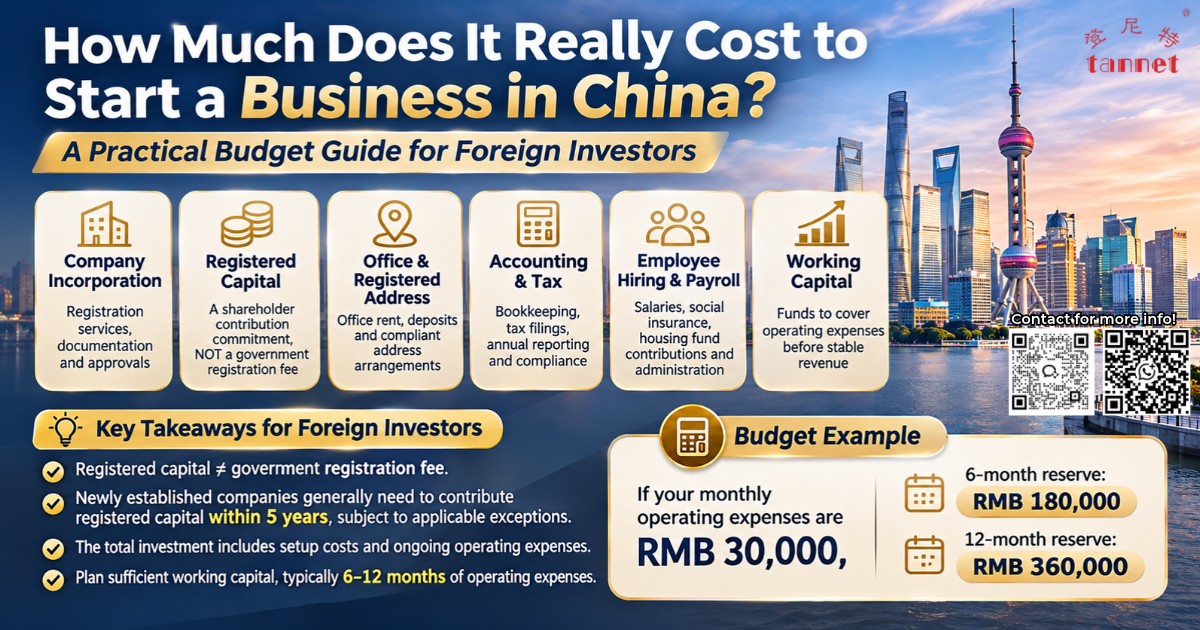
Registered capital is not a government fee paid to register a company. It represents the capital that shareholders commit to contribute to the business.
For example, if a foreign investor establishes a company with registered capital of RMB 500,000, this does not mean the investor must pay RMB 500,000 to the government as an incorporation fee.
Instead, the amount represents the shareholders’ capital contribution commitment, subject to the applicable legal requirements and contribution schedule.
Under China’s revised Company Law, which took effect on July 1, 2024, shareholders of newly established limited liability companies generally must fully contribute their subscribed registered capital within five years of establishment, unless a shorter period or different statutory requirement applies.
Some regulated industries may also impose specific minimum capital requirements or other financial conditions.
When determining registered capital, foreign investors should evaluate:
- The financial requirements of their intended operations.
- Expected equipment, inventory, and staffing expenses.
- Potential licensing or regulatory capital requirements.
- Shareholder funding capacity and contribution deadlines.
- Future expansion and financing plans.
Setting registered capital too high may create unnecessary funding commitments. Setting it too low may leave the business undercapitalised or unable to meet certain commercial or regulatory requirements.
The appropriate amount should reflect a realistic business plan rather than an arbitrary figure.
3. Office Rental and Registered Address Expenses
Every company registered in China generally needs a compliant registered address.
However, the cost of securing that address can vary significantly depending on the city, location, and type of premises.
For example, businesses operating in Beijing, Shanghai, Guangzhou, Shenzhen, or Chengdu may face different rental costs and local registration requirements.
Foreign investors should consider three common arrangements.
Physical Office Rental
Companies requiring employees, customer meetings, inventory coordination, or regular business operations may need a dedicated office.
Potential expenses include rental deposits, monthly rent, utilities, internet services, office furniture, and property management charges.
Serviced Offices
Serviced offices may offer flexible arrangements with furnished workspaces, shared facilities, and administrative support.
However, investors must verify whether the premises can legally be used as the company’s registered address.
Registered Address Services
Some jurisdictions and business activities may permit eligible companies to use approved registered address arrangements.
These services can reduce initial overhead, but availability depends on local registration policies and the company’s business scope.
A registered address service should not automatically be treated as permission to operate from a virtual office.
For activities involving manufacturing, food services, warehousing, or other regulated operations, specific physical premises and additional approvals may be necessary.
4. Accounting, Tax Filing, and Annual Compliance Costs
Company registration is only the beginning of corporate compliance in China.
Even a newly incorporated company with limited business activity may have ongoing accounting, tax reporting, and statutory filing obligations.
Foreign investors should include the following recurring expenses in their business budget:
Bookkeeping and Accounting
Companies generally need to maintain proper accounting records, prepare financial statements, and retain supporting transaction documents.
The cost of accounting services depends on transaction volume, business complexity, and reporting requirements.
Tax Registration and Filing
Businesses may have obligations involving corporate income tax, value-added tax, and other applicable taxes.
Filing requirements and reporting frequency depend on the company’s tax status and circumstances.
A company with no revenue should not automatically assume that it has no tax filing obligations.
Annual Enterprise Reporting
Companies generally must submit their annual enterprise information report through the relevant public information system between January 1 and June 30 for the preceding year.
Additional Compliance Requirements
Depending on the business, investors may also need to budget for statutory audit services, foreign investment information reporting, payroll administration, and licence renewals.
Certain companies may have additional regulatory or financial reporting obligations.
Failure to maintain proper compliance can lead to penalties, administrative restrictions, or adverse corporate credit records.
For this reason, accounting and compliance expenses should be treated as recurring operating costs rather than optional services.
5. Employee Hiring and Payroll Expenses
Hiring employees in China involves more than paying monthly salaries.
Foreign-invested businesses generally must comply with China’s employment laws, payroll administration requirements, and applicable statutory contribution obligations.
Employers should consider:
- Gross employee salaries.
- Employer social insurance contributions.
- Housing provident fund contributions.
- Recruitment and onboarding expenses.
- Payroll processing and individual income tax withholding.
- Employee benefits and statutory employment entitlements.
China’s social insurance system generally covers pension, medical, unemployment, work-related injury, and maternity insurance, with contribution arrangements varying by insurance category and locality.
Employers may also be required to contribute to the housing provident fund.
Contribution rates, calculation bases, and administrative requirements vary across cities and may change over time.
For example, the total employment cost of hiring someone in Shanghai may differ from that of hiring a similarly paid employee in Chengdu because of local contribution rules and salary expectations.
Foreign investors should therefore calculate the total employer cost, rather than using basic salary alone when preparing a staffing budget.
6. Additional Business Operating Expenses to Consider
Depending on the industry, companies may encounter additional expenses that are not immediately obvious during incorporation.
These can include:
Import and Export Operations
Trading companies may need to budget for customs-related registrations, logistics, freight forwarding, product inspection, warehousing, and applicable import duties or taxes.
Manufacturing Operations
Manufacturers may face factory rental, machinery purchases, environmental compliance, workplace safety requirements, and production-related approvals.
Technology and Digital Services
Technology companies may need software subscriptions, cybersecurity compliance support, cloud infrastructure, and applicable telecommunications or internet-related licences.
Professional and Consulting Services
Consulting businesses may require professional indemnity coverage, specialised licences where applicable, office facilities, and administrative support.
Foreign investors should identify these industry-specific expenses before finalising their company structure and investment budget.
7. How Much Working Capital Should You Prepare?
There is no single investment amount suitable for every foreign-owned business in China.
A small consulting company with limited staffing requirements may have a substantially different cost structure from an import-export business or manufacturing operation.
A practical starting budget should account for three financial categories.
One-Time Setup Costs
These include incorporation services, documentation, initial licensing, office deposits, equipment, and other pre-operational expenses.
Recurring Monthly Expenses
These include rent, salaries, employer contributions, accounting, administrative services, utilities, and ongoing business support.
Working Capital Reserve
Working capital helps the company cover expenses while waiting for customer payments, securing contracts, building inventory, or reaching profitability.
As a planning approach, investors may consider preparing sufficient funding for at least six to twelve months of anticipated operating expenses, depending on their industry, cash flow cycle, and commercial risks.
This is a budgeting guideline, not a statutory capital requirement.
For example, a business expecting RMB 30,000 in monthly operating expenses would require approximately RMB 180,000 to RMB 360,000 to cover six to twelve months of operations, excluding one-time setup costs and other financial commitments.
The appropriate funding reserve should ultimately be based on a realistic cash flow forecast.
8. Common Budgeting Mistakes Foreign Investors Should Avoid
Foreign investors sometimes underestimate the cost of establishing a company because they focus exclusively on incorporation expenses.
Common mistakes include:
- Confusing registered capital with government registration fees.
- Selecting registered capital without considering contribution deadlines.
- Choosing an office address that does not meet registration requirements.
- Underestimating employer social insurance and payroll costs.
- Ignoring annual accounting and compliance obligations.
- Assuming that a company without revenue has no reporting responsibilities.
- Failing to budget for industry-specific licences and approvals.
- Starting operations without sufficient working capital.
Careful financial planning can help businesses avoid these issues and establish more realistic expectations before entering the Chinese market.
9. Plan Your China Business Investment with TANNET
Starting a business in China requires more than completing company registration. Foreign investors must understand the relationship between registered capital, actual setup costs, ongoing compliance obligations, and operational funding.
A well-prepared investment budget should reflect the intended business activities, selected city, staffing requirements, and expected commercial development.
TANNET supports overseas entrepreneurs and international companies with China company incorporation, registered address assistance, business scope planning, accounting coordination, tax compliance services, and corporate setup advisory.
Whether you are planning a consulting company, international trading business, or a new China subsidiary, TANNET can help you understand the key establishment requirements and develop a more structured market-entry plan.
Planning to establish a company in China? Contact TANNET to discuss your proposed business activities, registration location, and corporate setup requirements before committing your investment.
📞 Free 1-on-1 Consultation Now,
Official Service Hotline: +86-755-82148419
Cell: +86-13823131503;+60 19-309 2363
WeChat ID: 13823131503;
WhatsApp:+86-13823131503;+60 19-309 2363
Email: mytannet08@gmail.com; susiehu@citilinkia.com