Key Takeaway
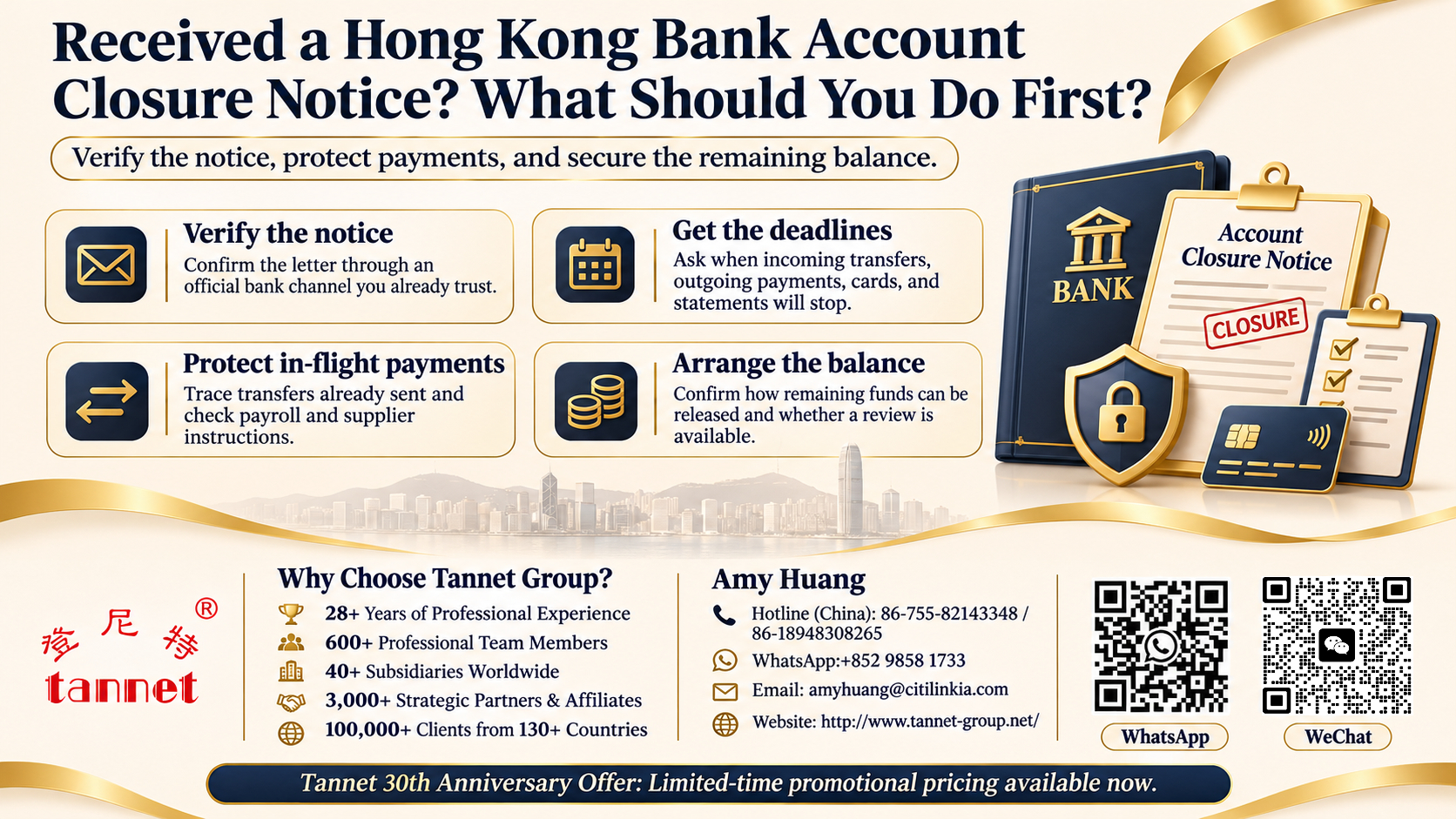
Verify the notice through a bank channel you already trust. Then ask what still works today, when each service ends and how the company can claim its remaining funds. A closure date alone tells you little about a customer transfer already in transit or a payroll file awaiting release.
For a foreign director managing a Hong Kong company, the immediate priorities are to protect the next payment deadline, preserve the account records and give the bank one authorised contact. Pursue a review alongside those tasks if you want the decision reconsidered.
Confirm the notice and the account it covers
Open the banking app independently or call a number obtained from the bank’s official website. Give the reference and ask the bank to confirm the notice, the company name and the affected account. If someone has already disclosed credentials or authorised a suspicious transfer, contact the bank’s fraud team immediately.
Ask whether the bank is announcing a future closure, requesting information by a deadline or applying an immediate restriction. These can require different responses. A request for updated business information may be answered through the bank’s review channel. A restriction already in force determines which instructions the bank can process today.
Save the notice and record when it reached an authorised person. A letter can spend days at a registered office before the director sees it. Tell the bank promptly if delivery was delayed, ask which deadlines still apply and request confirmation of any extension.
Get the deadlines in writing
Ask separately about incoming transfers, outgoing payments, direct debits, cards and access to electronic statements. For each relevant service, confirm the date, time and time zone. A director in another country may have less working time than the date printed on the letter suggests.
Name one authorised person to manage contact with the bank. Record the case reference, the answer to each question and any point awaiting written confirmation. Give payroll and accounts receivable the instructions that affect them so nobody promises a payment based on an assumption.
Sort payments by what has already happened
For an invoice the customer has yet to pay, ask the customer to hold the transfer while you verify the receiving route. Check marketplace settlements separately. A payout may already be locked into a batch even though the merchant dashboard still displays the old bank details.
For a transfer already sent, obtain the payer’s remittance advice, currency, value date and transaction reference. Ask the sending bank, through the payer, to trace it. Give the bank the same particulars and ask what status it can confirm. A debit on the payer’s statement establishes only one side of the transfer.
For payroll or supplier payments, check whether instructions are scheduled, awaiting approval, released or settled. Ask which items can still execute. If another payroll run becomes necessary, reconcile the original batch first so that each employee receives the amount due once.
List standing instructions for rent, insurance and tax payments. Contact the creditor before a payment falls due. Ask how to replace the mandate and confirm when it becomes active. Keep the old instruction under observation until the change takes effect.
Arrange the remaining balance
Request the balance in each currency and ask which amounts are available for release. Pending card entries, payments in clearing and funds subject to a hold may affect the figure. Ask how the bank will notify the company if another credit arrives after the closing statement.
Get the bank’s instructions for paying out the balance. Confirm the permitted destination, required signatories, acceptable evidence of account ownership and whether an appointment is necessary. An overseas director should check document certification and attendance requirements before arranging a courier or a flight.
If the company holds US dollars and euros, ask whether each can be paid out in its original currency. Confirm the receiving account supports the currency and method offered. If a cheque is proposed, establish who can collect it and where the company can deposit it.
Decide whether to request a review
The Hong Kong Monetary Authority says a customer may ask the bank to re-examine an account restriction or closure. Banks should explain their reasons where appropriate and legally permitted. Ask the bank which issue it can disclose and where to send relevant evidence.
A useful review request identifies the decision, states the outcome sought and answers the specific concern. If a distributor’s parent paid an invoice, identify all three parties. Include the contract, the invoice, evidence of payment and any written arrangement explaining why the parent paid.
Ask the reviewer to acknowledge receipt and confirm whether any deadline or restriction has changed. Continue planning from the last confirmed instructions until the bank answers. If a legal order is involved, obtain Hong Kong legal advice on the order and use the channels it permits.
Move collections and payments carefully
If another account in the company’s name is ready, verify that it can receive the required currencies and that authorised staff can operate it. A replacement application has its own approval process. Ask unpaid customers to agree a payment date if the company has yet to establish an eligible receiving account.
Tell customers about changed banking instructions through an established contact. Invite their finance team to call a number already on file. Give the effective date and legal beneficiary name. Hong Kong Police guidance on supplier bank detail scams explains why an independent check matters.
Check linked merchant services separately. A payment processor may continue paying the old account until it verifies the replacement. Ask about the next settlement batch and the route for refunds or chargebacks.
Preserve the evidence your accountant will need
Download statements for each currency, payment advices and any reports needed to reconcile transactions while access remains available. Ask how to obtain the final statement after closure. A screenshot of the current balance cannot explain how the company received or spent the money.
Under Hong Kong’s Inland Revenue Ordinance, businesses generally need sufficient records to establish their assessable profits and must retain them for at least seven years. Link each closing balance to its payout reference. Retain evidence of returned receipts, unpaid liabilities and later settlements alongside the relevant invoices.
Common mistakes
One team tells a buyer to resend money when the first transfer disappears from view. Another assumes a closure review automatically keeps payroll operating. In both cases, obtain the bank’s status for the original instruction before asking anyone to send a second payment.
Another error is circulating the director’s personal banking details when the company account stops receiving funds. Ask the bank for a permitted corporate payout route and coordinate with counterparties through verified channels. Keep the company’s contractual rights and records clear throughout the change.
Frequently asked questions
Q1. How much time do we have after receiving a notice?
Use the dates in the verified notice and ask about services already restricted. Obtain separate deadlines for payments, statement access and any balance release instructions.
Q2. Can the bank close our account without giving a detailed reason?
Ask what the bank is able to disclose. HKMA guidance recognises that reasons may be given where appropriate and legally permitted. Keep a record of the response.
Q3. Should a buyer recall a transfer sent this morning?
Ask the buyer to obtain a trace from its bank. Identify the transfer’s status before discussing a recall, a return or any replacement payment.
Q4. We have no second corporate account. What should we tell customers?
Ask customers with unpaid invoices to hold payment and agree when you will update them. Obtain the closing bank’s procedure for balance collection and pursue a suitable replacement account.
Q5. Does the HKMA decide whether our account must stay open?
The bank handles the closure review. A customer can complain about the bank’s handling of a matter. The HKMA explains that it cannot override a bank’s commercial decision.
Q6. Can we recover statements after online access ends?
Ask the bank which channel supplies archived statements, what a signatory must provide and how it will deliver them. Request the final statement explicitly.
When Tannet can assist
Contact Consultant Amy Huang if an overseas director must organise a review, explain a cross-border receipt or prepare another corporate account application. Share a redacted notice, the earliest deadline and the unresolved transaction. Tannet can help assemble the business records and questions. The bank controls the account and decides the outcome.
30th Anniversary Offer: Tannet has been established for 28 years, we are offering exclusive limited-time promotional pricing to celebrate Tannet’s 30th anniversary. Slots are limited and available on a first-come, first-served basis. Contact Consultant Amy Huang for details.
Written by: Tannet Business Services Team
Reviewed by: Consultant Amy Huang
First published: 20 Nov. 2026
Last reviewed: 20 Nov. 2026
————————————————Simplifying Business, Empowering Entrepreneurs————————————————