Key Takeaway
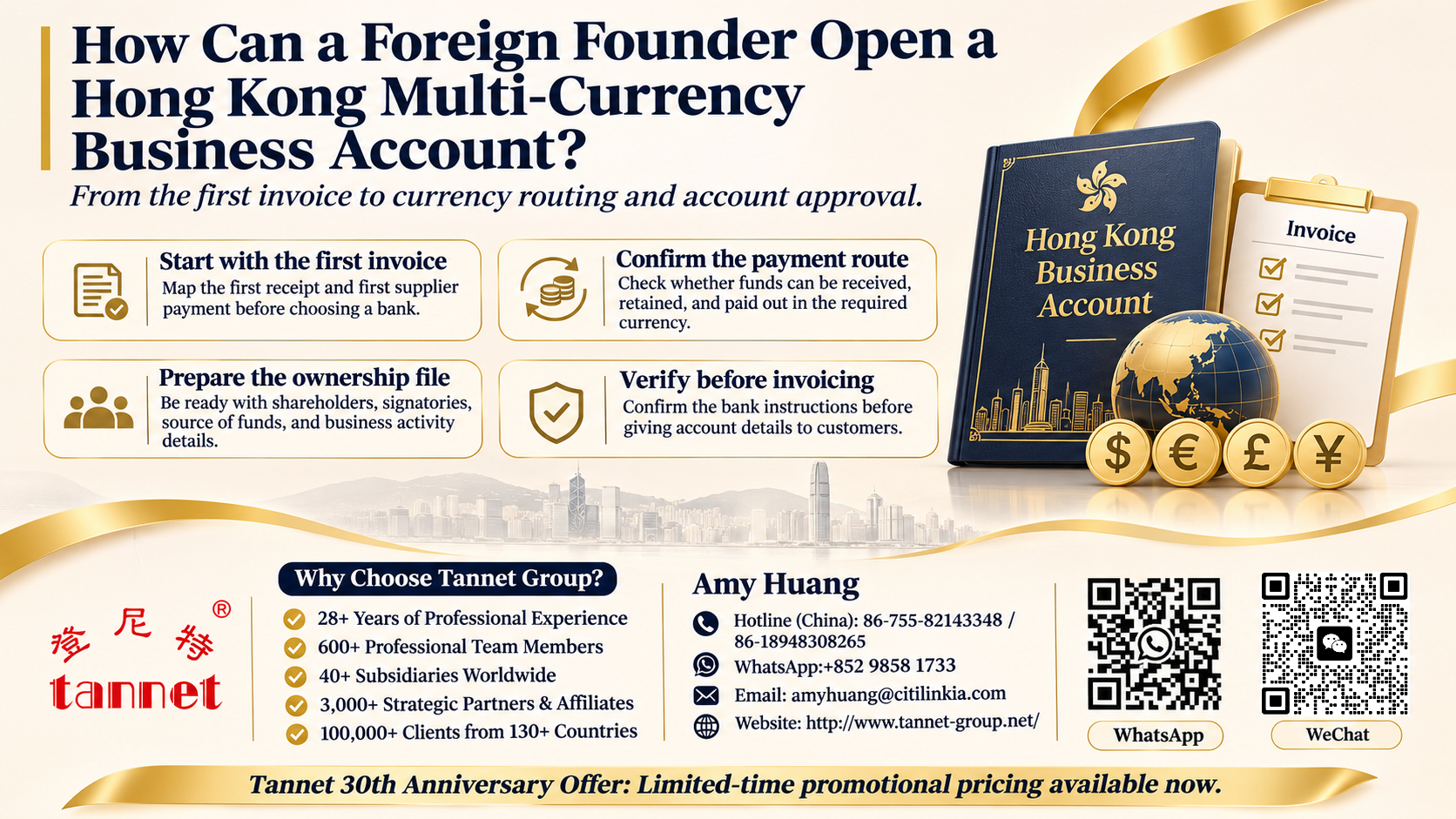
A foreign founder can apply on behalf of a Hong Kong company for a business account that holds several currencies. Start with the first customer receipt and supplier payment. Choose a bank that supports both transactions, then confirm how it will verify the company, its owners and the people authorised to operate the account.
This approach suits exporters, consultants and online sellers with overseas customers. Before quoting bank details, confirm that the account can receive, retain and send each required currency through the payment method your counterparty uses.
Step 1 Work backwards from the first invoice
Imagine a Hong Kong design studio with a customer in Germany and a subcontractor in Singapore. The customer pays in euros. The subcontractor also invoices in euros. The studio wants to retain the first receipt and use part of it to settle the second invoice without an intermediate conversion.
Ask the bank three questions about this sale. Can the customer send euros using its normal banking service? Will the proceeds stay in a euro balance? Can the company pay the subcontractor from that balance? A product description listing euros addresses only part of the decision.
Ask the customer how it intends to pay. Its procurement system might require local receiving details in a particular country. A Hong Kong account capable of holding the currency can still require an international transfer. Resolve that point before agreeing payment terms with the buyer.
Make a second list for expected payments out. For each supplier, record the invoice currency, destination country and person who approves payment. This prevents a sales requirement from overshadowing a purchasing requirement when you compare banks.
Step 2 Choose the bank and application route
Compare business banking products offered to a Hong Kong incorporated company. For example, HSBC Hong Kong lists euros, US dollars and Singapore dollars among the foreign currencies covered by its Business Integrated Account. Check the current product terms for your currencies and the transfer routes you need.
Give the bank the incorporation jurisdiction, ownership structure, directors’ locations and identification documents available. Ask which people must be verified and whether each can complete the process from their present location. Online form submission and final identification may involve different steps.
Check practical access too. Can the authorised user receive verification messages on their own mobile number abroad? How do they activate payment approval and recover access after changing phones? These questions matter when the person signing supplier payments lives outside Hong Kong.
Step 3 Establish who owns and controls the company
Use the checklist for your company type. A Hong Kong private company may be asked for its incorporation certificate, Business Registration Certificate, articles and current information on directors and shareholders. A recently incorporated company can ask which formation records the bank accepts before its first annual return falls due.
Draw an ownership chart if another company holds shares. Follow each relevant chain through to the individuals who ultimately own or control the applicant. Label each entity, jurisdiction and holding. Supply supporting registers or other ownership evidence in the format the bank requests.
Identify who may operate the account. Shareholding, directorship and payment authority are distinct. Have the board approve the mandate where required. Agree who can add beneficiaries and release transfers, then ensure the bank’s application and your internal instructions give each person the intended powers.
Step 4 Explain the activity behind each currency
Describe what the company sells, where customers are based and how suppliers are paid. Show one representative transaction from order through delivery to settlement. A consultant can use a scope of work and milestone schedule. A trader can use a purchase order and supplier quotation.
A new company may have no paid invoices. Present the evidence it genuinely has, such as a signed engagement, dated correspondence with a prospective buyer or a launch plan supported by supplier terms. Mark estimates as forecasts and identify any conditions before a sale becomes binding.
Explain who will fund the account initially. If a shareholder will provide working capital, identify the shareholder, the originating account and whether the contribution is equity or a loan. Keep the relevant company approval and evidence of the source available for follow-up questions.
Where a marketplace or group treasury company will remit the money, its name can differ from the customer on the invoice. Explain this in advance. A settlement statement or an agreement identifying the payer can help the reviewer follow the commercial relationship.
Step 5 Complete identity and tax declarations
The Hong Kong Monetary Authority describes the registered office and the principal place of business as separate particulars where they differ. If official mail goes to a secretary in Hong Kong while the founder delivers services abroad, describe the function of each location accurately.
The bank may also request a tax self-certification for the entity and, where applicable, its controlling persons. Hong Kong’s Inland Revenue Department explains how tax residence and taxpayer identification numbers are reported. Read the classification questions carefully and seek tax advice if the facts span several jurisdictions.
Send identity documents through the channel designated by the bank. Ask about certification or translation before ordering either. Keep a copy of the business description and ownership chart actually submitted so different directors answer later questions using the same dated information.
If the bank asks for documents, answer the question in its request. For example, a certificate showing the immediate shareholder may leave the ultimate owner unidentified. Send the missing ownership link and explain how it connects the records already supplied.
Step 6 Check the instructions before accepting money
After approval, obtain the bank’s instructions for the first incoming currency. Compare the beneficiary name and account identifier with the company’s legal details. Include the bank identifier and any intermediary instructions the bank specifies for that route. Have the customer confirm its bank can use them.
Designate someone to reconcile the first transfer against the invoice. Check the currency credited, the payer name, the reference and any difference between the invoiced amount and the receipt. Retain the transfer advice and investigate a discrepancy before treating the invoice as settled.
Common mistakes
One founder puts every possible currency on the application but cannot describe the first sale. Another describes the payer as a retailer even though a marketplace sends the settlement. Use an actual order or a realistic forecast to explain which parties and currencies the bank should expect.
A third founder assumes a dollar balance comes with domestic US payment details. Ask expressly whether a buyer can pay by its preferred domestic network or must send an international transfer. Send the customer only the instructions confirmed for its payment method.
Frequently asked questions
Q1. Can I apply if I live outside Hong Kong?
Yes, you can enquire as a nonresident founder of a Hong Kong company. Eligibility for a particular product and verification channel depends on the bank’s assessment and your circumstances.
Q2. Must every shareholder travel to a branch?
Ask which directors, beneficial owners and signatories need verification and how the bank will verify each. Obtain confirmation for your ownership structure before anyone books travel.
Q3. Can I open the account before the first customer pays?
Ask what the bank accepts for a startup. Explain the business stage honestly and present evidence of planned trade, expected funding and the currencies tied to identifiable transactions.
Q4. Will my US dollar receipt be converted to Hong Kong dollars?
Confirm the receiving instructions, currency balance and conversion settings with the bank. The currency shown on the customer invoice does not determine how a transfer will be credited.
Q5. Can a director’s personal account receive our business payments?
Apply for an account in the company’s name. Customers can then match the beneficiary to their contracting party, and the company can maintain a clear record of its receipts.
Q6. What can we do if the bank declines our application?
Ask the bank how to request a review. The Hong Kong Monetary Authority describes a bank review mechanism. Address the specific issue where the bank can identify it and submit relevant additional evidence.
When Tannet can assist
Contact Consultant Amy Huang if your company has foreign corporate shareholders, no trading history or a first customer who requires a particular receiving method. Share the ownership outline, expected payment route and bank’s outstanding question. Tannet can help organise supporting documents and coordinate enquiries. The bank decides eligibility and approval.
30th Anniversary Offer: Tannet has been established for 28 years, we are offering exclusive limited-time promotional pricing to celebrate Tannet’s 30th anniversary. Slots are limited and available on a first-come, first-served basis. Contact Consultant Amy Huang for details.
Written by: Tannet Business Services Team
Reviewed by: Consultant Amy Huang
First published: 20 Nov. 2026
Last reviewed: 20 Nov. 2026
————————————————Simplifying Business, Empowering Entrepreneurs————————————————