Key Takeaway
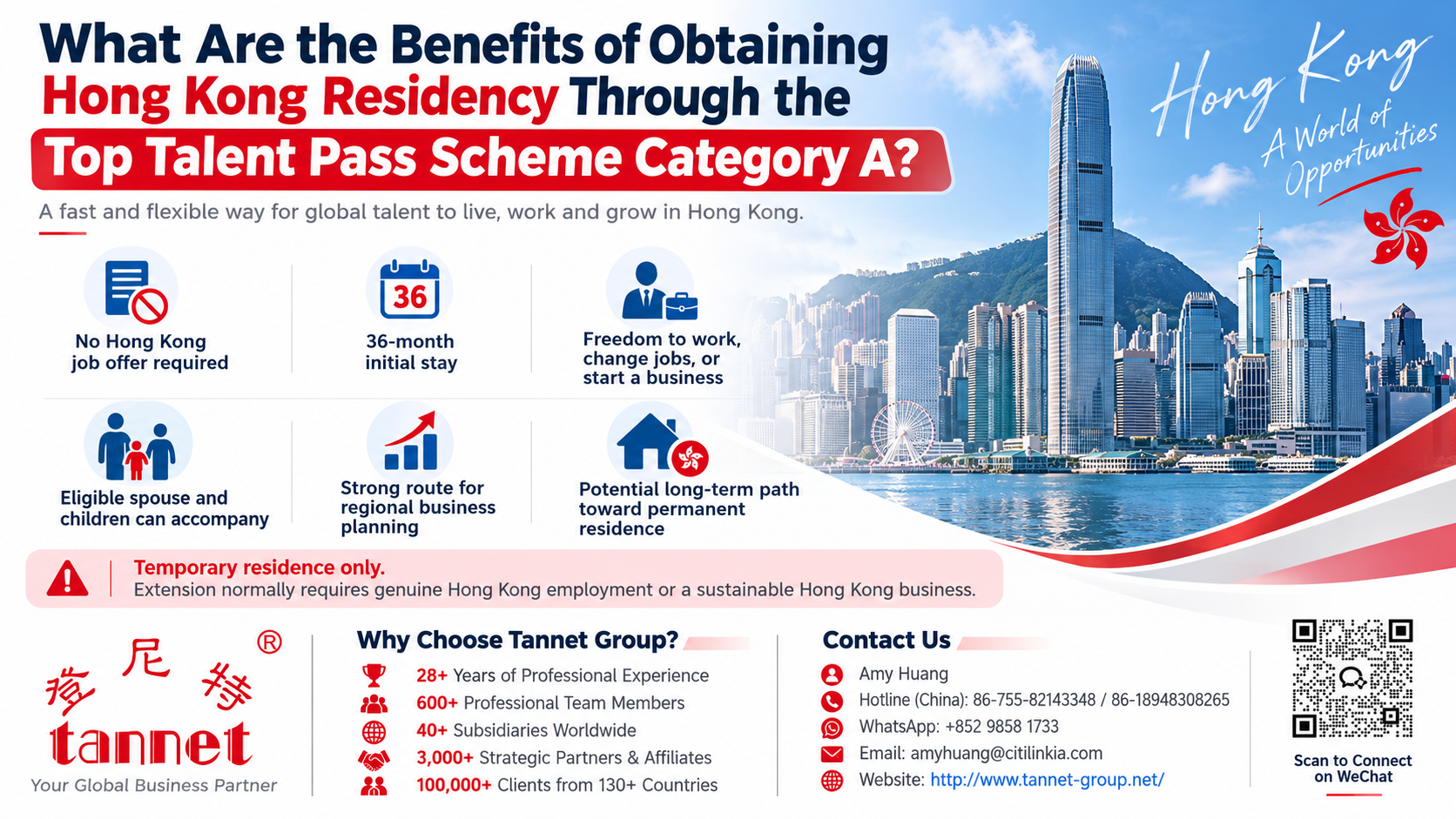
Hong Kong’s Top Talent Pass Scheme Category A is an admission route for people whose taxable employment or business income reached at least HK$2.5 million, or the foreign-currency equivalent, in the year immediately before application.
It suits high-income executives, entrepreneurs and business owners who want flexibility to work, change employers, establish a business or relocate with eligible dependants. Its main advantage is that no Hong Kong job offer is required at the application stage.
The main caution is equally important: approval provides temporary residence, not permanent residency, and extension normally requires genuine Hong Kong employment or a healthy, sustainable Hong Kong business.
What Category A actually provides
Category A is one of three admission categories under the Top Talent Pass Scheme, or TTPS. It is based on qualifying income rather than a university ranking, occupation list or points test.
The Hong Kong Immigration Department states that a Category A applicant must have annual income of at least HK$2.5 million in the year immediately preceding the application. The income may come from taxable employment or a self-owned business.
Qualifying employment income may include salary, allowances and stock options. Qualifying business income may include profits from a company owned by the applicant, subject to evidence and the Immigration Department’s assessment.
Income from personal investments is not counted. Portfolio gains, passive investment returns and asset appreciation should therefore not be assumed to satisfy the threshold.
Successful Category A applicants are normally granted an initial stay of 36 months. Each applicant may receive this initial stay only once.
Benefit 1 No Hong Kong job offer is required before applying
Many employment visas depend on a named local employer. Category A is different. An applicant does not need to secure a Hong Kong employment offer before submitting the application.
This gives professionals time to compare roles and helps entrepreneurs establish operations before committing to one commercial model.
The applicant still needs credible income evidence and must meet normal immigration requirements.
Benefit 2 Freedom to work change jobs or establish a business
TTPS entrants are admitted on time limitation only without other conditions of stay. During the permitted stay, they may take employment, change employment, establish a business or join a business without obtaining prior approval from the Director of Immigration.
This helps executives and founders adapt their Hong Kong activities as plans develop.
The freedom to change activities should not be confused with exemption from other laws. A regulated business may still need sector licences. A company must still meet registration, tax, employment and reporting requirements.
Benefit 3 A three year initial planning window
Category A entrants normally receive 36 months on first admission. Categories B and C normally receive 24 months.
The longer period gives families and business owners more time to arrange relocation and build an extension record.
However, the visa clock matters. Waiting until the final months to develop a Hong Kong employment or business record may weaken an extension case.
Benefit 4 Eligible family members may accompany the applicant
A TTPS applicant may sponsor an eligible spouse or legally recognised partner and unmarried dependent children under 18. The sponsor must prove the relationship and show adequate financial support and suitable accommodation.
Under the current policy, these dependants are not prohibited from working or studying in Hong Kong. A spouse can therefore pursue employment, while children can continue their education, subject to admission requirements.
The Education Bureau confirmed in September 2025 that school-age dependants under talent admission schemes may enrol in public-sector schools for free primary and secondary education. They may also apply to Direct Subsidy Scheme or international schools.
School admission is not automatic. Availability, language, curriculum, fees and individual school criteria must still be considered. A dependant’s permission to remain is also normally linked to the sponsor’s status.
Benefit 5 Access to Hong Kong as a regional business base
Hong Kong provides a common-law legal system, international financial infrastructure and close access to Mainland China and other Asian markets. For executives and founders, physical presence can support regional management, contracting, recruitment and relationship building.
TTPS status does not create tax residence, tax exemptions or bank approval. Financial institutions apply independent due diligence, while tax treatment depends on the applicant’s facts.
Benefit 6 Better sequencing for business owners
For a founder, Category A allows immigration planning and business establishment to move in parallel. The applicant can obtain approval without first proving a completed Hong Kong operation, then use the initial stay to create genuine activity.
This sequencing can support incorporation, premises, banking due diligence, contracts, local hiring and tax registration. None of these steps is automatic, and each provider or authority applies its own rules.
The advantage is time to build substance before renewal. The risk is assuming incorporation alone is substance. Applicants should document commercial decisions, capital flows, customer activity and their own management role from the beginning.
Benefit 7 A possible route toward permanent residence
A person admitted under TTPS who has ordinarily resided in Hong Kong continuously for at least seven years may apply for the right of abode in accordance with Hong Kong law.
This is not automatic. The applicant must maintain lawful status and prove ordinary residence. Travel does not necessarily break residence, but its pattern and purpose matter. Non-Chinese applicants must also meet the applicable declaration and evidence requirements.
What evidence Category A applicants should prepare
Applicants should prepare tax assessments, employer records, audited accounts, ownership evidence and bank records that explain the amount and nature of the income. Non-Chinese or non-English documents generally require certified translations. For business income, Immigration generally expects continuous ownership of the relevant shares throughout the assessment year used for the claim.
Extension planning should start before relocation
At extension, the original HK$2.5 million overseas income test is not enough by itself. The applicant must normally show stable Hong Kong employment or that the applicant has established or joined a business operating in Hong Kong.
For employees, Immigration may consider the role, remuneration, professional level and economic benefit. For entrepreneurs, it may examine turnover, investment, local jobs, business activity and contribution. A paper company may not support extension.
Applications may be submitted within three months before expiry. The Immigration Department advises applicants to apply as early as possible and, in all circumstances, at least six weeks before expiry.
Common mistakes
- Counting personal investment income toward the threshold.
- Using company turnover instead of income attributable to the applicant.
- Treating temporary permission to stay as permanent residency.
- Delaying employment or business activity until shortly before extension.
- Assuming dependants have status independent of the sponsor.
Frequently asked questions
Q1. Do I need a university degree for Category A?
No academic threshold is stated. The applicant must meet the income test and normal immigration requirements.
Q2. Can investment gains be used to meet the HK$2.5 million threshold?
No. Immigration expressly excludes income generated from personal investment.
Q3. Must I work for a Hong Kong employer after approval?
Not immediately. For extension, however, you normally need stable Hong Kong employment or a genuine business.
Q4. Can my spouse work in Hong Kong?
An approved dependant spouse is not prohibited from working or studying under policy.
Q5. Can my children attend public schools?
School-age dependants may access public-sector education, subject to admission rules and availability.
Q6. Does Category A automatically lead to permanent residency after seven years?
No. A separate right-of-abode application and assessment are required.
Q7. Can I renew if my Hong Kong company has little activity?
Renewal may be difficult without healthy, sustainable Hong Kong operations and supporting evidence.
How Tannet can assist
Tannet may assist high-income professionals and entrepreneurs with preliminary eligibility review, income-document organisation, certified-document coordination, dependant applications, Hong Kong company establishment and extension preparation. Immigration, education, banking and tax outcomes remain subject to the relevant authorities and institutions.
Applicants should review policy updates immediately before filing because eligibility and documentary requirements may change without prior notice.
30th Anniversary Offer: To celebrate Tannet’s 30th anniversary, preferential service pricing is now available. Please contact Consultant Amy Huang for details.
Written by: Tannet Business Services Team
Reviewed by: Consultant Amy Huang
First published: 13 Oct. 2026
Last reviewed: 13 Oct. 2026
————————————————Simplifying Business, Empowering Entrepreneurs————————————————