Hong Kong is widely recognized for its straightforward taxation system, making it an attractive destination for international professionals, entrepreneurs, and businesses.
However, one common question remains: If you work for a Hong Kong company, does that mean all your income is taxable in Hong Kong?
Not necessarily.
Hong Kong generally applies a territorial approach to salaries tax. This means that the source of employment income and the nature of the work performed are important when determining tax obligations.
Whether you are a foreign professional, company director, or business owner receiving a salary, understanding Hong Kong salaries tax can help you manage your income and remain compliant.
1. What Is Hong Kong Salaries Tax?
Hong Kong salaries tax is imposed on income arising in or derived from Hong Kong from employment, office, or pension.
Unlike jurisdictions that generally tax residents on their worldwide income, Hong Kong focuses on the source and nature of taxable income.
An individual’s nationality or possession of a Hong Kong identity card does not, by itself, determine whether employment income is subject to salaries tax.
Instead, the Inland Revenue Department (IRD) considers relevant facts, including the employment arrangement, the source of income, and where services are performed.
This distinction is particularly important for individuals working across Hong Kong, Mainland China, and other international markets.
2. Is Your Monthly Salary Taxable?
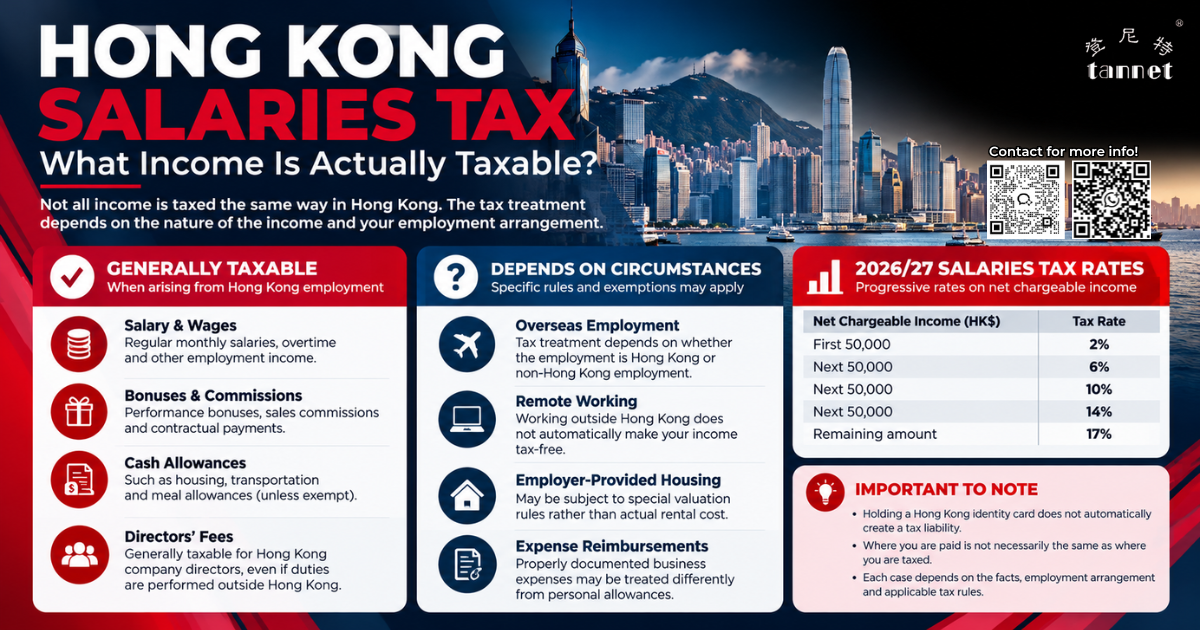
For employees holding Hong Kong employment, salary and wages are generally included in assessable income.
This can include regular monthly salaries, commissions, overtime payments, and other employment-related remuneration.
For example, an employee working for a Hong Kong company who receives a monthly salary of HK$35,000 would generally need to consider that employment income when assessing Hong Kong salaries tax obligations.
However, receiving a salary from a Hong Kong company does not automatically mean that every payment is fully taxable.
The source of employment and the employee’s actual working arrangements may affect the tax treatment.
Employees working across multiple jurisdictions should review their circumstances rather than assume that the location of their employer or bank account determines their tax liability.
3. Are Bonuses and Commissions Taxable?
Many employees receive additional remuneration beyond their basic salary.
These payments may include annual bonuses, performance incentives, sales commissions, and contractual gratuities.
In general, employment-related bonuses and commissions are taxable where they arise from taxable employment.
For example, a Hong Kong employee who receives a year-end performance bonus may need to include that bonus in their assessable income.
The timing of assessment can depend on when the income becomes legally due or is otherwise treated as accrued under the applicable tax rules.
Employers and employees should maintain accurate records of bonus arrangements, payment dates, and supporting payroll documentation.
4. What About Housing and Other Allowances?
Employment packages in Hong Kong may include benefits such as housing, transportation, meal allowances, and relocation support.
However, not all benefits receive identical tax treatment.
Cash allowances are generally taxable as employment income unless a specific exemption applies.
Employer-provided accommodation may be subject to special valuation rules rather than simply being taxed according to the employer’s actual rental expenditure.
For example, an employer providing accommodation directly may create a different salaries tax outcome from an employer paying an unrestricted cash housing allowance.
Certain properly documented reimbursements of business expenses may also be treated differently from personal allowances.
Employees should therefore distinguish between cash remuneration, reimbursed business expenditure, and employer-provided benefits.
5. Are Directors’ Fees Taxable in Hong Kong?
Company directors should pay particular attention to the treatment of directors’ fees.
Income received in the capacity of a director is generally assessed according to the location of the office of directorship.
For a director of a Hong Kong company, directors’ fees are generally regarded as Hong Kong-sourced income, even where the director performs duties outside Hong Kong.
This differs from the treatment of ordinary employment income, where the source of employment and location of services may be relevant.
A business owner who is both a director and an employee should also distinguish between remuneration received for directorship duties and remuneration received under a genuine employment arrangement.
These payments may require different tax considerations.
6. Is Overseas Employment Income Taxable?
International professionals frequently work across several jurisdictions.
A common misconception is that income becomes tax-free simply because an employee performs some duties outside Hong Kong.
In practice, the tax treatment depends on whether the employment is regarded as Hong Kong or non-Hong Kong employment, together with the applicable rules and exemptions.
For Hong Kong employment, income may remain assessable even when some services are performed outside Hong Kong, subject to relevant statutory exemptions and relief.
For non-Hong Kong employment, the portion of income attributable to services rendered in Hong Kong may generally be assessable, subject to applicable rules.
The IRD considers the facts of the employment arrangement rather than relying exclusively on the employer’s registered address or the employee’s nationality.
Cross-border employees should maintain reliable travel and work records to support their tax positions.
7. Does Working Remotely Change Your Tax Obligations?
Remote working has become increasingly common among professionals employed by international companies.
Some employees live outside Hong Kong while working for Hong Kong businesses. Others reside in Hong Kong while performing services for overseas employers.
These arrangements may create different tax outcomes.
For example, an employee working remotely from Malaysia for a Hong Kong company should not assume that their income is automatically exempt from Hong Kong salaries tax.
Likewise, an individual working physically in Hong Kong for an overseas employer may have Hong Kong tax obligations.
The source of employment, location of services, and relevant exemptions must be considered.
Cross-border arrangements may also create tax obligations in another jurisdiction.
Employees should assess the rules of each relevant jurisdiction and any applicable double taxation arrangements.
8. Does Having a Hong Kong Identity Card Mean You Must Pay Tax?
Holding a Hong Kong identity card does not automatically create a salaries tax liability.
Immigration status and tax obligations are separate matters.
A person may hold a Hong Kong residency-related visa without receiving taxable employment income.
Similarly, an individual without permanent residency may still be liable for Hong Kong salaries tax if they receive income that falls within the scope of the tax.
For individuals holding a Top Talent Pass Scheme visa or other employment-related permission, tax obligations should be assessed according to their actual income and employment circumstances.
It is also important to distinguish Hong Kong immigration status from tax residency for the purposes of double taxation agreements.
These concepts should not be treated as interchangeable.
9. How Is Hong Kong Salaries Tax Calculated?
Hong Kong salaries tax is generally calculated using progressive rates on net chargeable income, subject to a comparison with the applicable standard-rate calculation on net income.
For the 2026/27 year of assessment, the progressive salaries tax rates are:
- First HK$50,000: 2%
- Next HK$50,000: 6%
- Next HK$50,000: 10%
- Next HK$50,000: 14%
- Remaining net chargeable income: 17%
The standard-rate calculation generally applies 15% to the first HK$5 million of net income and 16% to the remainder.
The final tax liability depends on the relevant deductions, allowances, and applicable tax calculation rules.
Taxpayers should not simply multiply their gross annual salary by the highest progressive tax rate.
10. What Documents Should Employees Prepare?
Maintaining accurate documentation is important for both tax reporting and future financial planning.
Employees may need to retain employment contracts, payroll statements, bonus records, tax returns, and employer-issued remuneration information.
Individuals with cross-border employment arrangements should also maintain travel records and documentation showing where their services were performed.
Company directors should retain records distinguishing directors’ fees from other remuneration.
Business owners should ensure that their payroll records and corporate accounting information accurately reflect the remuneration paid.
Proper documentation can reduce inconsistencies and help support the information declared to the IRD.
11. How TANNET Can Assist
Hong Kong salaries tax can become more complicated when individuals receive income from multiple sources, work across borders, or operate their own companies.
Understanding the differences between employment income, directors’ fees, allowances, and overseas work arrangements is essential for effective tax compliance.
TANNET Group provides Hong Kong corporate services, including company formation, company secretarial support, accounting, and tax compliance assistance.
Our team can support businesses and individuals in coordinating corporate documentation and relevant tax compliance requirements.
Working in Hong Kong or receiving income from a Hong Kong company?
Contact TANNET Group to discuss your Hong Kong accounting, taxation, and cross-border business requirements.
📞 Free 1-on-1 Consultation Now,
Official Service Hotline: +86-755-82148419
Cell: +86-13823131503;+60 19-309 2363
WeChat ID: 13823131503;
WhatsApp:+86-13823131503;+60 19-309 2363
Email: mytannet08@gmail.com; susiehu@citilinkia.com