Key Takeaway
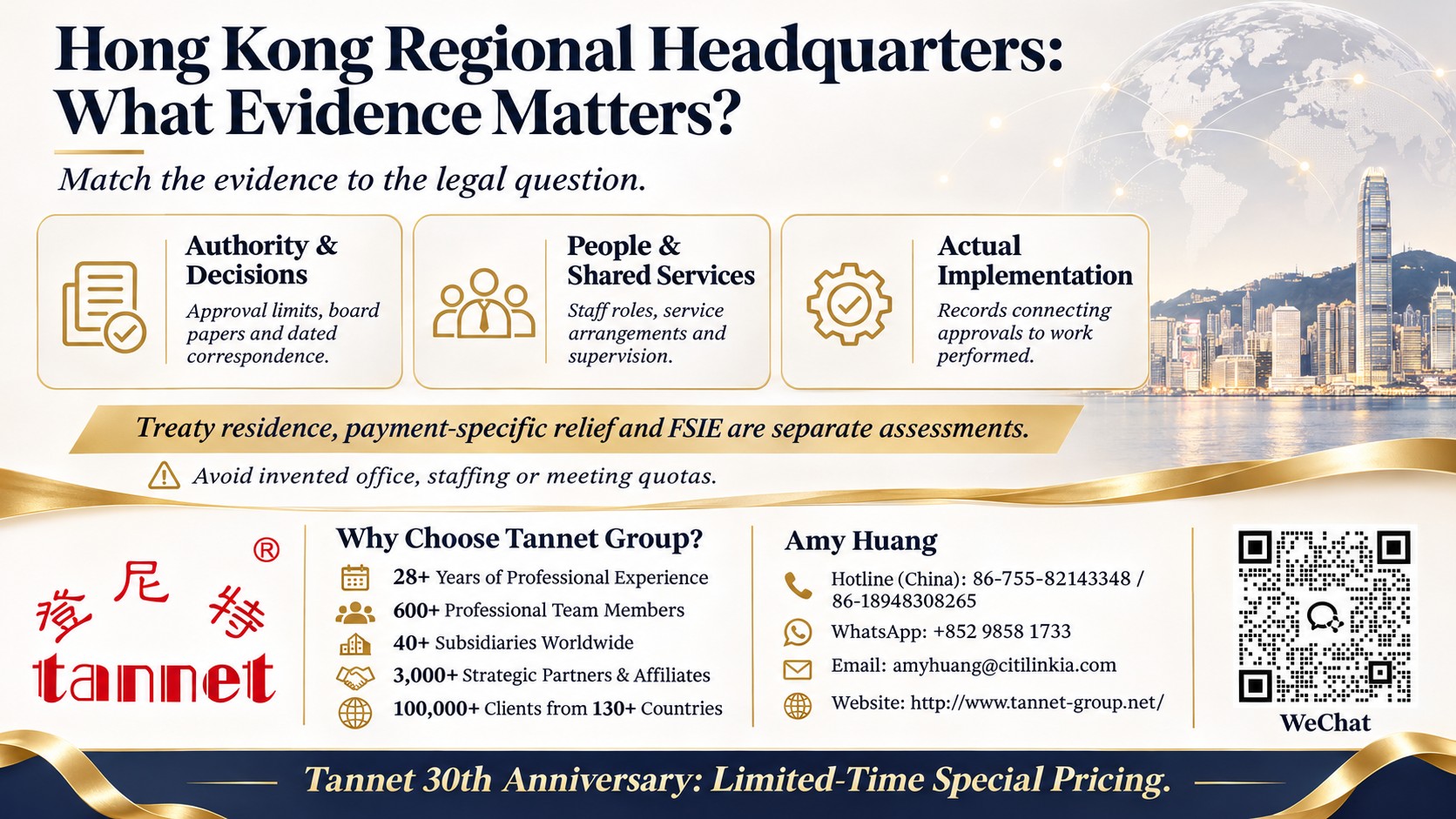
For a Hong Kong regional headquarters, the evidence that matters depends on the question being answered. Treaty residence, entitlement to a particular treaty benefit and economic substance under the foreign-sourced income exemption regime are separate assessments. The headquarters label does not resolve them.
This guide suits regional finance teams, directors and groups coordinating several markets. Start with the applicant’s incorporation status and the relevant treaty definition. Then organize records of authority, personnel, decisions and actual work where those facts are relevant.
Do not impose invented minimum staffing or meeting requirements. A Certificate of Resident Status supports treaty residence; it does not certify every tax position.
First identify the legal question
A regional headquarters may coordinate sales, treasury, procurement or investments. These functions can sit in one company or several entities. Identify the legal entity claiming residence and the income for which relief is requested. Group branding cannot replace that identification.
Separate three files conceptually. The residence file explains qualification under the relevant agreement. The treaty claim file addresses the particular payment and conditions for relief. An FSIE file, where relevant, addresses the Hong Kong treatment of specified foreign-sourced income received by an in-scope entity.
This separation prevents unnecessary work and misleading conclusions. A lease may help explain operations, but it cannot answer every tax question. Conversely, limited local activity should not automatically be described as disqualifying a Hong Kong-incorporated applicant without reading the applicable residence definition.
Before reviewing individual documents, agree which question the evidence is intended to answer. This prevents a personnel record collected for one purpose from being treated as a legal conclusion for another. Ask the adviser to identify the applicable condition and explain why each requested document is relevant. This also helps teams limit unnecessary disclosure when responding to overseas payers or authorities.
Step one establish the residence basis
The IRD’s approach, announced in June 2023, bases certification on the relevant treaty’s resident definition. Hong Kong-incorporated applicants are generally not required to provide full establishment and business activity details under that approach. Use current forms rather than the archived versions accompanying the announcement.
An overseas-incorporated headquarters may instead need to demonstrate management or control in Hong Kong under the applicable wording. Review its own facts. Do not apply a foreign-company management test indiscriminately to a locally incorporated entity or assume identical definitions across treaties.
Record the treaty partner and period alongside the legal analysis. Read applicable protocols and modifications, including corporate dual-residence provisions where necessary. Treat an assertion that another jurisdiction also regards the headquarters as resident as a question requiring review, not an inconvenient detail to omit.
Step two map authority before gathering documents
Prepare a written description of who may approve regional budgets, borrowings, acquisitions and significant contracts. Identify reserved matters and approval limits. Distinguish the Hong Kong company’s decisions from shareholder decisions and services performed for subsidiaries. A senior job title does not reveal whose authority is being exercised.
Use actual examples to test that description. Trace a financing proposal from analysis to approval and implementation. Identify who could reject alternatives, change terms or accept risk. Explain any overseas approvals honestly rather than describing all group decisions as Hong Kong decisions.
Keep delegations and changes in authority dated. If a regional finance director joined midway through the year, their later responsibilities do not prove earlier conduct. Link each material change to the period covered by the proposed application or supporting explanation.
Step three preserve decision records
Useful records may include board papers, approved budgets, treasury instructions and correspondence recording substantive choices. Retain drafts where they explain how alternatives were considered. The objective is a traceable account of real conduct, not a large collection of documents containing a Hong Kong address.
For meetings, record the entity concerned, participants, locations and decisions. Virtual attendance makes those details particularly useful. Do not treat a meeting platform, calendar invitation or signature location as conclusive. Identify whether the meeting decided the matter or merely acknowledged instructions already settled elsewhere.
Support minutes with implementation evidence. An approved budget should connect to operating instructions and financial reporting. If later action departed from the approval, retain the explanation. Differences may have legitimate commercial reasons, but unexplained contradictions make an assessment harder.
Step four explain people and premises
Employment agreements, job descriptions and reporting lines can explain the team’s capacity and responsibilities. Payroll and attendance records may corroborate the account. Headcount alone is weak evidence when the people counted work for another entity or perform unrelated functions.
Secondments and shared employees need particular care. Identify the employer, host entity, work performed and reporting arrangements. Record how time or costs are allocated where appropriate. These are practical documentation recommendations, not universal additional conditions for receiving a residence certificate.
Premises records should explain actual use. Retain relevant leases, access arrangements or service agreements. An expensive office is not automatically stronger evidence than a modest facility appropriate to the business. Avoid presenting photographs or rental expenditure as a prescribed tax-residence threshold.
Step five document shared services accurately
Regional headquarters often rely on group accounting, legal or treasury teams. Keep service agreements and evidence of deliverables. State which entity provides each service, who supervises it and which decisions remain with the recipient. Group resources should not be attributed to every company without explanation.
If FSIE outsourcing rules are relevant, assess them separately. IRD guidance addresses documentation of outsourced activities and adequate monitoring. A headquarters service agreement may assist that review, but the existence of an agreement does not prove that the specified activities occurred or were adequately monitored.
Related-party service charges also require their own pricing assessment. Check whether master file or local file obligations apply, including exemptions. A residence certificate does not establish an arm’s length charge. Keep the functional description consistent across the residence narrative and relevant transfer pricing records.
Step six build a proportionate evidence index
Create a short index linking each assertion to dated records. Include the entity, relevant period, document owner and storage location. Identify gaps explicitly. This recommended process helps an adviser select appropriate material rather than sending confidential personnel files without a clear purpose.
Preserve originals and the version submitted. Restrict access to identity details, signatures and commercially sensitive papers. If an assessor asks for additional information, record the question and approved response. Correct genuine mistakes openly instead of quietly replacing the earlier account.
Common mistakes
Avoid assuming that a regional headquarters designation guarantees residence or treaty relief.
Do not impose a fixed office size, employee count or board meeting quota without a legal basis.
Other mistakes include using a subsidiary’s records for its parent and describing a certificate as FSIE approval.
Do not reconstruct decisions that never occurred. Improvements to governance should operate prospectively and reflect genuine commercial responsibilities.
Creating template minutes after a payment does not change who controlled the relevant decision.
Explain missing evidence and obtain advice on its significance.
Frequently asked questions
Q1 Must a Hong Kong-incorporated headquarters prove local management to obtain a certificate?
Start with the treaty definition. Do not automatically impose the management test applicable to an overseas-incorporated company. Additional questions may arise from the facts or the specific treaty claim.
Q2 Is there a minimum number of employees?
There is no universal headquarters headcount that establishes treaty residence. FSIE adequacy, where relevant, is a separate assessment of activities and resources, not a fixed certificate application quota.
Q3 Are board minutes sufficient evidence?
They may be useful, but should accurately describe real decisions. Supporting correspondence, authority records and implementation documents can explain whether the minutes reflect actual conduct.
Q4 Can group employees support several entities?
Potentially, but explain their roles and the service arrangement. Do not assume resources belong to each entity. Review any applicable outsourcing and pricing requirements separately.
Q5 Does the certificate establish sufficient FSIE substance?
No. The IRD expressly distinguishes treaty residence certification from compliance with the FSIE economic substance requirement. Assess the relevant income and conditions independently.
Q6 What happens when a regional director relocates?
Record the date and changes in duties or authority. Reassess relevant treaty, foreign residence and substance questions. A change of address alone does not answer all three.
Where Tannet can assist
Tannet can help organize headquarters records, map entity responsibilities and coordinate certificate preparation with tax advisers. Specialist review is appropriate for dual residence, shared service arrangements or uncertain treaty conditions. Agree the scope before relying on an expected tax outcome.
Written by: Tannet Business Services Team
Reviewed by: Consultant Amy Huang
First published: 6 Nov. 2026
Last reviewed: 6 Nov. 2026
30th Anniversary Offer: Tannet has been established for 28 years, we are offering exclusive limited-time promotional pricing to celebrate Tannet’s 30th anniversary. Slots are limited and available on a first-come, first-served basis. Contact Consultant Amy Huang for details.
————————————————Simplifying Business, Empowering Entrepreneurs————————————————