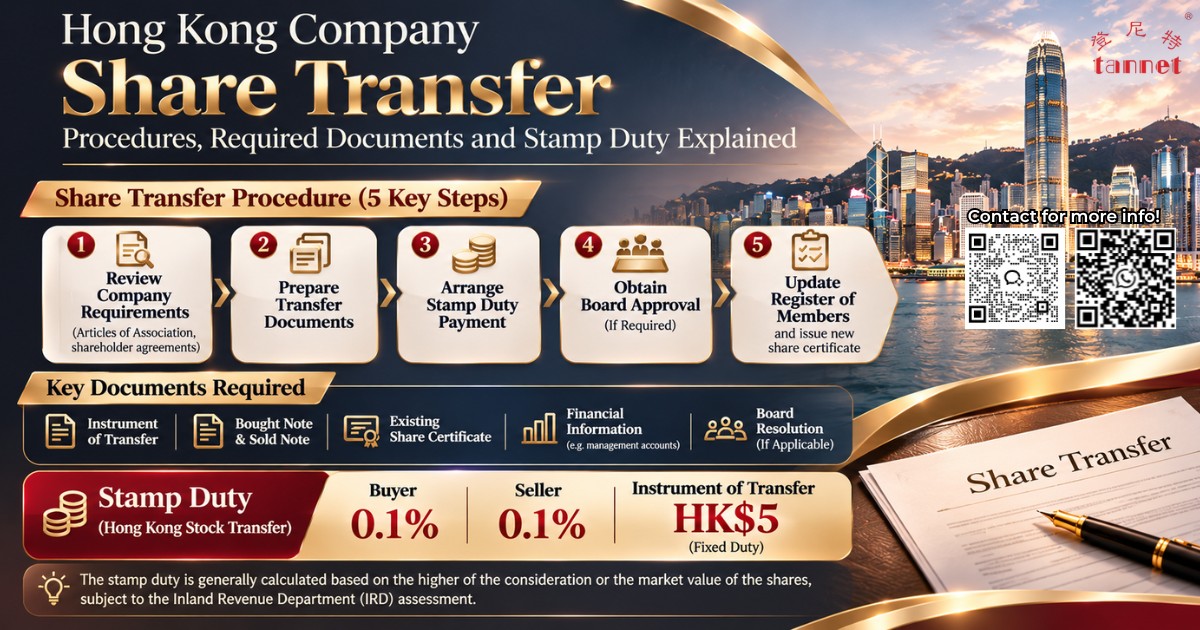
Transferring shares in a Hong Kong company is a common corporate transaction when shareholders change, investors enter or exit a business, or business owners restructure their company ownership. However, a share transfer involves more than simply signing an agreement between the buyer and seller. It requires proper documentation, stamp duty payment and updates to the company’s statutory records.
Understanding the process is essential for foreign investors, existing shareholders and business owners who want to complete a transaction properly and avoid unnecessary compliance issues.
This guide explains the Hong Kong company share transfer procedure, required documents, stamp duty considerations and key points to check before proceeding.
1. What Is a Share Transfer in a Hong Kong Company?
A share transfer refers to the transfer of existing shares from one shareholder (the transferor) to another person or entity (the transferee).
It may take place under several circumstances:
- An existing shareholder sells their shares to another investor.
- A new business partner joins the company by acquiring existing shares.
- A shareholder exits the business.
- Family members transfer shares as part of succession planning.
- Business owners restructure their company ownership.
- A parent company or holding company acquires shares in another entity.
Unlike a share allotment, which creates new shares, a share transfer changes the ownership of existing shares. The company’s total issued share capital generally remains unchanged.
For a Hong Kong private company, the transfer must comply with the Companies Ordinance (Cap. 622), the Stamp Duty Ordinance (Cap. 117) and the company’s Articles of Association.
2. Hong Kong Company Share Transfer Procedure
The procedure generally involves the following steps.
Step 1: Review the Company’s Articles of Association
Before initiating a transfer, review the company’s Articles of Association and any existing shareholders’ agreement.
Certain companies impose restrictions such as:
- Rights of first refusal for existing shareholders.
- Requirements for directors’ approval.
- Restrictions on transferring shares to third parties.
- Specific procedures for shareholder exits.
These provisions should be checked before signing the transaction documents.
Step 2: Agree on the Transfer Terms
The transferor and transferee should agree on the number and class of shares, consideration, payment arrangements and effective transaction terms.
For larger transactions, a share sale and purchase agreement may also be appropriate to document warranties, liabilities, conditions and completion arrangements.
Step 3: Prepare the Share Transfer Documents
The parties must prepare the relevant documents, including:
- Instrument of Transfer.
- Bought Note.
- Sold Note.
- Existing share certificate.
- Relevant supporting company and shareholder information.
The Instrument of Transfer records the transfer of ownership, while the Bought Note and Sold Note provide the transaction details for stamp duty assessment.
Step 4: Submit Documents for Stamp Duty Assessment
The relevant documents must be submitted to the Inland Revenue Department (IRD) for stamping.
The IRD assesses the applicable stamp duty based on the transaction details and the value of the shares.
Once the stamping requirements have been fulfilled, the stamped documents can be submitted to the company for registration of the transfer.
Step 5: Obtain Directors’ Approval Where Required
The directors should review the transfer in accordance with the company’s Articles of Association.
Where approval is required, the company should prepare the relevant board resolution or written approval to document the decision.
Step 6: Update the Register of Members
After the transfer has been accepted and the stamping requirements fulfilled, the company updates its Register of Members.
The outgoing shareholder’s holding is adjusted and the incoming shareholder’s details are recorded.
The company should also cancel the previous share certificate and arrange for a new share certificate to be issued.
Step 7: Review Other Statutory and Compliance Records
A share transfer does not automatically mean that every company record is updated.
If the transaction also involves changes to directors, company secretary or significant controllers, the relevant records and statutory filings should be reviewed separately.
A straightforward transfer of existing shares does not, by itself, require a separate share-transfer filing with the Companies Registry.
3. What Documents Are Required for a Hong Kong Share Transfer?
It depend on the transaction structure, the parties involved and the company’s existing records.
Commonly required documents include:
1. Instrument of Transfer
The principal document recording the transfer of shares from the existing shareholder to the incoming shareholder.
2. Bought Note and Sold Note
These documents record the purchase and sale details, including the parties, number of shares and consideration.
3. Existing Share Certificate
The company’s existing share certificate may be required for cancellation and replacement.
4. Latest Management Accounts or Financial Statements
These may be needed to establish the company’s financial position and support the valuation of unlisted shares for stamp duty assessment.
5. Shareholder Identification Documents
Identification documents and relevant corporate particulars may be requested for individual or corporate shareholders.
6. Board Resolution
Where applicable, a board resolution should document the approval or registration of the transfer.
7. Share Sale and Purchase Agreement
For commercial transactions, a separate agreement may be required to establish the rights and obligations of the buyer and seller.
Having the documents prepared correctly can reduce processing delays and prevent inconsistencies in the company’s statutory records.
4. Hong Kong Company Share Transfer Stamp Duty
Stamp duty is an important consideration when planning a transfer.
For a sale or purchase of Hong Kong stock, the general ad valorem stamp duty rate is:
- Buyer: 0.1% of the consideration or value, whichever is higher.
- Seller: 0.1% of the consideration or value, whichever is higher.
- Instrument of Transfer: Fixed duty of HK$5.
The applicable assessment is subject to the Stamp Duty Ordinance and IRD requirements.
For example, if the chargeable value of the shares is HK$1,000,000:
- Buyer’s stamp duty: HK$1,000.
- Seller’s stamp duty: HK$1,000.
- Instrument of Transfer: HK$5.
The total is HK$2,005, excluding professional and administrative fees.
Importantly, stamp duty is not necessarily calculated using the agreed selling price alone. If the actual consideration is lower than the market value, the IRD may assess the duty using the higher value.
For unlisted companies, the IRD may request the latest financial statements, management accounts and other supporting information to determine the value of the shares.
A gift or transfer without consideration may also attract stamp duty based on the value of the shares. Therefore, shareholders should not assume that a transfer without payment is automatically exempt.
5. Important Considerations for Foreign Investors
Foreign investors acquiring shares in a Hong Kong company should consider several matters before completing the transaction.
Review existing liabilities: A share acquisition means acquiring an ownership interest in the company, which may carry exposure to its existing business obligations and liabilities.
Check ownership restrictions: Review the Articles of Association and any contractual arrangements affecting the transfer.
Assess the company’s financial position: Review outstanding taxes, financial statements, contracts, litigation and compliance obligations.
Consider beneficial ownership: Changes in ownership may affect the company’s Significant Controllers Register and related compliance records.
Review the wider corporate structure: If the transfer involves an overseas parent company, holding company or corporate shareholder, additional corporate approvals and supporting documents may be necessary.
Proper planning is particularly important when the transfer forms part of a wider cross-border investment or restructuring arrangement.
6. How TANNET Can Assist with Hong Kong Company Share Transfers
A properly executed share transfer helps ensure that changes in company ownership are reflected accurately in the company’s statutory records.
TANNET provides corporate secretarial and business support services to shareholders, foreign investors and business owners undertaking Hong Kong company changes.
Our support may include:
- Reviewing the proposed share transfer arrangements.
- Preparing the necessary share transfer documentation.
- Coordinating stamp duty submission and related procedures.
- Arranging corporate approvals and statutory record updates.
- Updating shareholder information and relevant company registers.
- Assisting with related director, secretary and corporate structure changes.
Whether you are bringing in a new investor, transferring shares between existing shareholders or restructuring your Hong Kong holding company, TANNET can assist in coordinating the necessary corporate procedures.
Planning a Hong Kong company share transfer? Contact TANNET to discuss your proposed ownership changes and corporate secretarial requirements.
Frequently Asked Questions (FAQs)
1. Can foreigners transfer shares in a Hong Kong company?
Yes. Foreign individuals and overseas corporate entities can generally acquire or transfer shares in a Hong Kong company, subject to applicable legal requirements and the company’s Articles of Association.
2. Is a Companies Registry filing required for a share transfer?
A straightforward transfer of existing shares does not normally require a separate immediate filing with the Companies Registry. However, the Register of Members must be updated, and the change will be reflected in the company’s next Annual Return. Other changes arising from the transaction may require separate filings.
3. Is stamp duty payable when transferring shares to a family member?
A gift or transfer without consideration may still attract stamp duty based on the value of the shares. The applicable assessment should be confirmed with the IRD.
4. Can I transfer shares for HK$1?
A nominal transfer price does not automatically mean that stamp duty will be calculated using HK$1. The IRD may assess the shares based on their market value if it is higher than the consideration.
5. Does changing shareholders require changing the company director?
No. Shareholders and directors have different legal roles. A share transfer does not automatically require a director change unless the parties separately decide to make that change.
6. What happens after the share transfer is completed?
The company should ensure that its Register of Members, share certificates and relevant statutory records are updated. Any resulting changes to significant controllers, directors or other corporate particulars should also be addressed.
📞 Free 1-on-1 Consultation Now,
Official Service Hotline: +86-755-82148419
Cell: +86-13823131503;+60 19-309 2363
WeChat ID: 13823131503;
WhatsApp:+86-13823131503;+60 19-309 2363
Email: mytannet08@gmail.com; susiehu@citilinkia.com