Key Takeaway
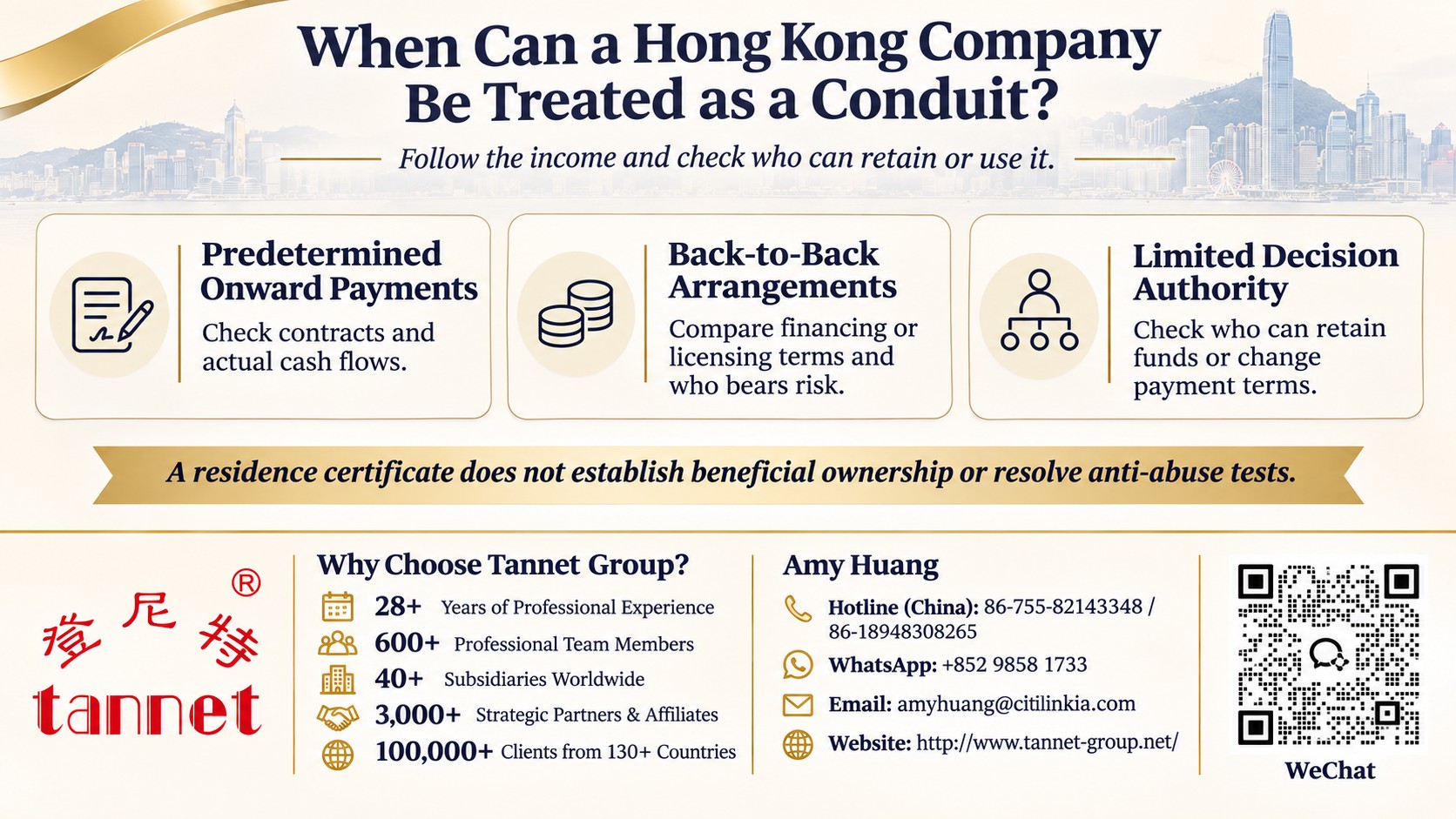
A Hong Kong company may be treated as a conduit for a treaty claim when it receives income for another party and lacks meaningful freedom to use or retain it. The risk is highest when contracts or actual payment practices show that dividends, interest or royalties must move onward.
This matters to holding companies, group lenders and licensing businesses claiming reduced withholding tax. Review the specific payment, the applicable treaty and the source jurisdiction’s rules.
A Hong Kong Certificate of Resident Status supports residence. It does not establish beneficial ownership or prevent denial under a separate anti-abuse rule.
What makes a company a conduit?
Conduit describes the company’s role in an arrangement. It is not a Hong Kong incorporation category. A company may control one stream of income while acting as an intermediary for another. Analyse each material payment rather than assigning the entire company a permanent label.
Start with the right to use the income. An agent may collect funds into its own bank account while owing them to the principal. A licensing entity may invoice in its own name but have little control over the proceeds. Legal title and access to a bank account do not settle the question.
Hong Kong’s Inland Revenue Department explains in Form IR1313B that an obligation to pass income onward can prevent the recipient from being its beneficial owner. The IRD distinguishes a fiduciary intermediary from the person entitled to the income. This inquiry is different from identifying the ultimate individual owner for corporate transparency or bank checks.
Which facts increase the risk?
The onward payment is predetermined
Look for assignment clauses, cash sweeps, side letters and instructions requiring the company to forward a particular receipt. Trace payments across several cycles. An obligation may be visible in practice even when the main contract does not describe it.
A later shareholder distribution is not automatically equivalent to forwarding an incoming dividend. Examine whether the board could retain the cash, change the amount or defer distribution. Then check whether directors actually exercised that discretion when cash needs changed.
The financing or licensing contracts mirror each other
A Hong Kong company borrows from its parent and lends to an overseas subsidiary. Similar amounts, maturities and payment dates deserve scrutiny. A narrow spread does not establish that the Hong Kong entity controls the interest or bears meaningful risks.
For royalties, compare both licence agreements. Ask who negotiates terms, administers rights and bears losses if a sublicensee defaults. An entity that merely invoices and remits receipts has a different role from one that runs a licensing business.
Records do not support the company’s stated role
An office lease shows access to premises. It does not show who made the investment decision. Minutes establish more when supported by decision papers, approval records and subsequent actions. Compare the responsibilities on paper with the staff and resources actually available.
Limited headcount is not conclusive. An investment holding company may have a narrower role than an operating business. The relevant issue is whether the company performs and controls the functions it claims, and can bear the risks assigned to it.
Apply the rules for the payment’s source
In the Chinese Mainland, State Taxation Administration Announcement 2018 No. 9 applies to beneficial ownership under the dividend, interest and royalty provisions of the Hong Kong arrangement. An obligation to pass at least 50% of the income to a third jurisdiction resident within 12 months is an adverse factor.
The announcement also considers actual onward payments without a written obligation, substantive activities, low effective taxation and linked financing or rights arrangements. Assess the facts together. Staying below a percentage or paying later does not create a universal safe harbour.
Certain dividend claims may qualify under specific ownership chain rules or safe harbours. These have conditions. Do not extend them to interest or royalties by analogy. Document the chain, residency and timing before relying on a provision.
For another treaty partner, check the operative agreement, protocols and any effective multilateral modifications. The Chinese Mainland’s domestic guidance is not a test for every jurisdiction. Confirm local procedures and deadlines before instructing a payer to apply reduced withholding.
Keep the principal purpose test separate
The principal purpose test asks why the arrangement or transaction producing the benefit was put in place. Where it applies, relief can be denied if obtaining that benefit was one of its principal purposes, unless granting it is consistent with the purpose of the relevant treaty provisions.
The Fifth Protocol introduced this test into the Hong Kong arrangement with the Chinese Mainland. Even a company that satisfies beneficial ownership conditions can face a separate purpose review. Keep records of the commercial choices, alternatives and constraints that existed when the structure was selected.
Five steps before claiming relief
Step 1. Identify the actual claim
Record the payer, recipient, income type, payment date and relief sought. Find the exact treaty provision and the effective version. Check whether domestic law already provides relief and whether the payer needs documentation before payment.
Step 2. Reconcile the cash flows
Match bank entries to contracts, ledger postings and resolutions. Record the destination, purpose and timing of onward transfers. Distinguish a distribution, repayment or service fee from an obligation linked to receiving the original income.
Step 3. Test who can make decisions
Identify who can retain funds, refinance, renegotiate or absorb a loss. Compare formal approval limits with actual decisions. Preserve an example of a real decision rather than creating new minutes for an old transaction.
Step 4. Review each condition separately
Maintain separate conclusions for treaty residence, beneficial ownership and applicable anti-abuse tests. A Hong Kong Certificate of Resident Status is evidence for the first question. The source jurisdiction determines whether the claim meets its conditions for relief.
Step 5. Decide how to proceed
If the claim is uncertain, obtain advice before applying a reduced rate. Check whether withholding at the domestic rate followed by a refund claim is available. A refund route does not eliminate the need to meet treaty conditions or local time limits.
Record the expected cash impact under both rates. Confirm who bears the tax cost under the contract and who can file a refund claim. Flag any unresolved obligation before the payer closes its next reporting cycle.
Common mistakes
Treating every intercompany payment as evidence of a conduit overstates the rule. Ignoring repeated onward transfers because there is no contract understates the risk. Examine whether the company could genuinely choose a different outcome.
Do not confuse a certificate, bank account or local director with authority over the income. Do not treat a commercial rationale written after an enquiry as equivalent to dated investment papers.
Avoid using one year’s assessment after a refinancing, ownership change or new cash sweep. Recheck the position when the facts change. Preserve prior versions of contracts and approvals so the company can explain earlier claims.
Frequently asked questions
Q1 Is a Hong Kong holding company automatically a conduit?
No. Holding shares is not disqualifying by itself. Examine its control over the specific income and the applicable treaty conditions.
Q2 Does paying an annual dividend to the parent cause denial?
Not on its own. Compare independent distribution decisions with a commitment or practice that effectively requires forwarding the same income.
Q3 Can the company pass residence checks but lose treaty relief?
Yes. Residence is only one requirement. Beneficial ownership, anti-abuse provisions and filing requirements can still affect the outcome.
Q4 Does keeping a small margin prove beneficial ownership?
No. Check actual control, financial capacity, recourse and who bears a loss. An accounting spread is not a substitute for that evidence.
Q5 What if there is no written onward payment clause?
Review treasury instructions and actual transfers. In the Chinese Mainland, the relevant announcement expressly includes payment in practice when describing this adverse factor.
Q6 Can the ultimate parent simply claim the reduced rate instead?
Not automatically. Check the relevant agreement, domestic rules and whether a specific ownership chain provision or separate claim is available.
Q7 What records should finance collect first?
Start with the signed agreements, payment history and authority records. Add dated decision papers that explain the role and the commercial rationale.
Where Tannet can assist
Tannet can help organise company records, trace supporting documents and coordinate a treaty review. Consult a qualified adviser in the source jurisdiction if relief is disputed or an onward payment obligation appears likely.
Official sources
State Taxation Administration — Announcement 2018 No. 9 on treaty beneficial ownership
Written by: Tannet Business Services Team
Reviewed by: Consultant Amy Huang
First published: 9 Nov. 2026
Last reviewed: 9 Nov. 2026
30th Anniversary Offer: Tannet has been established for 28 years, we are offering exclusive limited-time promotional pricing to celebrate Tannet’s 30th anniversary. Slots are limited and available on a first-come, first-served basis. Contact Consultant Amy Huang for details.
————————————————Simplifying Business, Empowering Entrepreneurs————————————————