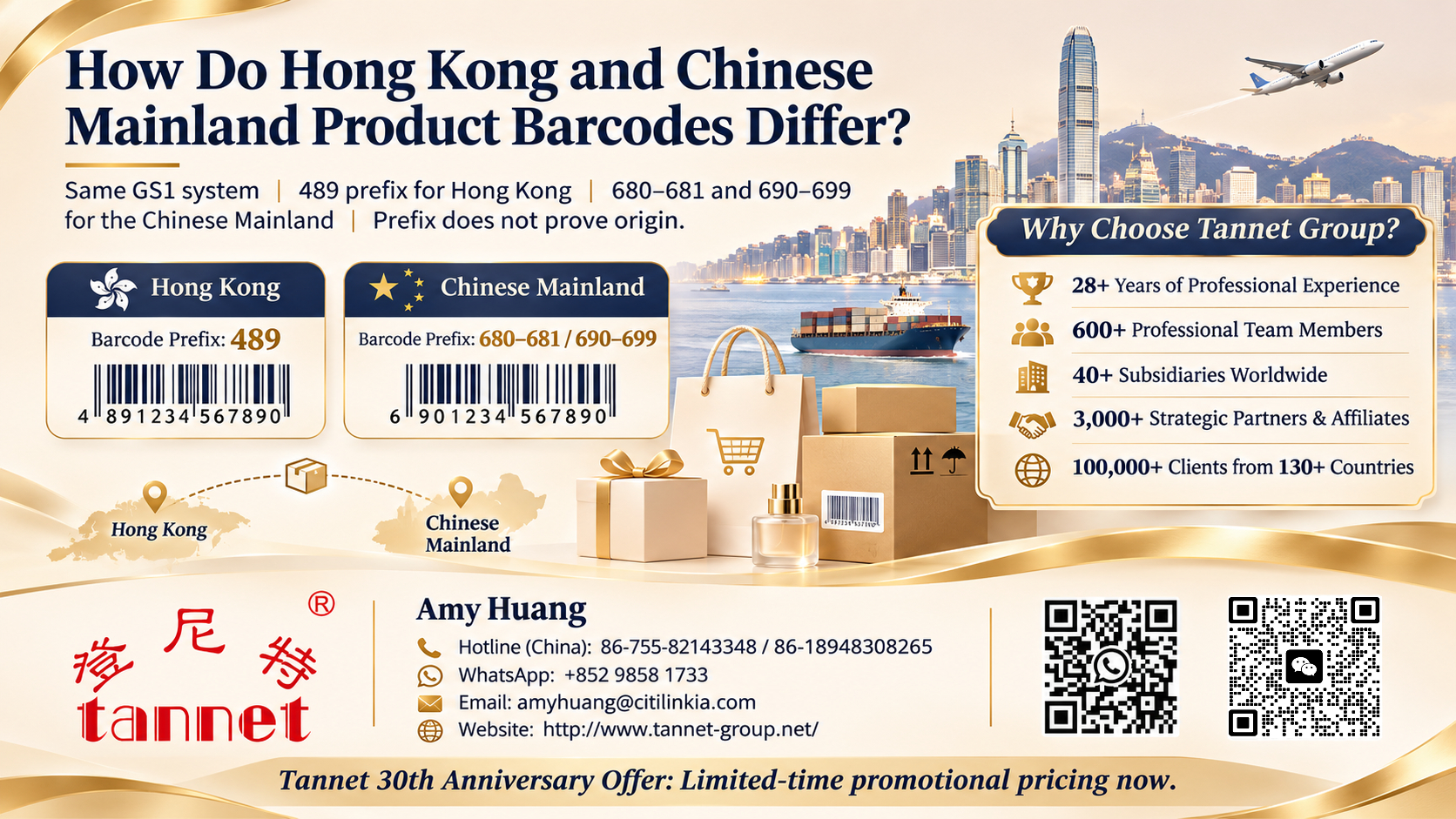
Key Takeaway
Hong Kong and the Chinese Mainland use the same GS1 system to identify retail products. The prefix 489 is assigned to GS1 Hong Kong. Prefixes assigned to GS1 China include 680–681 and 690–699. Those digits tell a buyer where the number was issued. They do not establish where the goods were made.
For a brand owner or distributor, the bigger question is whether the same trade item is crossing a border or a new product is being created. A Hong Kong brand commissioning production in the Chinese Mainland must also consider local rules on barcode use and filing.
What the first digits actually tell a buyer
Picture two jars of chilli sauce on a Hong Kong supermarket shelf. One number starts with 489 and the other with 697. The jars could have been filled at the same factory. Each brand can hold numbering rights through a different GS1 member organisation while using the same contract manufacturer.
A Global Trade Item Number, or GTIN, identifies the particular item a trading partner orders, invoices or sells. On many retail packs, the identifier appears in an EAN-13 barcode. The format can look identical on both jars because both use the same international standard.
The three-digit prefix is only part of the identifier. It cannot tell a buyer which company holds the full number, which size of jar it identifies or whether the label belongs on this product. For those questions, the full GTIN and its associated product record matter.
Which company is responsible for the number?
The brand owner usually allocates the GTIN because it stands behind the product specifications. That can be a Hong Kong retailer commissioning a private label, a factory selling its own brand or an importer launching a product under its own name. The billing address alone cannot establish that responsibility.
Suppose a Hong Kong distributor buys finished bottles from a Chinese Mainland brand. The bottles arrive sealed, in the original retail packaging. If the distributor resells them unchanged, it normally keeps the brand owner’s existing GTIN. Its new wholesale account in Hong Kong can be linked to that same product.
Now suppose the distributor commissions a different bottle under its own brand. The buyer is ordering a new trade item. An old number from the factory’s catalogue describes the factory’s product. Before artwork is approved, establish which company commissions the new item and takes responsibility for its declarations.
Why the manufacturing arrangement matters
The State Administration for Market Regulation amended the Chinese Mainland Measures for Administration of Commodity Barcodes with effect from 1 May 2026. Two provisions matter particularly to Hong Kong companies. One deals with commissioned production. The other addresses domestically produced goods carrying a barcode registered outside the Chinese Mainland.
Article 19 requires goods made under a manufacturing commission to use the commissioning party’s registered or filed company identification code and corresponding barcode. A printer may have a factory number ready to use. Its availability says nothing about whether it is the appropriate number for that commission.
Article 21 requires the enterprise responsible for product quality to file with the national commodity barcode technical institution when domestically produced goods use an externally registered barcode. The rule names evidence such as barcode registration and authorisation documents. The entity with quality responsibility deserves particular attention when several companies share a brand.
Consider a Hong Kong skincare brand commissioning a Shenzhen factory to produce a cream for sale in the Chinese Mainland. The jar may properly carry a 489 number. Its international readability and the applicable local filing are separate matters. The contract, the licence holder and the production arrangement help establish who must address each one.
Does entering another market require a second GTIN?
A new sales destination alone normally does not change the GTIN of an unchanged trade item. Assigning a second number merely because an existing item reaches a Hong Kong shop can create two catalogue entries for identical stock. Returns and replenishment then become harder to reconcile.
A genuine product change can produce a different answer. Imagine a Hong Kong distributor selling a bottle of shampoo individually and introducing a sealed gift set containing that bottle and a conditioner. The set is a separately orderable assortment. Its GTIN distinguishes the set from either bottle inside.
Declared net content and primary brand also matter under the GS1 GTIN Management Standard. A smaller jar sold for a new market is a different trade item if its declared net content changes. A new warehouse address or a different sales representative does not change the contents of the jar.
What the buyer may actually be asking for
A request for a “local barcode” can mean several things in practice. A buyer may need the existing retail GTIN entered in its catalogue. Its compliance team may want evidence about external barcode use on locally manufactured goods. Its warehouse may simply need the identifier for an orderable case.
The quickest way to understand a rejection is to ask for the field or document the buyer could not accept. If a case number was entered for an individual jar, a replacement prefix solves nothing. If the buyer needs filing evidence, sending a photograph of a successful scan answers the wrong question.
Verified by GS1 can help identify the company associated with a number and show available product data. It cannot certify the place of manufacture or establish that a separate filing has been made. A production record, a GS1 lookup and a filing record each support a different claim.
For an imported, finished jar, ask where the goods were actually produced. Selling that jar in the Chinese Mainland does not, by itself, meet Article 21’s domestic production condition. If a local supplier also processes or repackages the goods, explain that work when seeking advice.
Common mistakes
1. “Hong Kong brand”and “Made in Hong Kong” are sometimes confused.
A 489 prefix supports neither a factory address nor an origin claim. Origin information should come from the actual production facts and the requirements applicable to that claim.
2. Assuming that a group can freely share unused numbers.
Article 19 provides for a specific group arrangement subject to filing and conditions concerning central development, design, production arrangements and a common brand. Shared ownership alone does not establish those conditions.
The group must file before authorising a subsidiary to use its code on qualifying products of the same kind.
3. Changing the packaging before resolving a discrepancy in the buyer’s catalogue.
One system may list the Hong Kong brand owner while another lists the invoicing distributor. Those names can legitimately differ. Clarifying the commercial roles may resolve the question without changing a single printed label.
Frequently asked questions
Q1. A bottle begins with 691. Can we list it at a Hong Kong retailer?
Yes, an unchanged product can generally retain its existing GTIN. Confirm that the retailer has the correct number for the retail bottle and the product data it requires.
Q2. Do we need a Chinese Mainland number because our factory is in Shenzhen?
Factory location alone cannot decide that. Identify the commissioning party, who holds the barcode rights and which entity bears quality responsibility. Check the rules for external registration where applicable.
Q3. Does a Hong Kong barcode make our product an imported good?
The barcode cannot establish import status. The physical movement of the goods and the relevant trade documentation answer that question.
Q4. What if the marketplace says our company name does not match?
Compare its request with the GS1 licence record and the brand owner’s authorisation. A distributor may invoice legitimately under a different name.
Q5. Can a factory print the Hong Kong brand owner’s number?
A factory can reproduce the authorised number on the agreed product. Check the commissioned manufacturing and filing position before releasing packaging for production.
Q6. Can we keep the number if we change the pack size for local buyers?
A change in the declared net content requires a new GTIN. Also review any orderable cases containing the changed item.
When Tannet can help
Contact Consultant Amy Huang at Tannet if the licensing company, commissioning party and factory are different entities, or a retailer asks for a local barcode without explaining why. Bring the buyer’s wording, the proposed label and a description of the manufacturing arrangement. These give the discussion a concrete starting point.
30th Anniversary Offer: Tannet has been established for 28 years, we are offering exclusive limited-time promotional pricing to celebrate Tannet’s 30th anniversary. Slots are limited and available on a first-come, first-served basis. Contact Consultant Amy Huang for details.
Written by: Tannet Business Services Team
Reviewed by: Consultant Amy Huang
First published: 26 Nov. 2026
Last reviewed: 26 Nov. 2026
————————————————Simplifying Business, Empowering Entrepreneurs————————————————