When Can a Hong Kong Company Be Treated as a Conduit Company?
Key Takeaway A Hong Kong company may be treated as a conduit for a treaty claim when it receives income for another party and lacks meaningful freedom to use or…

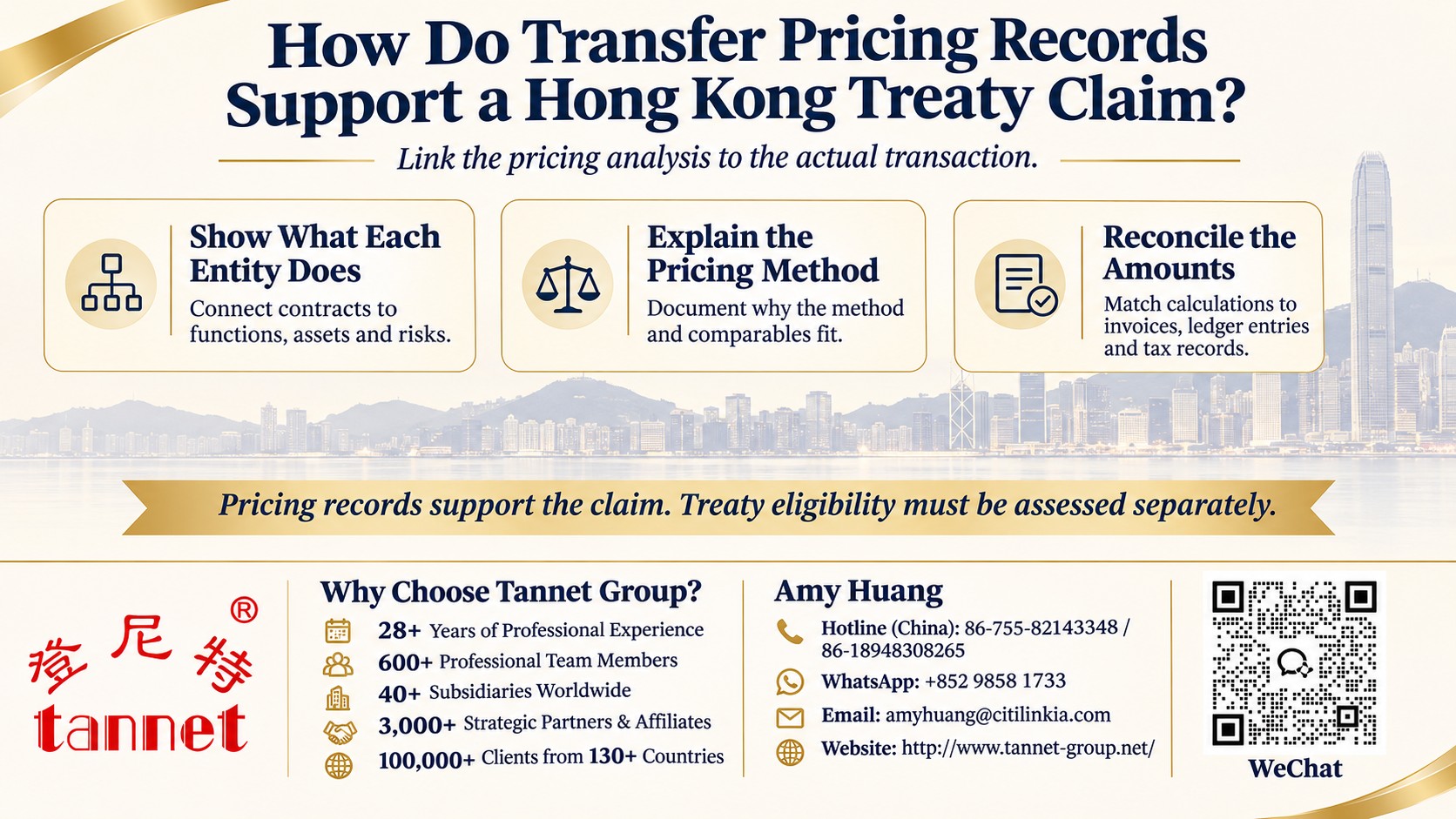
Transfer pricing records support a Hong Kong treaty claim by showing what related companies actually did, how they set the price, and whether the amount claimed matches the underlying transaction. They are useful to Hong Kong groups seeking reduced foreign withholding tax or dealing with a foreign profit adjustment.
A local file, benchmarking study or intercompany agreement cannot establish treaty eligibility on its own. Check the effective treaty, residence, the correct income article and any relevant beneficial ownership or anti-abuse conditions separately. Start with the individual payment or adjustment, then link each conclusion to dated records.
A foreign payer may seek a reduced withholding rate for interest or royalties paid to a Hong Kong company. Transfer pricing records can help explain what the payment covers and why the amount is commercially supportable. The applicable agreement determines the actual conditions for relief.
A foreign tax authority may instead increase an affiliate’s taxable profits by disallowing part of a related-party expense. The same profit can then be taxed in both jurisdictions if the Hong Kong recipient has already included the payment in taxable income. The group may need to seek a corresponding adjustment.
These are different procedures. For withholding relief, the question concerns the treatment of a payment under an income article. For a corresponding adjustment, the question is whether the other jurisdiction should adjust its assessment in response to an arm’s length adjustment.
Write down the legal parties, payment date, amount, currency and claimed relief. Identify the tax and the income article that may apply. Check the treaty, relevant protocols and effective dates. For mixed contracts, read the rights and obligations rather than relying on invoice labels.
A charge described as a service fee may cover both implementation work and a licence. Document what the customer can do with the software and what staff actually deliver. Check whether the treaty and source jurisdiction treat those elements separately before allocating the price.
The Inland Revenue Department explains that its Certificate of Resident Status supports residence. The treaty partner decides whether the foreign relief conditions are met. The certificate cannot settle income classification, beneficial ownership or an applicable anti-abuse test.
Use the agreement as a starting point. Identify which entity performs the work, uses the assets and controls the relevant risks. Compare contract terms with staff responsibilities, approval records and what happened when results differed from forecasts.
For a group loan, keep the drawdown notice, credit analysis, funding records and signed terms. Show who can approve amendments and who bears losses. An interest rate study may support pricing, but it does not show that the recipient can retain the interest.
For shared services, identify recipients, deliverables and the costs charged. Explain why each allocation key reflects the expected benefit. A headcount key might suit payroll support. It may be inappropriate for a project with identifiable users and separately tracked hours.
The OECD Transfer Pricing Guidelines and Hong Kong’s Departmental Interpretation and Practice Notes on associated persons explain the arm’s length principle. The aim is to evaluate the conditions independent parties would agree to in comparable circumstances.
Record the method and why it fits. If a royalty is compared with independent licences, explain material differences in territory, exclusivity and duration. For a loan, consider currency, maturity, security and borrower credit. A range without the underlying comparison is difficult to defend.
Read the treaty’s related-party provisions where they apply. Some interest or royalty articles limit treaty treatment to the amount independent parties would have agreed. A treaty cap on withholding and an arm’s length price are different numbers. Check how the applicable treaty and domestic law treat any excess.
Trace the price calculation to the invoice, ledger and settlement. Tie the claimed payment to the tax or withholding record. Explain exchange rates, gross versus net amounts and timing differences. Where one invoice covers several items, show how the calculation allocates the charge.
Record any year-end adjustment. If finance issues a debit note after withholding has been filed, check how the source jurisdiction treats it. Do not assume the adjustment automatically changes tax already paid or creates a right to a refund.
If the contract provides for a tax gross-up, show the amount before and after withholding. Identify who bears the tax under the contract. Reconcile those figures to the payer’s return rather than comparing only the cash received.
The Hong Kong IRD distinguishes the master file, which describes the group and its policies, from the local file, which analyses material controlled transactions of the relevant entity. Check the documentation requirements and applicable exemptions for the accounting period.
Where required, prepare the files within nine months after the accounting period ends and retain them for at least seven years after that end date. The IRD expects them to be available on request. Do not treat this timetable as a foreign withholding or treaty claim deadline.
An exemption from the formal files does not itself establish an arm’s length price or treaty eligibility. Retain proportionate records for the actual claim. Give the payer or authority the evidence required under the applicable process, rather than assuming the entire local file must be sent.
Obtain the assessment and the authority’s reasoning. Map its calculation to the transaction, year, taxpayer and tax already assessed in Hong Kong. Show where the same profit is taxed twice. Preserve the original pricing analysis and explain any differences from the authority’s method.
Separate the adjustment to taxable profit from any interest and penalties. This helps advisers identify which amounts the treaty mechanism may address.
Check the treaty’s associated enterprises and Mutual Agreement Procedure provisions. A corresponding adjustment is not automatic. It depends on the relevant rules and whether the adjustment is accepted in principle and amount. Identify the treaty time limit and preserve domestic objection rights separately.
Do not use a residence certificate as proof of pricing or a benchmark as proof of residence. Neither demonstrates, by itself, that the recipient is the beneficial owner where that condition applies.
Do not submit a group policy without linking it to the amount actually charged. Mark unexplained differences rather than adjusting the file to fit the return. Record material changes in contracts, personnel and functions during the claim period.
Do not assume a treaty cap, domestic deduction and foreign refund all rise or fall together. Each may depend on a different rule. If an assessment arrives, calendar domestic and treaty deadlines immediately.
Q1 Does an arm’s length price guarantee a reduced withholding rate?
No. Check residence, the correct income article and other conditions under the applicable treaty. The pricing work addresses the amount, not all grounds for relief.
Q2 Is a master file enough to support a claim?
Usually it is too general by itself. Keep records linking the payment to the parties, signed terms, price calculation and amount reported.
Q3 Do we need a full local file to claim treaty relief?
Not as a universal rule. Hong Kong documentation requirements and the source jurisdiction’s claim procedures are distinct. Check both before deciding what to prepare or submit.
Q4 Can a cost allocation spreadsheet prove that services were provided?
No. Keep deliverables, service records or other evidence of work. Then show why the cost pool and allocation key reflect those services.
Q5 What if the invoice and transfer pricing study show different amounts?
Reconcile them. Identify currency conversion, rounding, accruals or later adjustments. If the difference remains material, review the position before filing.
Q6 Does the foreign assessment automatically change Hong Kong tax?
No. Seek advice on corresponding relief under the applicable treaty and domestic provisions. Track local objections and treaty deadlines separately.
Q7 Should the same pricing analysis be used next year?
Review the facts first. Changes in funding, functions, markets or contract terms may make an earlier analysis unsuitable. Keep the updated calculation tied to the new period.
Tannet can help assemble agreements, invoices, entity records and payment reconciliations for a treaty review. A qualified tax adviser should assess the method, interpret the applicable treaty and advise on any foreign claim or dispute.
OECD — Transfer Pricing Guidelines
Written by: Tannet Business Services Team
Reviewed by: Consultant Amy Huang
First published: 9 Nov. 2026
Last reviewed: 9 Nov. 2026
30th Anniversary Offer: Tannet has been established for 28 years, we are offering exclusive limited-time promotional pricing to celebrate Tannet’s 30th anniversary. Slots are limited and available on a first-come, first-served basis. Contact Consultant Amy Huang for details.
————————————————Simplifying Business, Empowering Entrepreneurs————————————————