Key Takeaway
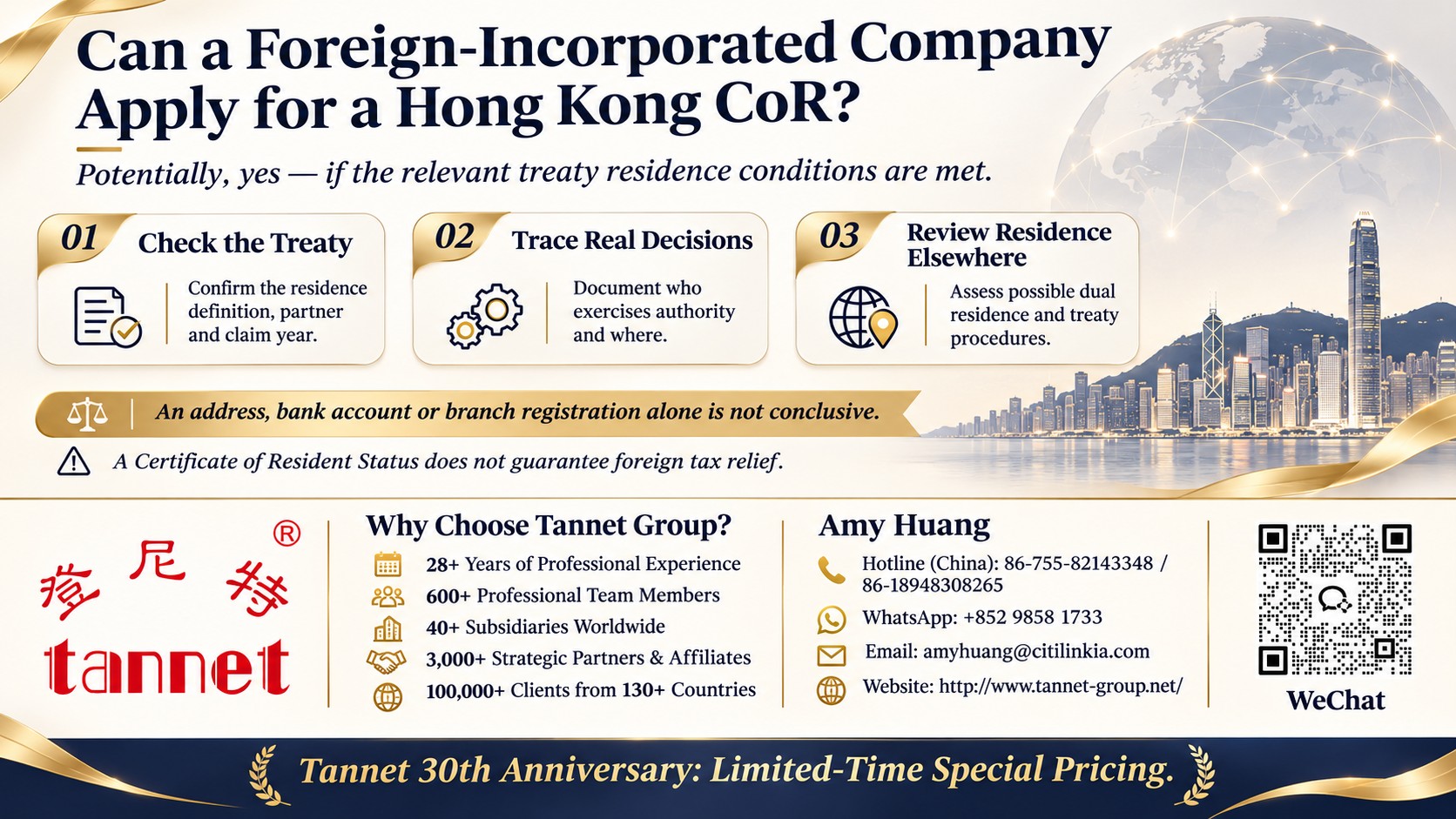
Yes. A company incorporated outside Hong Kong can apply for a Hong Kong Certificate of Resident Status if it meets the residence definition in the relevant tax treaty. The Inland Revenue Department generally includes overseas companies managed or controlled in Hong Kong among eligible applicants.
This route may suit international businesses with genuine Hong Kong management functions. It does not require every applicant to incorporate a new Hong Kong subsidiary. However, a local address, bank account or business registration alone does not establish treaty residence.
Check the treaty, document actual decisions and review residence elsewhere. Receiving the certificate does not guarantee foreign tax relief.
Understand the applicant and the purpose
A Certificate of Resident Status supports a claim under an effective comprehensive double taxation agreement or arrangement. It is not an incorporation certificate, immigration status or general business endorsement. Start with the payment and the treaty partner, rather than an application form.
Identify the legal entity receiving the income. A Hong Kong branch belongs to the overseas company, whereas a subsidiary is a separate entity. Map the contract, invoice, ownership of the receivable and bank receipt to the correct entity before collecting residence evidence.
The IRD’s published guidance expressly recognizes companies incorporated outside Hong Kong but managed or controlled there. That general statement identifies a possible application route. The relevant treaty article and protocols determine the actual residence test for the requested claim.
Step one read the applicable residence article
Record the treaty partner, calendar year and category of income. Confirm when the agreement and relevant provisions take effect. A signed agreement is not necessarily available for the payment period. Use the IRD treaty directory to locate current texts and applicable modifications.
Preserve the wording of the residence test. Do not automatically replace “normally managed or controlled” with “central management and control.” These expressions can have different meanings. Nor should an adviser turn “or” into “and” when summarizing a treaty.
For the Chinese Mainland Arrangement, IRD Practice Note 44 discusses ordinary business management separately from top-level control. Its explanation helps identify relevant facts. Read that older interpretation alongside current treaty texts and subsequent changes, rather than treating it as a universal rule.
Step two establish where decisions actually happen
Build a chronology for the claim year. Identify who approved budgets, selected financing, directed operations and evaluated performance. State where those people worked and what authority they exercised. Describe the company’s own functions rather than only the activities of its wider group.
Keep contemporaneous board papers, meeting records, delegated authority documents and relevant correspondence. A meeting agenda should connect to a real decision. A signature collected in Hong Kong is weaker evidence if substantive instructions were settled elsewhere and merely presented for approval.
For virtual meetings, record participants’ locations and how the discussion led to a decision. Do not assume the software server, meeting invitation address or chairperson’s travel automatically determines residence. Review the overall pattern against the treaty wording.
Step three prepare an evidence file
Organize evidence by assertion. If the application says Hong Kong personnel approve financing, connect that statement to authority limits, loan discussions and approvals. This approach makes inconsistencies visible before an assessor asks questions. It is a recommended preparation method, not an additional statutory form.
Create an index showing the document date, decision and responsible person. Keep original records available. If material is translated, preserve the original alongside the translation so reviewers can trace the explanation back to its source without confusion.
Include records explaining overseas functions. Foreign offices and directors do not disappear because the application concerns Hong Kong. Describe their responsibilities honestly. Where authority is shared, explain the division and identify which decisions are made locally, escalated or reserved to another governing body.
Distinguish required attachments from supporting material selected for the facts. Current company forms request incorporation documentation and relevant name changes. Further evidence may help explain management. Do not present an office lease, a local employee or a bank account as an automatic substitute for the residence test.
Step four choose the correct form
Companies use IR1313A for the Chinese Mainland Arrangement and IR1313B for other treaty jurisdictions. The choice follows the treaty partner, not the company’s place of incorporation. Download the current official version and read its notes before completing the declaration.
For an ordinary foreign-incorporated applicant that has not re-domiciled, complete the applicable overseas-applicant appendix. It asks about operations, personnel and management across locations. Reconcile the answers with business commencement records and explain differences instead of adjusting dates simply to make documents look consistent.
Re-domiciled companies have a separate documentary position under current IRD guidance. Do not confuse registration of an overseas company with completed re-domiciliation. Obtain advice about the actual corporate status before deciding which appendix or supporting documents apply.
Step five check residence in another jurisdiction
Incorporation abroad or management elsewhere may create another residence claim under that jurisdiction’s law. Prepare a separate assessment. Hong Kong certification does not automatically remove foreign residence, filing duties or disclosure obligations. Coordinate advisers so the same facts are described consistently.
If the company is dual resident, read the relevant corporate tie-breaker. Some treaties require competent-authority agreement. Others use different mechanisms. Check applicable protocols and multilateral modifications. Do not choose whichever residence produces the lowest rate without satisfying the legal process.
Step six separate certification from tax relief
After establishing residence, review the income article. Dividends, interest, royalties and business profits have different conditions. Beneficial ownership, anti-abuse provisions, ownership thresholds or permanent establishment questions may remain relevant. A certificate addresses residence; it does not certify every element of the payment’s treatment.
Agree the foreign claim process with the payer. Ask whether relief can be applied before payment or requires a refund. Identify filing dates, acceptable documents and the person responsible. Preserve withholding records so any subsequent claim can be reconciled to the amount actually deducted.
Before promising a payment date, list unresolved questions and assign each to an adviser or finance contact. Keep certification work separate from the customer’s internal onboarding checks. Completing one process may not complete the other, even with overlapping documents.
After submission, retain the signed declaration and document index. Record each information request, the response date and any revised explanation. This reduces conflicting answers when different colleagues communicate with the assessor or payer about the same claim period.
Common mistakes
Common errors include treating a Hong Kong branch registration as conclusive residence, selecting a form by incorporation country and submitting identical minutes for unrelated decisions. Another error is describing the certificate as a guaranteed reduced withholding rate. Keep commercial facts and the requested tax outcome separate.
Do not manufacture historical substance. If the evidence does not support the requested year, explain the gap and consider future governance changes prospectively. A new process may improve later records, but it does not relocate decisions already taken abroad.
Frequently asked questions
Q1 Must we establish a Hong Kong subsidiary first?
Not necessarily. The overseas company may apply in its own right if it satisfies the relevant residence test. A subsidiary would be a separate entity requiring its own assessment.
Q2 Is a Hong Kong business registration enough?
No. Registration and treaty residence answer different questions. Explain the functions performed in Hong Kong and connect them to the applicable treaty definition.
Q3 Must all directors live in Hong Kong?
Do not assume a universal director-residence requirement. Review actual responsibilities and decision locations. Director addresses are evidence, but they are not a replacement for the treaty analysis.
Q4 Does approval remove our foreign tax obligations?
No. Review foreign residence, local filing requirements and the treaty’s relief conditions separately. The overseas authority ultimately decides whether the requested benefit is available.
Q5 How should we plan the application timetable?
The IRD targets a certificate or assessment response within 21 working days of a properly completed application. A request for information can extend the overall process. Leave time for evidence preparation and foreign procedures.
Where Tannet can assist
Tannet can help organize corporate records, map management responsibilities and coordinate the application file with tax advisers. Specialist review is appropriate for dual residence, complex decision structures or disputed treaty eligibility. Confirm the service scope before relying on a planned payment date.
Written by: Tannet Business Services Team
Reviewed by: Consultant Amy Huang
First published: 6 Nov. 2026
Last reviewed: 6 Nov. 2026
30th Anniversary Offer: Tannet has been established for 28 years, we are offering exclusive limited-time promotional pricing to celebrate Tannet’s 30th anniversary. Slots are limited and available on a first-come, first-served basis. Contact Consultant Amy Huang for details.
————————————————Simplifying Business, Empowering Entrepreneurs————————————————