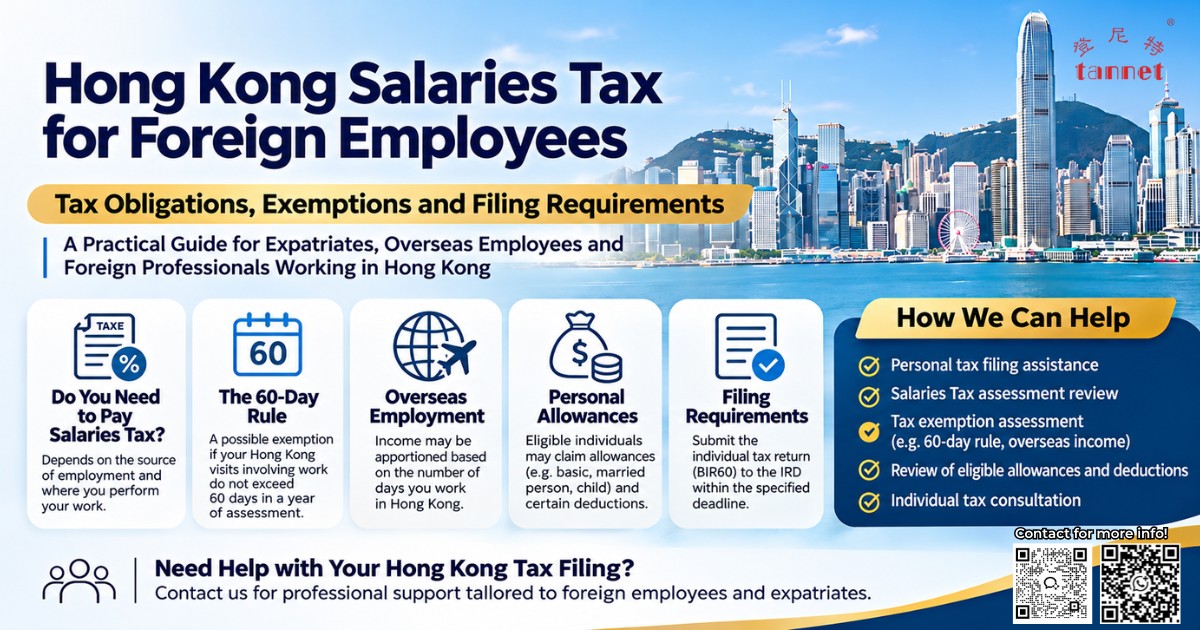
Foreign professionals working in Hong Kong often assume that they are exempt from Hong Kong Salaries Tax because they are not permanent residents or hold overseas employment contracts. However, Hong Kong’s tax system does not determine tax liability solely by nationality, immigration status or place of residence.
Under Hong Kong’s territorial tax system, the source of employment income and the location where employment duties are performed are important factors in determining whether an individual is subject to Salaries Tax.
For expatriates, overseas employees and foreign professionals, understanding the applicable tax rules can help prevent unnecessary tax payments, missed filing deadlines and potential penalties.
This guide explains Hong Kong Salaries Tax for Foreign Employees.
1. Do Foreign Employees Need to Pay Hong Kong Salaries Tax?
Yes. Foreign employees and non-Hong Kong residents may be liable for Hong Kong Salaries Tax if they earn income arising in or derived from Hong Kong through employment or an office.
Hong Kong does not impose a general income tax on worldwide income. Instead, Salaries Tax generally applies to employment income sourced in Hong Kong.
The Inland Revenue Department (IRD) considers several factors when determining the source of employment, including:
- Where the employment contract was negotiated and signed.
- Where the employer is located.
- Where the employee’s remuneration is paid.
The actual circumstances of the employment relationship are important.
For example, a foreign professional employed by a Hong Kong company and working primarily in Hong Kong may be subject to Salaries Tax, even if the employee maintains overseas citizenship or permanent residence elsewhere.
Therefore, being a foreign national or non-Hong Kong resident does not automatically provide an exemption from Hong Kong tax obligations.
2. How Is Salaries Tax Applied to Non-Hong Kong Residents?
The tax treatment depends largely on whether the individual has Hong Kong employment or non-Hong Kong employment.
Hong Kong Employment
If an employee has Hong Kong-sourced employment, the full employment income is generally chargeable to Salaries Tax, even if some duties are performed outside Hong Kong.
However, an exemption may apply where all employment services are performed outside Hong Kong, subject to the relevant statutory conditions. Short visits to Hong Kong involving services may be disregarded if they do not exceed a total of 60 days during the year of assessment.
Non-Hong Kong Employment
For employees employed by overseas companies, only income attributable to services rendered in Hong Kong is generally subject to Salaries Tax.
The taxable portion is commonly calculated using a time-apportionment method based on the number of days spent in Hong Kong during the relevant year of assessment.
For example, an overseas employee earns HK$600,000 annually and spends 90 days in Hong Kong during a 360-day employment period.
The indicative Hong Kong-sourced portion would be:
HK$600,000 × 90 ÷ 360 = HK$150,000.
The actual calculation depends on the employment arrangement, service period and applicable IRD rules.
3. What Salaries Tax Exemptions Are Available?
Foreign employees may qualify for certain exemptions or tax relief, depending on their employment arrangements and where their services are performed.
The 60-Day Rule
Individuals with Hong Kong employment may qualify for a full exemption where their visits to Hong Kong do not exceed 60 days during a year of assessment, subject to the applicable statutory conditions.
The year of assessment runs from 1 April to 31 March of the following year.
Importantly, the 60-day rule is not a universal exemption for every foreign employee. Its application depends on the type of employment and circumstances of the visit.
Income from Services Performed Outside Hong Kong
Employees with non-Hong Kong employment may generally claim exemption for income attributable to services performed outside Hong Kong.
The exempt portion is normally calculated through time apportionment.
Tax Paid in Another Jurisdiction
In certain circumstances, individuals who have already paid substantially similar income tax overseas may qualify for relief under Hong Kong’s tax legislation or an applicable Double Taxation Arrangement.
Supporting documents may be required to establish the overseas tax payment and the relevant income.
Foreign employees should assess their circumstances carefully before claiming any exemption, as overseas tax payment does not automatically eliminate Hong Kong Salaries Tax liability.
4. Can Foreign Employees Claim Hong Kong Salaries Tax Allowances?
Yes. Eligible individuals may claim applicable personal allowances and deductions when calculating their Hong Kong Salaries Tax liability.
Depending on their circumstances, these may include:
- Basic allowance.
- Married person’s allowance.
- Child allowance.
- Dependent parent or grandparent allowance.
- Approved charitable donations.
- Qualifying mandatory retirement scheme contributions.
- Other eligible deductions under Hong Kong tax legislation.
The availability of allowances depends on the relevant statutory requirements and individual circumstances.
For example, a foreign employee with a qualifying spouse and children may be eligible for certain family-related allowances even if their family members do not reside in Hong Kong.
However, not every allowance is automatically available to every non-resident taxpayer. Eligibility should be reviewed before submitting a tax return.
5. What Are the Hong Kong Salaries Tax Filing Requirements?
Individuals who receive a Tax Return – Individuals (BIR60) from the IRD should complete and submit it within the specified deadline.
The general filing process involves:
Step 1: Review Employment Information
Confirm the employer’s details, employment period, remuneration and location of employment.
Step 2: Calculate Taxable Employment Income
Identify salary, bonuses, commissions, allowances, share awards and other taxable employment benefits.
Step 3: Review Exemptions and Deductions
Determine whether overseas services, the 60-day exemption, foreign tax relief or applicable personal allowances can be claimed.
Step 4: Prepare Supporting Documents
Relevant documents may include employment contracts, travel records, salary statements, employer confirmations and overseas tax payment evidence.
Step 5: Submit the Individual Tax Return
Complete the BIR60 return and submit it to the IRD within the applicable deadline.
Step 6: Review the Tax Assessment
Once the IRD issues a Notice of Assessment, review the assessed income, deductions, allowances and tax payable.
If there are discrepancies, taxpayers may need to raise an objection or provide additional supporting information within the prescribed period.
6. What Happens If Foreign Employees Fail to File Their Tax Returns?
Foreign employees should not assume that leaving Hong Kong or returning to their home country automatically terminates their tax obligations.
Failure to submit required returns or provide accurate income information may result in:
- Estimated tax assessments.
- Additional tax and penalties.
- Prosecution in serious cases.
- Difficulties resolving outstanding tax liabilities when leaving Hong Kong.
Employees planning to relocate overseas or terminate their Hong Kong employment should also review their tax position before departure.
Employers may have separate reporting and notification obligations when an employee ceases employment or leaves Hong Kong.
7. How TANNET Can Assist with Hong Kong Personal Tax Filing
Understanding Hong Kong Salaries Tax can be challenging for foreign employees, particularly those working across multiple jurisdictions or receiving remuneration from overseas employers.
TANNET provides Hong Kong personal tax support to help individuals understand their tax obligations and manage their filing requirements.
Our services include:
- Individual Salaries Tax filing assistance.
- Review of employment income and tax assessments.
- Assessment of potential tax exemptions.
- Review of eligible personal allowances and deductions.
- Individual tax consultation.
- Assistance with tax-related documentation and IRD correspondence.
Whether you are an expatriate working in Hong Kong, an overseas professional on assignment or an employee receiving income from multiple jurisdictions, understanding your tax position is essential.
Planning to work or currently employed in Hong Kong? Contact TANNET for professional assistance with Hong Kong personal tax filing and Salaries Tax consultation.
📞 Free 1-on-1 Consultation Now,
Official Service Hotline: +86-755-82148419
Cell: +86-13823131503;+60 19-309 2363
WeChat ID: 13823131503;
WhatsApp:+86-13823131503;+60 19-309 2363
Email: mytannet08@gmail.com; susiehu@citilinkia.com