Key Takeaway
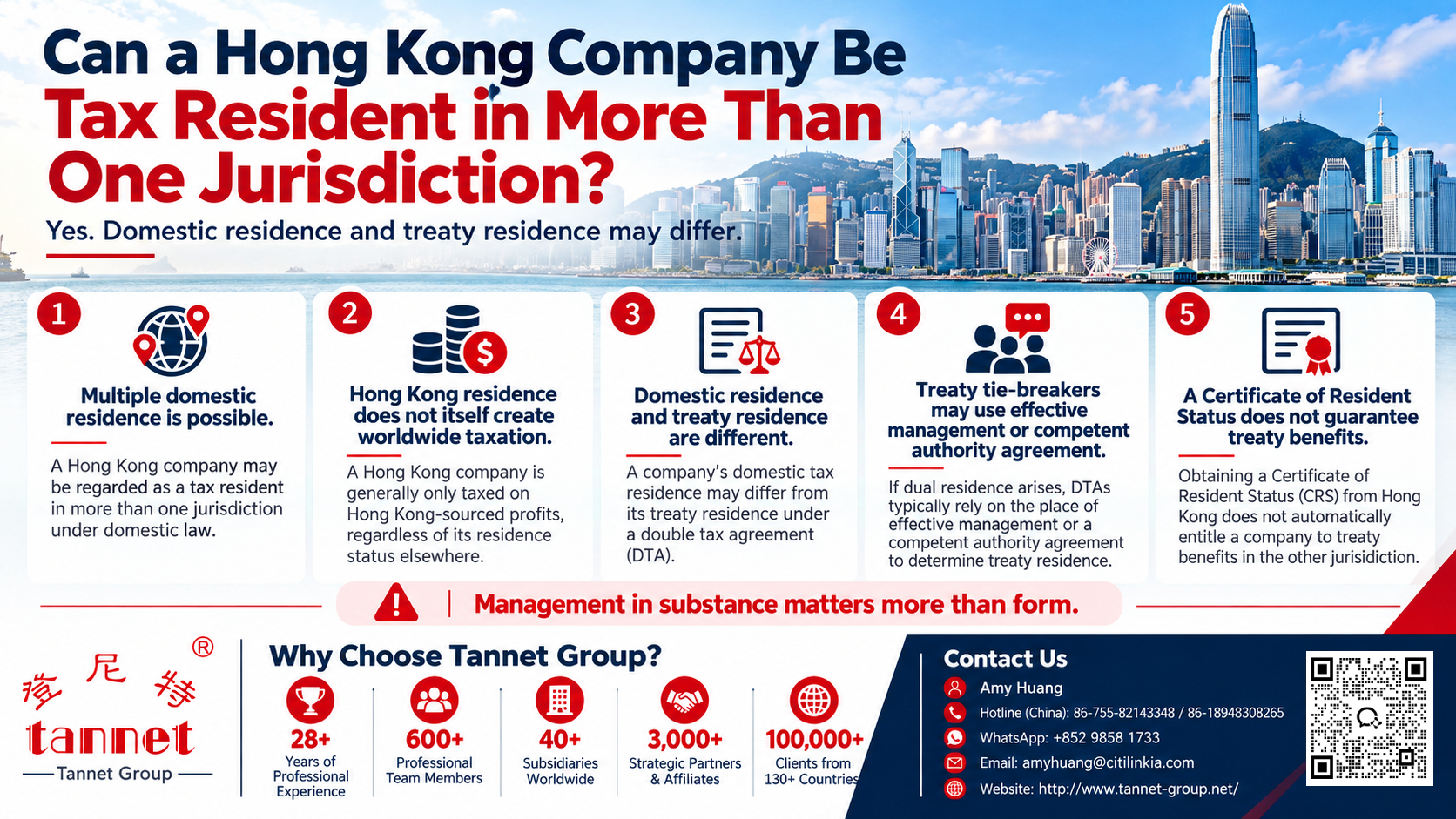
Yes. A Hong Kong company can be treated as tax resident in two or more jurisdictions under their separate domestic laws.
Hong Kong incorporation may establish Hong Kong treaty residence, while another jurisdiction may claim residence because central management, effective management, directors, or executive decisions are located there.
This does not automatically mean that the company receives treaty benefits from both places.
The applicable tax treaty may use a place-of-effective-management test or require the competent authorities to agree on one treaty residence.
The central caution is to distinguish domestic residence, treaty residence, permanent establishment, and income source, then document where real management occurs.
Multiple domestic residence is legally possible
Each jurisdiction applies its own tax law. One may use incorporation. Another may use central management and control, place of effective management, registered seat, or a similar connecting factor.
A company incorporated in Hong Kong can therefore remain a Hong Kong resident under a relevant treaty definition while another jurisdiction also treats it as resident under local law. The second claim often arises when directors and senior executives make strategic decisions abroad.
This is called dual residence when two jurisdictions are involved. Multiple residence can arise when management and operations are divided among three or more places.
Hong Kong residence does not itself create worldwide taxation
Hong Kong generally taxes profits arising in or derived from Hong Kong. The Inland Revenue Department explains that no person is liable to Hong Kong tax merely because of resident status.
That territorial principle does not prevent another jurisdiction from taxing the same company as a resident under its own worldwide-income rules. The company may face foreign tax returns, provisional tax, withholding issues, reporting duties, or penalties even if its Hong Kong profits tax position is limited.
Residence and source must therefore be analysed separately. A Hong Kong-source profit may be taxable in Hong Kong, while the other residence jurisdiction may also include it in a wider tax base and then provide credit relief.
Domestic residence and treaty residence are different
Domestic law determines whether each jurisdiction initially regards the company as resident. A treaty then allocates benefits and taxing rights between the two treaty partners.
The treaty result is often a deemed residence for purposes of that treaty only. It may not cancel domestic registration, return filing, record keeping, payroll, transfer pricing, or tax-payment obligations in either jurisdiction.
A company can therefore remain a domestic resident in two places while being treated as resident of only one place for a specific DTA. It may receive a different outcome under another DTA because the wording and facts differ.
How treaty tie-breakers work
Older or unmodified treaties may deem a dual-resident company to be resident where its place of effective management is situated. This focuses on where key management and strategic decisions are made in substance.
Many modern treaties or treaties modified by the OECD Multilateral Instrument use competent authority agreement. The authorities consider effective management, incorporation, constitution, and other relevant factors.
Article 4 of the MLI states that, without agreement, a dual-resident entity may receive no treaty relief or exemption except to the extent agreed by the authorities. Reservations and notifications can change how the MLI applies, so the synthesised treaty text must be checked.
Place of effective management is factual
IRD guidance on the Mainland arrangement describes place of effective management as the location where key management and strategic decisions necessary for the business are made in substance.
The inquiry is not limited to where minutes are signed. Authorities may examine who has real authority, where senior decision-makers work, where commercial risks are accepted, and where important contracts, financing, budgets, investments, and policies are approved.
Routine administration is less persuasive than strategic conduct. A Hong Kong company secretary, registered office, bank account, or annual filing does not alone prove that effective management is in Hong Kong.
Remote boards create evidence challenges
Video meetings can distribute participants across several places. The legal meeting location stated in minutes may not answer where the actual decision-making process occurred.
The company should record participant locations, information reviewed, alternatives considered, conflicts declared, approvals given, and the executives responsible for implementation.
Repeated decisions by an overseas parent, founder, or investment committee may outweigh occasional Hong Kong board meetings. Formal approval after decisions have already been made elsewhere is particularly risky.
A permanent establishment is not tax residence
A Hong Kong company may operate an office, employ staff, maintain a construction site, or act through an agent in another jurisdiction. Those facts may create a permanent establishment.
A permanent establishment normally permits the host jurisdiction to tax attributable business profits. It does not necessarily make the company resident there.
Conversely, a foreign residence claim can arise even without a large operational office if central management and control occur there. Residence and permanent establishment require separate tests.
Certificate of Resident Status has a limited role
A Hong Kong Certificate of Resident Status proves Hong Kong residence for a claim under an effective DTA. The IRD generally issues one certificate for each DTA and year, subject to special arrangements.
The IRD expressly warns that a certificate does not guarantee treaty benefits. The treaty partner decides whether residence, beneficial ownership, holding periods, anti-abuse rules, and other requirements are satisfied.
If a foreign authority argues that the company is dual resident, the CoR may be part of the evidence but not the final answer. A tie-breaker or competent authority process may still be required.
Steps to assess a dual-residence risk
- Identify every jurisdiction with incorporation, directors, executives, offices, employees, banking, or strategic decisions.
- Apply each jurisdiction’s domestic corporate residence rules.
- Identify the exact treaty and its effective text for the relevant period.
- Read the residence article and any MLI modification.
- Map where strategic and operational decisions occur in substance.
- Check permanent establishment, income source, beneficial ownership, and anti-abuse issues separately.
- Estimate filing duties, cash tax, credits, withholding, and dispute timing in both places.
Common mistakes
- Assuming Hong Kong incorporation prevents residence elsewhere.
- Treating a registered office as proof of management.
- Confusing a permanent establishment with corporate residence.
- Relying on a CoR as automatic treaty approval.
- Ignoring the treaty’s current MLI-modified text.
- Recording only formal board meetings and not real decisions.
- Applying one treaty conclusion to every jurisdiction and year.
Frequently asked questions
Q1. Can a Hong Kong company be resident in Hong Kong and Mainland China?
Yes, domestic tests can produce that result. The consolidated arrangement uses a competent authority process for a dual-resident entity and considers effective management, incorporation, and other relevant factors.
Q2. Does paying profits tax in Hong Kong settle residence?
No. Hong Kong profits tax is source-based. Payment may be relevant evidence, but another jurisdiction applies its own residence law and the treaty rules.
Q3. Can a company hold two residence certificates?
It may receive domestic documentation from more than one authority. That does not mean both certificates produce treaty benefits for the same bilateral treaty claim.
Q4. Are online board meetings acceptable?
They can be valid, but tax authorities may examine where participants were located and where substantive decisions were made. The evidence should reflect the real process.
Q5. What happens if the authorities do not agree?
The result depends on the treaty. Under an MLI-style rule, treaty relief may be unavailable except to the extent agreed by the competent authorities.
Q6. Does dual residence always cause double tax?
Not always. Domestic exemptions, foreign tax credits, source rules, treaty allocation, or a mutual agreement may reduce duplication. Timing and cash-flow differences can remain.
Q7. Should management be moved to Hong Kong?
Only if it matches commercial reality. Artificial relocation of meetings without authority, personnel, or implementation in Hong Kong may not change the substantive conclusion.
Map every jurisdiction whose domestic law may treat the company as resident before filing any treaty claim.
Keep reliable records for every period.
When Tannet may assist
Tannet may assist companies with residence-risk mapping, Hong Kong CoR preparation, governance records, management-and-control evidence, treaty document coordination, and communication with advisers in the other jurisdiction. Legal conclusions and foreign tax filings should be confirmed with qualified advisers in each relevant jurisdiction.
30th Anniversary Offer: To celebrate Tannet’s 30th anniversary, we are offering exclusive limited-time promotional pricing. Slots are limited and available on a first-come, first-served basis. Don’t miss out—contact Consultant Amy Huang for details.
Written by: Tannet Business Services Team
Reviewed by: Consultant Amy Huang
First published: 14 Oct. 2026
Last reviewed: 14 Oct. 2026
————————————————Simplifying Business, Empowering Entrepreneurs————————————————