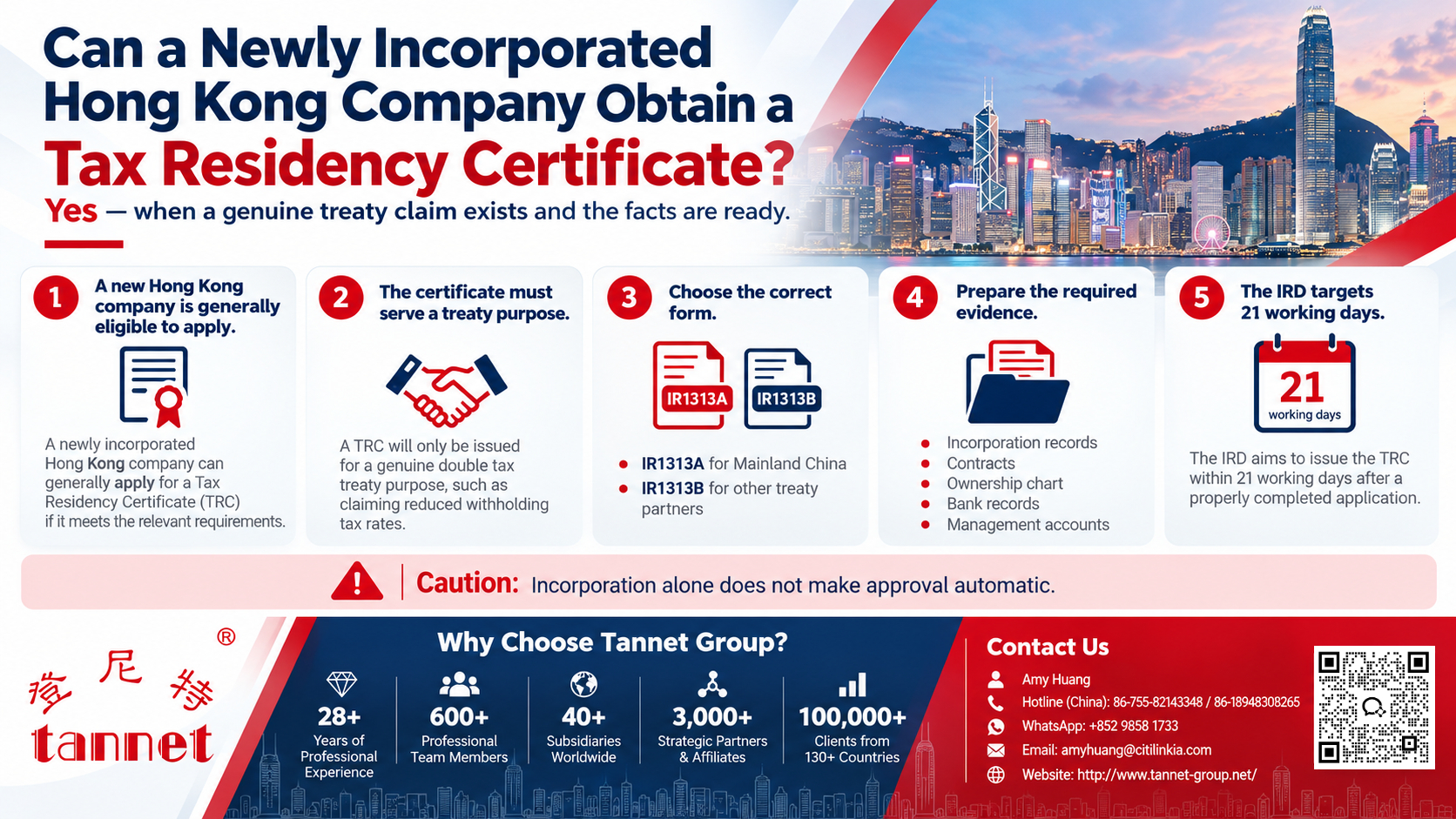
Key Takeaway
Yes. A newly incorporated Hong Kong company can apply for a Hong Kong Certificate of Resident Status when it needs residence evidence to claim benefits under an effective double tax agreement.
The Inland Revenue Department does not publish a universal minimum company-age requirement. However, incorporation alone does not make approval automatic.
The application must identify the treaty partner, claim year, income and beneficial owner.
A young company may also need to explain its business, management, staff, contracts and transaction timeline. The most important point is timing: file only when a genuine treaty claim exists and the facts can be supported by contemporaneous records.
A new company is generally eligible to apply
The Hong Kong Inland Revenue Department lists a company incorporated in Hong Kong among the persons that may apply for a Certificate of Resident Status, commonly called a CoR.
The official guidance does not state that a company must first complete a full year of trading, receive a profits tax return, or prepare audited financial statements. This means a newly incorporated company is not disqualified merely because it is new.
Eligibility to apply is not the same as entitlement to receive a certificate. The IRD examines the relevant treaty definition and the information supplied in the application.
The certificate must serve a treaty purpose
A CoR is issued to support a claim for benefits under a comprehensive double taxation agreement or arrangement. It is not a general corporate status certificate.
The IRD FAQ says a CoR will not be issued where there is no effective DTA with the relevant jurisdiction. It also says the certificate is not issued merely for banking, compliance, tendering, or other non-treaty purposes.
A new company should therefore identify the foreign payer, expected income, treaty partner, claim year and relevant treaty article before filing.
There is no automatic approval at incorporation
Hong Kong incorporation is an important residence connection. It allows the company to fall within the general class of applicants identified by the IRD.
It does not eliminate the application review. Form IR1313A or IR1313B asks for the date and place of incorporation, business registration number, Companies Registry number, Hong Kong addresses and contact person.
The form also asks about the nature and amount of income, the beneficial owner, headquarters, main branches, directors, senior management and other staff during the claim year.
Choose the correct application form
Use Form IR1313A when the intended claim is under the arrangement between Hong Kong and the Chinese Mainland.
Use Form IR1313B for claims under Hong Kong’s DTAs with other jurisdictions. The relevant agreement must already be effective.
The July 2025 versions are the current forms identified on the IRD CoR page. Applicants should check for a later revision immediately before submission.
What a newly incorporated company should prepare
The standard form requires a copy of the certificate of incorporation. A certificate of change of name is also required if applicable.
The company should prepare a concise evidence file even where the form does not initially request every document. Useful records include:
- a transaction summary and expected payment date;
- executed or near-final contracts;
- invoices, licence terms or financing documents;
- an ownership and group structure chart;
- board minutes and written approvals;
- bank account records or onboarding correspondence;
- office, company secretarial and service arrangements;
- staff, payroll or outsourced service records;
- budgets and current management accounts.
The evidence should describe what actually existed during the calendar year of claim. A business plan should not be presented as completed activity.
What if the company has no tax return or audit yet?
This is common for a new company. The absence of a first profits tax return or completed audit is not listed by the IRD as an automatic bar.
The applicant should explain the formation date, accounting period and current stage of business. It can provide available alternatives, such as management accounts, bank statements, contracts, funding evidence and dated board records.
The IRD may request more information. A complete explanation is safer than leaving a gap or implying that unavailable records exist.
The 2023 application approach matters
The IRD announced in June 2023 that it would base the issuance decision on the plain definition of Hong Kong resident in the relevant DTA.
It also stated that a company incorporated or established in Hong Kong is generally not required to provide full details of its establishment and business activities in the revised forms.
This administrative approach simplifies the initial filing. It does not prevent the IRD from requesting further information, and it does not control whether the treaty partner grants the claimed relief.
Beneficial ownership remains separate
New holding, finance and licensing companies often focus on residence but overlook beneficial ownership.
Forms IR1313A and IR1313B explain that a recipient constrained by a contractual or legal obligation to pass income to another person is not the beneficial owner. An agent, nominee or conduit is not treated as beneficial owner merely because it receives the payment.
A company expecting dividends, interest or royalties should review cash flow, financing, contractual duties and decision-making before submitting the claim.
Source-country rules still decide the tax benefit
The IRD expressly states that issuing a CoR does not guarantee treaty benefits. The treaty partner decides whether all conditions are met.
Those conditions may include an ownership threshold, minimum holding period, beneficial ownership, permanent establishment analysis, income classification, limitation-of-benefits wording or a principal purpose test.
The foreign payer or adviser should confirm whether the certificate must be supplied before payment, with a relief-at-source filing, or during a refund procedure.
Application timing for a new company
Apply when the treaty partner, income and claim period can be identified. Filing immediately after incorporation without a real transaction may produce questions that the company cannot answer.
Do not wait until a foreign deadline is about to expire. The IRD’s target is to issue the certificate, request further information or notify a decision within 21 working days after receiving a properly completed application.
That target is not a promise of completion within 21 working days. An incomplete file or follow-up enquiry can extend the practical timetable.
Common mistakes
- Applying for a non-treaty purpose.
- Selecting the wrong form or treaty partner.
- Using an incorrect calendar year of claim.
- Filing before the income or transaction can be explained.
- Treating incorporation as proof of beneficial ownership.
- Providing forecasts as though they were completed operations.
- Ignoring the treaty partner’s filing and refund deadlines.
Frequently asked questions
Q1. Can a company apply immediately after incorporation?
It may apply once there is a genuine claim under an effective DTA and the requested facts can be provided. The IRD does not publish a general waiting period.
Q2. Must the company have revenue first?
The IRD guidance does not state a universal revenue threshold. However, the application must identify the relevant income and treaty benefit. Pre-revenue activity should be explained accurately.
Q3. Is an audited financial statement compulsory?
The standard company forms do not state that every applicant must attach an audit. The IRD may request supporting information, so provide available financial and transaction records.
Q4. Can the certificate be requested for opening a bank account?
Not by itself. The IRD FAQ says a CoR is issued for claiming DTA benefits, not for unrelated purposes.
Q5. Does a CoR guarantee a reduced withholding rate?
No. The treaty partner decides whether all conditions are satisfied, including beneficial ownership and anti-abuse requirements.
Q6. How long does the application take?
The IRD targets 21 working days after receiving a properly completed application to issue a certificate or notify the applicant of an enquiry or decision.
Q7. Can an agent submit the application?
Yes. A company secretary or tax representative can be appointed for online CoR services. The company remains responsible for accuracy.
When Tannet may assist
Tannet may assist newly incorporated companies that need to identify the correct treaty route, prepare the application form, organise formation and transaction records, respond to IRD enquiries, or coordinate with source-country tax advisers. The result depends on the relevant DTA, the company’s facts and the treaty partner’s review.
Keep the submission copy for later treaty and audit reviews.
30th Anniversary Offer: To celebrate Tannet’s 30th anniversary, preferential service pricing is now available. Contact Consultant Amy Huang for details.
Written by: Tannet Business Services Team
Reviewed by: Consultant Amy Huang
First published: 14 Oct. 2026
Last reviewed: 14 Oct. 2026
————————————————Simplifying Business, Empowering Entrepreneurs————————————————