Hong Kong is one of Asia’s leading international business hubs, attracting entrepreneurs, investors, multinational companies, and professionals from around the world. However, operating a Hong Kong company or holding Hong Kong residency status does not necessarily mean you qualify as a Hong Kong tax resident.
For individuals and businesses involved in international transactions, understanding the Hong Kong Tax Residency Certificate, officially known as the Certificate of Resident Status (CoR), can be important for cross-border tax planning and compliance.
But who actually needs this certificate? Does every Hong Kong company need to apply? And can holding a Hong Kong identity card help you qualify?
What Is a Hong Kong Tax Residency Certificate?
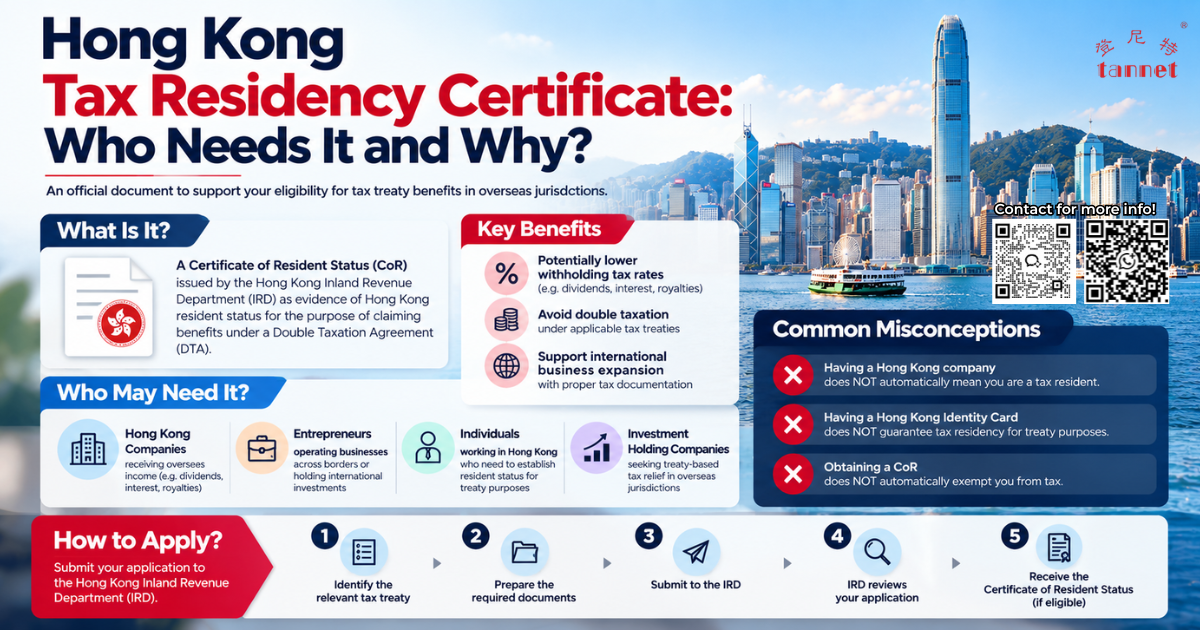
A Certificate of Resident Status is an official document issued by the Hong Kong Inland Revenue Department (IRD).
It serves as evidence of Hong Kong resident status for the purpose of claiming benefits under a Comprehensive Avoidance of Double Taxation Agreement or Arrangement (CDTA).
Hong Kong has entered into tax agreements with various jurisdictions to help address double taxation and facilitate international economic activities.
These agreements may provide tax relief on certain types of cross-border income, subject to the relevant treaty provisions and eligibility requirements.
A CoR helps establish residency status for treaty purposes. However, obtaining the certificate does not automatically guarantee tax treaty benefits. The tax authority in the other jurisdiction ultimately determines whether the applicable benefits can be granted.
Who May Need a Hong Kong Tax Residency Certificate?
1. Hong Kong Companies Receiving Overseas Income
Companies conducting international business may need a CoR when claiming tax treaty benefits in another jurisdiction.
For example, a Hong Kong company receiving royalties, interest, or dividends from overseas may be subject to withholding taxes in the jurisdiction where the payments originate.
Where an applicable tax treaty provides relief, the overseas tax authority may request a Hong Kong CoR as supporting evidence.
The availability of relief depends on the relevant treaty, the nature of the income, and the company’s eligibility.
2. Entrepreneurs Operating Businesses Across Borders
Entrepreneurs who own or manage businesses in multiple jurisdictions may encounter questions about their tax residency.
For instance, a business owner may hold a Hong Kong company while conducting commercial activities in Mainland China, Malaysia, Singapore, or elsewhere.
In such circumstances, it is important to distinguish between company incorporation, individual residency, and tax residency.
A CoR may become relevant where the entrepreneur seeks benefits under a tax agreement in their individual capacity, provided they qualify under the applicable provisions.
3. Individuals Working in Hong Kong
Individuals working in Hong Kong may also need to consider their tax residency when receiving income or maintaining financial interests across different jurisdictions.
However, employment in Hong Kong does not automatically mean a person needs a CoR.
The certificate is generally relevant when an individual wishes to establish Hong Kong resident status for the purpose of claiming benefits under an applicable tax agreement.
Eligibility depends on the relevant residency rules and individual circumstances.
4. Companies With Cross-Border Investment Structures
Hong Kong is frequently used as a regional holding and investment platform.
A Hong Kong company holding investments in another jurisdiction may need to demonstrate its residency status when applying for treaty-based tax relief.
Nevertheless, incorporation alone does not establish eligibility for every treaty benefit.
Depending on the applicable agreement, other requirements may include beneficial ownership, anti-abuse provisions, and the commercial substance of the arrangement.
Does Having a Hong Kong Company Automatically Qualify You?
No.
Registering a company in Hong Kong and obtaining a Business Registration Certificate (BR) or Certificate of Incorporation (CI) are not equivalent to obtaining a Certificate of Resident Status.
A company must satisfy the applicable tax residency requirements.
For treaty purposes, the place of incorporation and the location where a company is normally managed or controlled may be relevant, depending on the circumstances and applicable agreement.
Companies should therefore review their corporate structure and management arrangements before applying.
Does Having Hong Kong Residency Mean You Are a Tax Resident?
Not necessarily.
Hong Kong immigration residency and tax residency serve different purposes.
A person may obtain permission to reside in Hong Kong through an immigration scheme, including the Top Talent Pass Scheme (TTPS), but this does not automatically establish eligibility for a CoR.
Similarly, holding a Hong Kong Identity Card does not, by itself, guarantee recognition as a Hong Kong tax resident under a particular tax agreement.
The applicable residency tests must be considered separately.
This distinction is particularly important for entrepreneurs and professionals who maintain business interests, employment, or family connections outside Hong Kong.
Why Is the Certificate Important?
The main purpose of a Hong Kong CoR is to support claims for benefits under applicable tax agreements.
These benefits may include reduced withholding tax rates or other forms of relief from double taxation, where the relevant agreement provides for them.
Without appropriate supporting documentation, taxpayers may encounter difficulties when requesting treaty benefits from overseas tax authorities.
For businesses, obtaining the relevant documentation can also help support cross-border tax compliance and transaction planning.
However, a CoR is not a general tax exemption certificate, nor does it establish that all income received by a Hong Kong company is exempt from tax.
How Do You Apply for a Hong Kong CoR?
Applications are submitted to the Hong Kong Inland Revenue Department.
The application process generally involves identifying the relevant tax agreement, determining the applicant’s eligibility, and providing the required information and supporting documents.
The exact documentation depends on whether the applicant is an individual, a company, or another type of entity, as well as the relevant treaty and application circumstances.
The IRD may request additional information to assess residency status.
Applicants should also identify the relevant year or period for which certification is required.
Importantly, a certificate issued for one period should not be assumed to establish residency status for every subsequent year.
Common Misunderstandings About Hong Kong Tax Residency
One common misconception is that every Hong Kong company automatically qualifies for treaty benefits.
Another is that paying Hong Kong tax guarantees that a company or individual will receive a CoR.
In practice, the certificate concerns residency status for treaty purposes, rather than simply whether tax has been paid.
Similarly, holding a Hong Kong visa, maintaining a bank account, or registering a business does not independently guarantee eligibility.
Tax residency must be assessed according to the relevant rules.
When Should You Consider Applying?
A CoR application is worth considering when an overseas tax authority, payer, or treaty-benefit procedure requires evidence of Hong Kong resident status.
Before proceeding, individuals and businesses should establish whether an applicable tax agreement exists, whether the income or transaction qualifies for potential relief, and whether the applicant satisfies the relevant residency conditions.
Applying without first confirming these matters may lead to unnecessary documentation or delays.
How TANNET Global Can Assist
For entrepreneurs and businesses operating internationally, company incorporation, immigration status, and tax residency are closely related but legally distinct considerations.
TANNET Global provides corporate and cross-border business services, including Hong Kong company formation, company secretarial support, accounting, taxation-related coordination, and corporate compliance services.
Businesses considering Hong Kong tax residency documentation can contact our team to discuss their circumstances and the appropriate next steps.
Conclusion
A Hong Kong Tax Residency Certificate is particularly relevant to individuals and businesses seeking benefits under applicable double taxation agreements.
However, not every Hong Kong company owner, employee, or identity holder needs to apply.
The key question is not simply whether you have a Hong Kong company or Hong Kong identity, but whether you qualify as a Hong Kong resident for the relevant tax treaty and need documentary evidence to claim its benefits.
Understanding this distinction can help businesses and individuals make better-informed decisions about their international tax obligations.
Disclaimer: This article provides general information and does not constitute tax or legal advice. Eligibility and treaty benefits depend on the applicable agreement and individual circumstances.