Key Takeaway
Hong Kong residency is permission to live in the city under a specific immigration route. It can support employment, entrepreneurship, family relocation, education planning and a future application for permanent residence.
It suits qualified professionals, high earners, graduates, technology specialists, entrepreneurs and eligible investors.
The most important point is that a visa, a Hong Kong identity card, tax residence and permanent residence are different statuses. Applicants must select the correct scheme, prove every eligibility fact and plan for renewal.
Seven years in Hong Kong does not create permanent status automatically; ordinary residence and other legal conditions still require assessment.
What Hong Kong residency means
“Hong Kong residency” is not a single visa. Most new applicants first obtain a visa or entry permit under an employment, talent, graduate, entrepreneur or investment scheme. Their stay has a time limit and may carry conditions.
Eligible residents normally apply for a Hong Kong identity card after arrival. That card records identity and immigration status. It is not proof that the holder is already a permanent resident, a Chinese citizen or a Hong Kong tax resident.
The distinction matters. Immigration status controls the right to stay and work. Tax residence depends on tax rules and applicable treaties. Permanent residence generally requires a separate right-of-abode assessment.
Why people apply for Hong Kong residency
The first reason is lawful access to work and business activity. Some routes are linked to a named employer. Others give broader freedom to change employment or establish a business during the permitted stay.
The second reason is family planning. Many talent and employment entrants may sponsor a spouse or legally recognised partner and unmarried dependent children under 18. The sponsor must prove the relationship and adequate support.
The third reason is long-term settlement. The Immigration Department states that persons admitted under several professional and talent routes may apply for right of abode after ordinarily residing in Hong Kong continuously for at least seven years.
The fourth reason is regional mobility. Hong Kong is closely connected with Mainland China and international markets. Residency can make it practical to manage a local team, serve regional clients and maintain a base for Greater Bay Area activities.
The main benefits
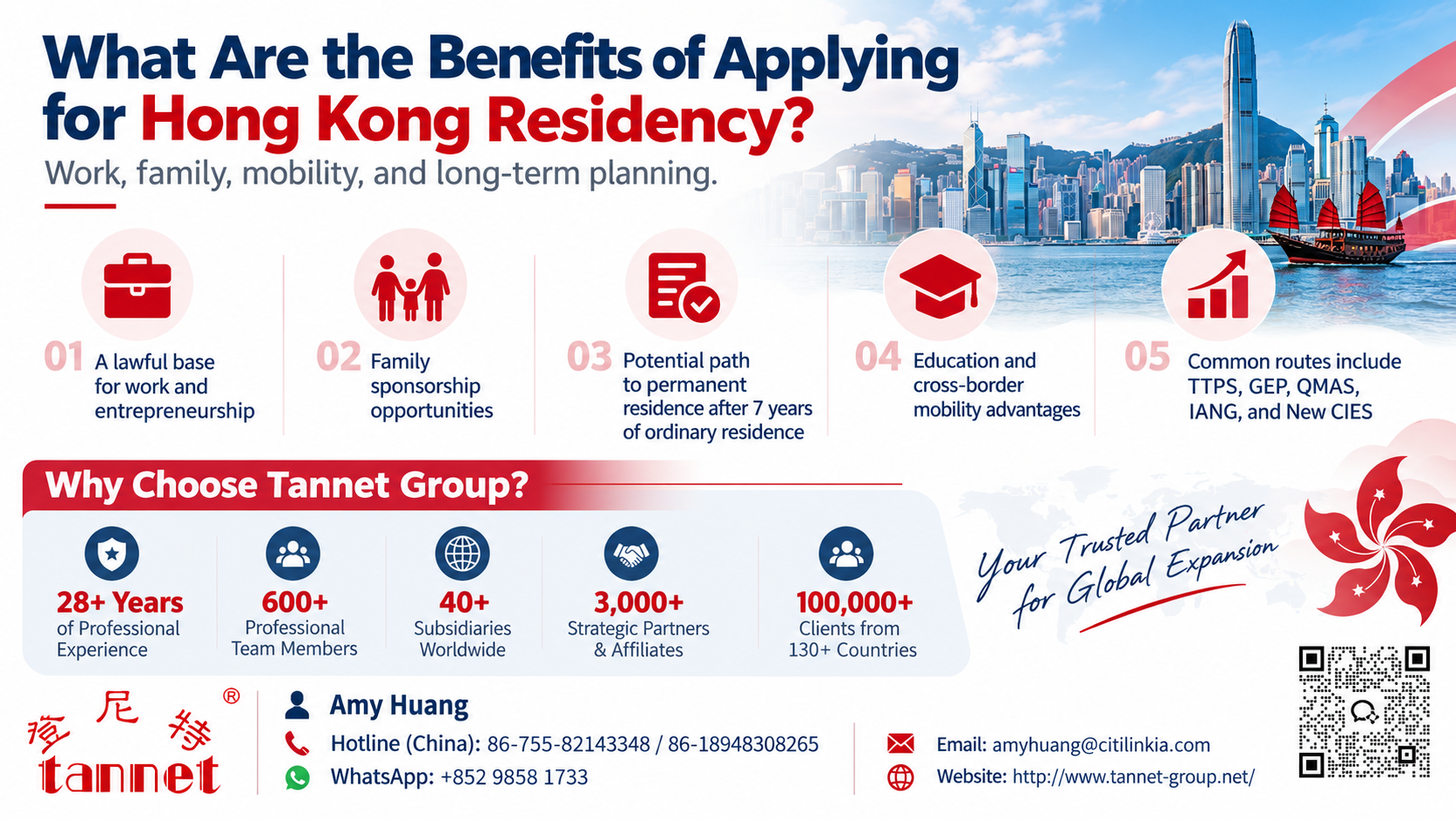
1. A lawful base for work and entrepreneurship
A valid status lets the holder conduct activities permitted by that route. Under the Top Talent Pass Scheme, entrants are admitted without other conditions of stay and may change jobs or establish or join a business without prior approval during the permitted period.
By contrast, a professional admitted under the General Employment Policy is normally tied to approved employment. Prior approval is generally required before changing employers. The benefit therefore depends on the visa conditions, not simply possession of an identity card.
2. A route for eligible family members
Dependants may usually include a spouse or qualifying legally recognised partner and unmarried dependent children under 18. Under many professional and talent routes, dependants are not prohibited from working or studying.
This can support coordinated relocation. However, dependant status is linked to the sponsor. Changes in the relationship, sponsorship or the sponsor’s status can affect renewal.
3. A possible path to permanent residence
Qualifying residents may later seek right of abode. The common benchmark is seven years of continuous ordinary residence. A non-Chinese national must also have taken Hong Kong as the place of permanent residence.
This is an application, not an automatic conversion. The Immigration Department considers the purpose and pattern of residence, absences, family circumstances and other evidence. Applicants should retain a consistent record from the start.
4. Career and education flexibility
Hong Kong offers routes for experienced professionals, high-income applicants, recent graduates and researchers. A suitable route can reduce uncertainty about where a person may work, study or build a career.
Children admitted as dependants may study, subject to school admission rules and available places. Residency does not itself guarantee entry to a particular school, public benefit or subsidised service.
5. A platform for cross-border planning
Residents may coordinate employment, corporate management and family arrangements from Hong Kong. This can be useful for founders, regional executives and professionals covering Mainland China and Asia-Pacific markets.
Immigration approval does not by itself produce tax advantages. Personal and corporate tax consequences require separate analysis under Hong Kong law, foreign law and any applicable treaty.
Main application routes and conditions
1. Top Talent Pass Scheme
TTPS does not require a Hong Kong job offer at the application stage. Category A requires annual income of at least HK$2.5 million in the year immediately before application.
Category B covers degree graduates of an eligible university with at least three years of work experience during the preceding five years. Category C covers recent graduates of eligible universities with less experience, subject to an annual quota and stated exclusions.
2. Quality Migrant Admission Scheme
QMAS targets highly skilled or talented people. Applicants must meet prerequisites on age, financial support, character and education, then satisfy the current assessment route published by the Immigration Department.
A job offer is not generally required before applying. Renewal requires evidence that the entrant has taken steps to settle and contribute, such as qualified employment or a genuine business.
3. General Employment Policy
GEP is suitable for overseas professionals with a confirmed Hong Kong job. The applicant normally needs a relevant degree or strong technical qualifications and experience.
The vacancy must be genuine. The role should match the applicant’s background, not be readily filled locally and provide market-level remuneration. Mainland Chinese residents normally use the separate Admission Scheme for Mainland Talents and Professionals.
4. Immigration Arrangements for Non-local Graduates
IANG serves eligible non-local graduates of qualifying programmes. Recent graduates applying within the specified period may apply without first securing employment.
Returning graduates generally need an offer for a graduate-level role with market-level remuneration. Applicants should confirm whether their institution, programme, location and graduation timing fall within the current rules.
5. Technology Talent Admission Scheme
TechTAS is an employer-sponsored route for research and development work. The employing company needs an approved quota from the Innovation and Technology Commission.
The applicant must work full time in Hong Kong, principally conduct technology R&D and meet the stated qualification or exceptional technical criteria. Pay must not be below the prevailing market level.
6. New Capital Investment Entrant Scheme
New CIES is for eligible investors seeking residence through qualifying investment. Current rules require at least HK$30 million in net assets or equity throughout the prescribed assessment period and at least HK$30 million in permissible investments.
The investment structure includes a required allocation to the scheme portfolio. Nationality or residence eligibility, asset ownership, investment timing and self-support conditions must all be checked before funds move.
7. Entrepreneur route
An entrepreneur may apply under the investment limb of the General Employment Policy to establish or join a Hong Kong business. Immigration examines the business plan, financial resources, investment, local jobs, technology or skills and expected economic contribution.
A paper company is insufficient. Evidence should show a credible, funded and operational proposal with a genuine role for the applicant.
A route review should also test nationality restrictions, document translation requirements, processing fees, travel plans and whether the applicant can satisfy extension evidence.
Common mistakes
- Treating company registration, property ownership or investment as automatic residence.
- Choosing the fastest-looking route instead of the route supported by evidence.
- Assuming a Hong Kong identity card proves permanent or tax residence.
- Ignoring renewal requirements until the permitted stay is nearly over.
- Counting every day toward seven years without analysing ordinary residence.
- Making inconsistent statements across immigration, employment and corporate records.
- Assuming family members qualify without relationship and support evidence.
Frequently asked questions
Q1. Does buying property give me Hong Kong residency?
No. Property ownership alone is not an immigration route. Some qualifying investments may fall within New CIES limits, but the full scheme conditions still apply.
Q2. Can I apply without a Hong Kong job offer?
Possibly. TTPS, QMAS and some IANG applicants do not need an offer initially. GEP normally requires confirmed employment.
Q3. Can my spouse work in Hong Kong?
Dependants under many professional and talent schemes are not prohibited from employment. The exact sponsor category and conditions must be checked.
Q4. Will I become a permanent resident after seven years?
Not automatically. You must apply and prove continuous ordinary residence and any additional conditions relevant to your nationality.
Q5. Does residency make me a Hong Kong tax resident?
Not automatically. Immigration residence, domestic tax liability and treaty residence use different legal tests.
Q6. Which route is easiest?
There is no universal answer. The appropriate route is the one whose income, education, employment, graduate, technical or investment conditions you can document accurately.
When Tannet may assist
Tannet can assist when an individual or family needs an initial eligibility review, route comparison, document checklist, company or employment coordination, renewal planning or cross-border tax and corporate support. Immigration decisions remain with the authorities, and legal or tax advice may be required for complex cases.
Written by: Tannet Business Services Team
Reviewed by: Consultant Amy Huang
First published: 12 Oct. 2026
Last reviewed: 12 Oct. 2026
30th Anniversary Offer: To celebrate Tannet’s 30th anniversary, preferential service pricing is now available. Please contact Consultant Amy Huang for details.
————————————————Simplifying Business, Empowering Entrepreneurs————————————————