Key Takeaway
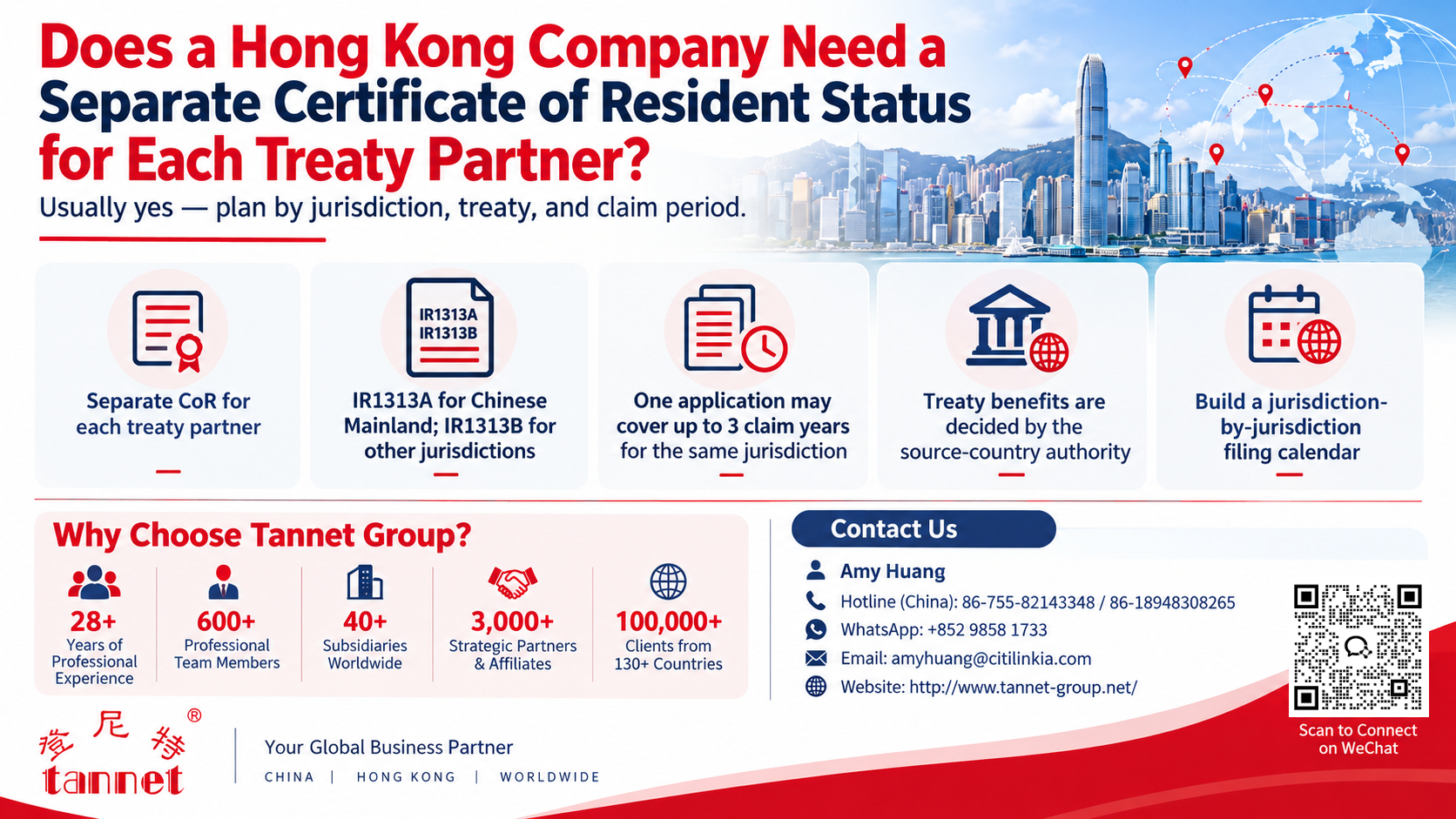
Usually, yes. A Hong Kong company should plan for a separate Certificate of Resident Status application for each treaty partner because the certificate is issued in relation to a specific comprehensive double taxation agreement, jurisdiction and claim period.
One certificate should not be treated as universal proof for every country. The Hong Kong Inland Revenue Department generally issues only one certificate for each DTA for each year.
An application for the Chinese Mainland follows a separate form and administrative arrangement.
A company receiving income from several jurisdictions should create a jurisdiction-by-jurisdiction calendar and confirm the local recipient authority’s format, validity and filing deadline before payment.
Why the treaty partner matters
A Certificate of Resident Status, or CoR, proves that the applicant is a Hong Kong resident for the purpose of claiming benefits under an effective double taxation agreement or arrangement.
It is not a general certificate of incorporation. It is linked to a treaty claim. The relevant treaty partner must therefore be identified when the application is made.
Hong Kong IRD Form IR1313B asks a company to name the relevant jurisdiction. It also asks for the calendar year of claim, the income concerned and the beneficial owner.
These fields make the application fact specific. A certificate requested for income from France does not automatically document a claim under Hong Kong’s agreement with Japan, the United Kingdom or another partner.
Is a separate application always required?
The safest operational rule is to prepare one application stream for each treaty partner. The IRD states that generally only one CoR will be issued to an applicant in respect of each DTA for each year.
This wording has two effects. First, a company should not expect one certificate to cover several treaty partners. Second, it normally should not submit duplicate applications for the same DTA and year without a reason.
The company should still check the receiving jurisdiction’s procedure. Some authorities ask for the Hong Kong certificate itself. Others require a prescribed local form, electronic filing, legalization, translation or additional beneficial-ownership documents.
The source-country authority decides whether treaty benefits are granted. The Hong Kong certificate establishes residence evidence, but it does not approve the foreign claim.
Chinese Mainland claims follow a distinct route
The IRD separates applications for the Chinese Mainland from applications for other jurisdictions. Companies use Form IR1313A for Mainland claims and Form IR1313B for other treaty partners.
The Mainland arrangement also has a special administrative feature. The IRD states that a certificate issued for a particular calendar year generally serves as proof of Hong Kong resident status for that year and the two succeeding calendar years.
That three-year treatment does not convert the Mainland certificate into a certificate for other partners. It remains connected to the Mainland arrangement.
The Mainland tax authority also determines whether the claimant meets all treaty conditions. Residence, beneficial ownership, ownership thresholds, holding periods and anti-abuse rules may all remain relevant.
One application may cover up to three claim years
The IRD’s current CoR FAQ states that an applicant may submit one application covering at most three calendar years of claim for the same jurisdiction.
This rule can reduce repeat administration. It does not mean the IRD will issue one global certificate for every treaty partner.
Companies should distinguish three concepts: the number of applications, the years covered by an application and the period for which a receiving authority will accept the resulting certificate.
Those concepts may not be identical. A source country may request a recent certificate even where the Hong Kong application covered multiple years.
What if the company receives income from several countries?
Build a separate claim file for each country. Begin with the applicable DTA and the nature of income.
Dividends, interest, royalties, service income and capital gains may be governed by different articles. The supporting facts can also differ by payment.
For each jurisdiction, record the payer, income type, payment date, domestic withholding rate, treaty rate, local form and submission deadline.
Then identify the evidence needed. This normally includes the CoR, contracts, invoices or resolutions, ownership records, payment documents and beneficial-ownership support where relevant.
Do not assume that a successful claim in one jurisdiction proves eligibility elsewhere. Treaty wording, limitation rules and domestic procedures can differ.
Can the same evidence package be reused?
Core corporate evidence can often be reused. Examples include the certificate of incorporation, business registration, organization chart, director information, office records and financial statements.
Reuse should be controlled. Every application must reflect the correct claim year, treaty partner, income and current business facts.
If management, ownership, employees, office arrangements or payment flows changed, update the evidence before filing.
The company should also reconcile the application with the foreign claim. Names, addresses, amounts, currencies and beneficial-owner statements should match across forms, contracts and bank records.
A practical multi-jurisdiction workflow
- List every jurisdiction from which treaty-covered income is expected.
- Confirm that the relevant DTA is effective for the claim period.
- Classify each payment under the correct treaty article.
- Confirm whether the source country requires a CoR, local form or both.
- Use the Mainland application route for Mainland claims and the other-jurisdiction route for other partners.
- Group up to three calendar years only where the IRD application and local process allow it.
- Prepare a consistent evidence file for residence, beneficial ownership and the transaction.
- Track the source-country filing deadline and the IRD processing period.
- Archive the certificate, submission receipt and final tax outcome by jurisdiction.
This workflow separates residence certification from treaty entitlement. It also prevents one country’s documents from being filed incorrectly in another country.
A certificate strategy should follow the payment map, not the group chart alone. Two subsidiaries in different countries may require different evidence even when they pay the same Hong Kong recipient. Finance, legal and tax teams should agree who requests each certificate, who answers IRD questions and who confirms acceptance with the foreign payer before funds are released.
Timing and digital certificates
The IRD’s processing target is 21 working days after receiving a properly completed application. Within that period, it may issue the certificate, request further information or notify the applicant that the application cannot be accepted.
The target begins after a properly completed application is received. Internal preparation and responses to follow-up questions can extend the project timeline.
Hong Kong now provides digital CoR services through its tax portals. Applicants can submit applications and supplementary information online and receive an electronic certificate through the relevant portal.
Digital delivery does not remove source-country requirements. Confirm whether the foreign authority accepts an electronic certificate, needs authenticity verification, or asks for a printed or translated copy.
Common mistakes
- Using a certificate naming one treaty partner for a claim in another jurisdiction.
- Treating the CoR as proof of beneficial ownership or automatic treaty approval.
- Confusing an application covering several years with a certificate covering several countries.
- Using the other-jurisdiction form for a Chinese Mainland claim.
- Filing before confirming the income article and source-country procedure.
- Reusing outdated management, ownership or payment information.
- Applying after the payer’s withholding deadline without preserving a refund option.
Frequently asked questions
Q1. Can one Hong Kong CoR be used for France and Germany?
Usually not. The application identifies the relevant jurisdiction and DTA. Plan separate applications and confirm each country’s local requirements.
Q2. Can one application cover several years?
Yes. The IRD FAQ says one application may cover at most three calendar years of claim for the same jurisdiction.
Q3. Does the Mainland three-year rule apply to every treaty partner?
No. It is a special administrative arrangement for the Mainland and Hong Kong arrangement.
Q4. Is a new CoR required for every payment?
Not necessarily. It depends on the DTA, claim year, receiving authority and whether the facts have changed. Confirm before each payment cycle.
Q5. Can a payer accept a copy of an earlier certificate?
Possibly, but acceptance is governed by the source-country procedure. The payer should obtain written confirmation from its tax adviser or authority.
Q6. Does a CoR guarantee the reduced withholding rate?
No. The source-country authority evaluates treaty eligibility, including beneficial ownership and anti-abuse conditions.
Q7. What if the company already paid full withholding tax?
It may have a refund route under local law. Check the statutory deadline and required evidence immediately.
Conclusion
A Hong Kong company with income from several treaty partners should manage CoR applications by jurisdiction, treaty and claim period. Core evidence may be reused, but each file must be tailored to the relevant DTA and source-country process.
Tannet can assist with jurisdiction mapping, Hong Kong CoR applications, evidence checklists and coordination of Mainland China documentation. Foreign filing positions and disputed interpretations should also be reviewed by qualified advisers in the source jurisdiction.
Written by: Tannet Business Services Team
Reviewed by: Consultant Amy Huang
First published: 12 Oct. 2026
Last reviewed: 12 Oct. 2026
30th Anniversary Offer: To celebrate Tannet’s 30th anniversary, preferential service pricing is now available. Contact Consultant Amy Huang for details.
————————————————Simplifying Business, Empowering Entrepreneurs————————————————