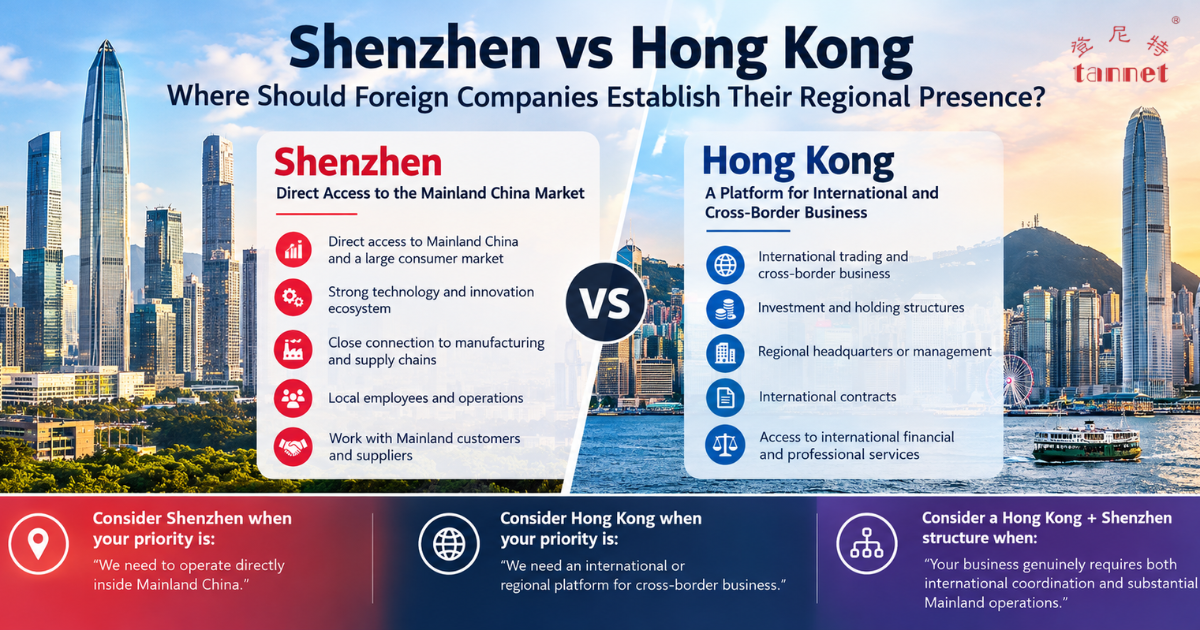
Shenzhen vs Hong Kong: Where Should Foreign Companies Establish Their Regional Presence?
For foreign companies looking to enter China or expand across Asia, Shenzhen and Hong Kong are often considered together.
The two cities are located next to each other and form an important part of the Guangdong–Hong Kong–Macao Greater Bay Area (GBA), but they serve very different business functions.
Hong Kong is commonly used as an international business, investment and financial platform, while Shenzhen provides direct access to Mainland China’s technology, manufacturing, supply-chain and consumer ecosystems.
For international companies, the question is therefore not simply “Shenzhen or Hong Kong?”
A better question is:
What role should each city play in your regional business structure?
Shenzhen: Direct Access to the Mainland China Market
Shenzhen has developed into one of China’s major technology and innovation centres and is closely connected with the manufacturing and supply-chain ecosystem of the wider Pearl River Delta.
For foreign companies whose business activities will take place primarily in Mainland China, establishing a Shenzhen entity can provide a direct local operating platform.
Depending on the business model and applicable foreign-investment rules, a Shenzhen company may be used for activities such as:
- Selling products or services in Mainland China
- Employing local staff
- Entering into contracts with Mainland customers and suppliers
- Developing local distribution networks
- Working with manufacturers and technology partners
- Establishing a physical office and operational team
- Conducting permitted import and export activities
Foreign-invested enterprises can be established in Shenzhen, although the registration and approval requirements depend on the proposed industry and whether the activity is subject to China’s foreign-investment restrictions.
Qianhai, for example, has specific procedures for establishing foreign-invested enterprises. Activities outside restricted sectors are generally registered according to the applicable foreign-investment registration framework, while businesses falling within restricted areas must satisfy the relevant requirements.
Hong Kong: A Platform for International and Cross-Border Business
Hong Kong serves a different function.
Its legal, financial and commercial infrastructure makes it a common location for international companies establishing holding companies, trading entities, regional management functions and cross-border business structures.
A Hong Kong company may be particularly relevant for businesses involved in:
- International trading
- Cross-border investment
- Regional headquarters or management
- Holding shares in subsidiaries
- International contracts
- Professional and business services
- Intellectual property and licensing structures
- Expansion into Mainland China and other Asian markets
Hong Kong also operates a territorial profits tax system. In general, profits arising in or derived from Hong Kong from a trade, profession or business carried on there are subject to Hong Kong profits tax.
However, determining the source of profits is a question of fact and depends on the actual profit-producing activities. In addition, multinational enterprise groups receiving certain foreign-sourced income in Hong Kong should consider the Foreign-sourced Income Exemption (FSIE) regime and its economic-substance and other applicable requirements.
Shenzhen vs Hong Kong: Key Differences
Market Access
Shenzhen provides direct access to the Mainland Chinese market.
Hong Kong provides an international platform that can support cross-border business involving China and overseas markets.
Business Environment
Companies operating in Shenzhen are subject to Mainland China’s company, tax, employment, foreign-investment and industry-specific regulatory frameworks.
Hong Kong operates under its own company law, tax system and regulatory framework.
Operational Function
A Shenzhen entity may be more relevant when a company requires employees, customers, suppliers, offices or substantial operations inside Mainland China.
A Hong Kong entity may be more relevant when the company’s primary requirements involve international transactions, investment holding, regional coordination or cross-border commercial activities.
Supply Chain
Shenzhen’s location within the Pearl River Delta makes it particularly relevant for technology, electronics, manufacturing and supply-chain businesses.
Hong Kong, meanwhile, can serve as a commercial, financing and international coordination platform for businesses operating across multiple jurisdictions.
Do Companies Have to Choose Only One?
Not necessarily.
For some international businesses, Shenzhen and Hong Kong can perform complementary functions.
A group might establish:
Overseas Parent / Investor
↓
Hong Kong Company
↓
Shenzhen / Mainland China Company
Under such a structure, the Hong Kong entity could perform appropriate international or regional functions while the Shenzhen entity conducts Mainland China operations.
However, this structure should not be adopted automatically.
Tax residency, transfer pricing, beneficial ownership, economic substance, permanent establishment exposure, foreign-investment restrictions and cross-border payment arrangements should all be considered before implementation.
The appropriate structure depends on what each entity actually does.
Which Location Fits Your Business Model?
Consider Shenzhen when your priority is:
“We need to operate directly inside Mainland China.”
Consider Hong Kong when your priority is:
“We need an international or regional platform for cross-border business.”
And consider a Hong Kong + Shenzhen structure when your business genuinely requires both international coordination and substantial Mainland operations.
The objective is not to select the city with the simplest registration process.
It is to establish a corporate structure that matches where your customers, employees, contracts, revenue and business activities will actually be located.
For foreign investors evaluating Shenzhen, Hong Kong or a combined Greater Bay Area structure, professional assessment before incorporation can help identify the appropriate company type, ownership structure, tax considerations and ongoing compliance requirements.
📞 Free 1-on-1 Consultation Now,
Official Service Hotline: +86-755-82148419
Cell: +86-13823131503;+60 19-309 2363
WeChat ID: 13823131503;
WhatsApp:+86-13823131503;+60 19-309 2363
Email: mytannet08@gmail.com; susiehu@citilinkia.com