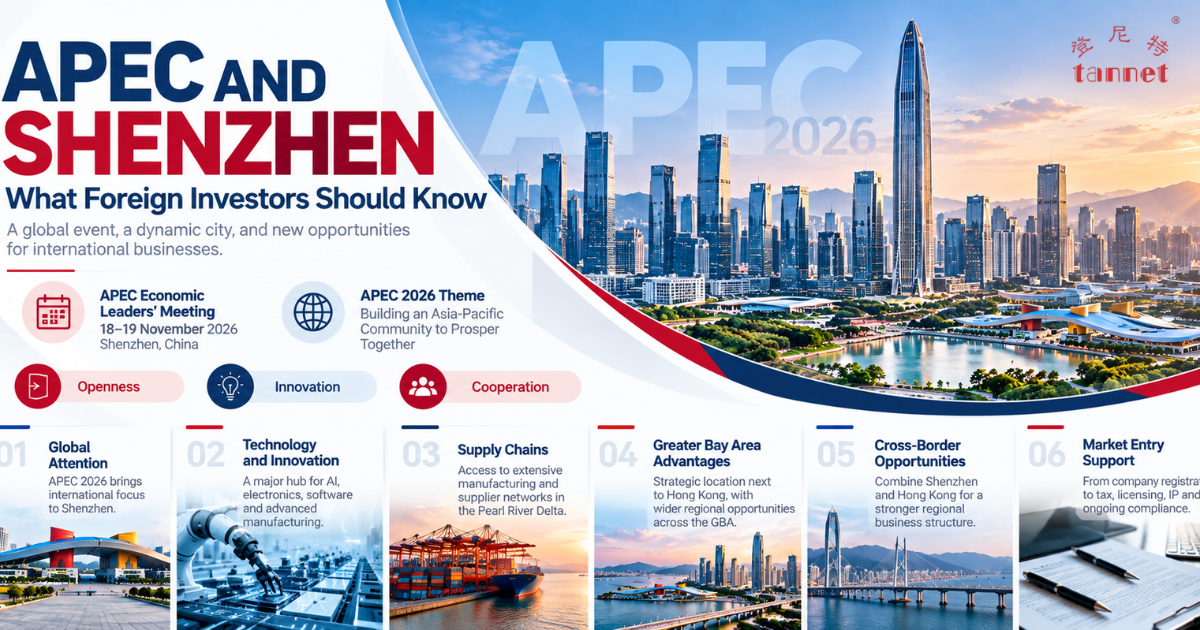
As Shenzhen prepares to host the APEC Economic Leaders’ Meeting on 18–19 November 2026, international attention is increasingly turning toward one of China’s most important business and innovation centres.
For foreign investors, APEC 2026 is more than a major international event. It provides an opportunity to examine Shenzhen’s role in regional trade, technology, supply chains and cross-border investment — and to consider whether the city could serve as an entry point into the wider Chinese market. Here’s to understand how APEC and Shenzhen means to foreign investors.
Why APEC 2026 Matters
The Asia-Pacific Economic Cooperation (APEC) forum brings together 21 member economies to promote economic cooperation, trade and shared prosperity across the Asia-Pacific.
China is hosting APEC in 2026 under the theme “Building an Asia-Pacific Community to Prosper Together,” with three major priorities: Openness, Innovation and Cooperation.
These priorities are particularly relevant to companies considering expansion across the Asia-Pacific. Discussions throughout the 2026 APEC agenda have covered areas including regional economic integration, trade facilitation, digital transformation, artificial intelligence, supply chains, services and investment.
For businesses, these discussions can help identify the broader policy and economic trends shaping future opportunities in the region.
Why Shenzhen?
Shenzhen’s selection as the host city for the APEC Economic Leaders’ Meeting places additional international attention on a city that is already deeply connected to global business.
Shenzhen was one of China’s first Special Economic Zones and has developed into a major centre for technology, advanced manufacturing, international trade and innovation.
According to APEC, Shenzhen’s GDP reached approximately RMB 3.68 trillion in 2024, while its total trade reached around RMB 4.5 trillion.
Its location is another important consideration for foreign investors.
Situated directly next to Hong Kong, Shenzhen forms part of the Guangdong-Hong Kong-Macao Greater Bay Area (GBA), giving companies access to a wider regional business ecosystem encompassing manufacturing, finance, professional services, logistics, technology and international trade.
Business Opportunities Foreign Investors Should Watch
APEC 2026’s emphasis on openness and innovation closely intersects with several areas in which Shenzhen has developed significant commercial capabilities.
Technology and Digital Economy
Shenzhen has a substantial technology ecosystem covering areas such as artificial intelligence, electronics, software, telecommunications and digital services. Companies entering China to develop technology partnerships, source products or explore digital opportunities may find Shenzhen particularly relevant.
Advanced Manufacturing and Supply Chains
The city and surrounding Pearl River Delta have extensive manufacturing and supplier networks. Foreign companies involved in electronics, machinery, consumer products and technology-related industries can use Shenzhen as a base for supplier engagement, product development and China market exploration.
Cross-Border Trade
Shenzhen’s trade infrastructure and proximity to Hong Kong make cross-border business another important area to consider. Companies should assess how their Chinese operations will interact with suppliers, customers, logistics providers and overseas entities before establishing their corporate structure.
Shenzhen or Hong Kong?
Foreign investors do not necessarily need to view Shenzhen and Hong Kong as competing choices.
Depending on the business model, the two locations can serve different functions within the same regional strategy.
A Hong Kong company may support international contracting, cross-border transactions or regional operations, while a Shenzhen entity can provide a direct operating presence in Mainland China.
The appropriate structure depends on factors such as where customers are located, where employees will work, how revenue will be generated and whether the company requires local licences, import-export capabilities or physical operations.
What Should Foreign Investors Prepare?
Before establishing a company in Shenzhen, foreign investors should evaluate several practical issues:
- Proposed business activities and company structure
- Shareholder and legal representative arrangements
- Registered address requirements
- Business licence and industry-specific approvals
- Corporate bank account arrangements
- Tax registration and ongoing accounting
- Employment and social insurance requirements
- Import-export arrangements, where applicable
- Trademark and intellectual property protection
Companies should also consider whether Shenzhen, Guangzhou, Hong Kong or a combination of locations provides the most suitable structure for their China and Greater Bay Area strategy.
Turning APEC Attention into a Market Entry Strategy
APEC 2026 is bringing greater international visibility to Shenzhen, but entering the Chinese market still requires careful planning.
Foreign companies should look beyond the event itself and evaluate the practical fundamentals of operating in China: company registration, taxation, banking, licensing, intellectual property, staffing and ongoing compliance.
For international investors exploring China and the Greater Bay Area, Shenzhen can be more than an APEC host city. It can also be a practical starting point for understanding one of Asia’s most active commercial regions.
Planning to establish or expand your business in Shenzhen, Hong Kong or the Greater Bay Area?
Tannet can assist international businesses with company registration, corporate services, accounting and taxation, trademark registration, business licences and cross-border market-entry support.