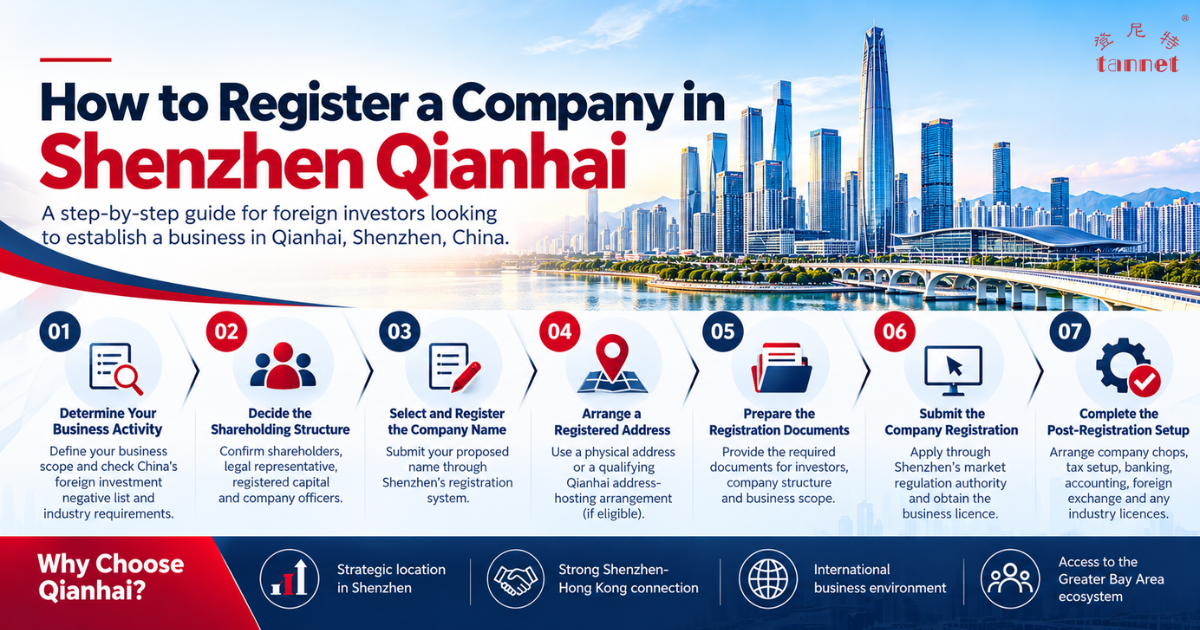
For international companies looking to enter China, Shenzhen is one of the country’s most important commercial and technology hubs. Within Shenzhen, the Qianhai Shenzhen-Hong Kong Modern Service Industry Cooperation Zone has developed into a significant platform for cross-border business, particularly for companies connecting Mainland China, Hong Kong and international markets.
But how does a foreign investor actually register a company in Shenzhen Qianhai?
The process is relatively structured, but investors need to consider their business scope, ownership structure, registered address, capital arrangements and industry requirements before submitting an application.
1. Determine Your Business Activity
The first step is defining what the company will actually do in China.
This is important because the proposed business activities affect the company’s registered business scope and may determine whether additional licences or regulatory approvals are required.
Common activities may include:
- Business consulting
- Technology services
- Software and IT services
- Import and export
- Supply chain services
- E-commerce
- Professional services
- Trading
Foreign investors should also check whether their proposed activities are subject to China’s foreign investment access restrictions.
China applies a negative-list system to foreign investment. Activities outside the applicable foreign investment negative list are generally administered according to the principle of equal treatment between domestic and foreign investment.
Businesses operating in regulated sectors may still require industry-specific approvals or licences.
2. Decide the Shareholding Structure
A foreign-invested company can potentially be established by foreign individuals, overseas companies or a combination of investors, subject to the requirements applicable to the proposed sector.
Before registration, investors should determine:
- Shareholder(s)
- Legal representative
- Directors or executive director
- Supervisor or other required governance positions
- Registered capital
- Shareholding percentages
- Company business scope
The appropriate structure should be planned according to the company’s future operations rather than treating incorporation as an isolated administrative procedure.
For example, companies expecting to hire employees, conduct cross-border trade or obtain specialised licences should consider these requirements during the initial structuring stage.
3. Select and Register the Company Name
The proposed company name must comply with Chinese company naming requirements and be submitted through Shenzhen’s enterprise registration system.
Investors should prepare alternative names in case their preferred name is unavailable or cannot be approved.
The final Chinese company name is particularly important because it will become the company’s official registered legal name.
4. Arrange a Registered Address
A company registered in Shenzhen needs an acceptable registered address.
For companies intending to establish themselves in Qianhai, address arrangements should be reviewed carefully before incorporation.
Qianhai has historically provided address-hosting arrangements for qualifying enterprises without their own physical premises in the area, but eligibility and current requirements should be confirmed before relying on such an arrangement.
The address is not simply a mailing detail. It can affect company registration, regulatory correspondence and subsequent administrative procedures.
5. Prepare the Registration Documents
The required documents depend on the investor type and company structure.
Foreign-invested companies may need documentation relating to:
- Foreign shareholder identity or corporate qualification
- Proposed company name
- Articles of association
- Registered address
- Legal representative
- Directors and other company officers
- Registered capital
- Business scope
- Foreign investment information
Overseas corporate documents may also need to satisfy applicable authentication or verification requirements.
Preparing the documents correctly at the beginning can significantly reduce delays caused by amendments or supplementary document requests.
6. Submit the Company Registration
Once the structure and documentation are ready, the incorporation application can be submitted to Shenzhen’s market regulation authority.
According to Shenzhen’s current enterprise registration guidance, the general sequence includes preparing the establishment documents, obtaining company name approval and receiving the business licence.
Foreign-invested enterprises must also fulfil applicable foreign investment information reporting obligations.
Once approved, the company receives its business licence and becomes a legally registered Chinese enterprise.
7. Complete the Post-Registration Setup
Receiving a business licence does not mean the company is fully operational.
Depending on the business model, the company may subsequently need to arrange:
Company chops
Official company seals are essential for executing many corporate documents in China.
Tax registration and tax setup
The company needs to establish its tax and accounting arrangements and comply with ongoing filing obligations.
Corporate bank account
A Chinese corporate bank account is normally required for day-to-day operations.
Foreign exchange arrangements
Companies receiving overseas investment or making cross-border payments may need to complete applicable banking and foreign-exchange procedures.
Industry licences
Certain businesses require additional licences before regulated activities can begin.
Why Consider Qianhai?
Qianhai’s location within Shenzhen and its role in Shenzhen-Hong Kong cooperation make it particularly relevant for businesses looking at opportunities across Mainland China and Hong Kong.
However, choosing Qianhai should be based on the company’s actual commercial requirements rather than location alone.
Investors should assess whether Qianhai fits their business activities, operational requirements, customer base and longer-term China strategy.
Planning to Establish a Company in Shenzhen?
A successful China market entry involves more than obtaining a business licence.
Tannet can assist international investors with company incorporation, business structuring, registered address arrangements, corporate secretarial support, accounting and taxation, bank account assistance, intellectual property and other market-entry services.
If you are considering establishing a company in Shenzhen or Qianhai, planning the structure correctly from the beginning can make subsequent operations significantly easier.
📞 Free 1-on-1 Consultation Now,
Official Service Hotline: +86-755-82148419
Cell: +86-13823131503;+60 19-309 2363
WeChat ID: 13823131503;
WhatsApp:+86-13823131503;+60 19-309 2363
Email: mytannet08@gmail.com; susiehu@citilinkia.com