Key Takeaway
APEC 2026 matters to overseas businesses because its China-year agenda highlights openness, innovation and cooperation across an existing commercial region, not because the forum creates automatic investment incentives.
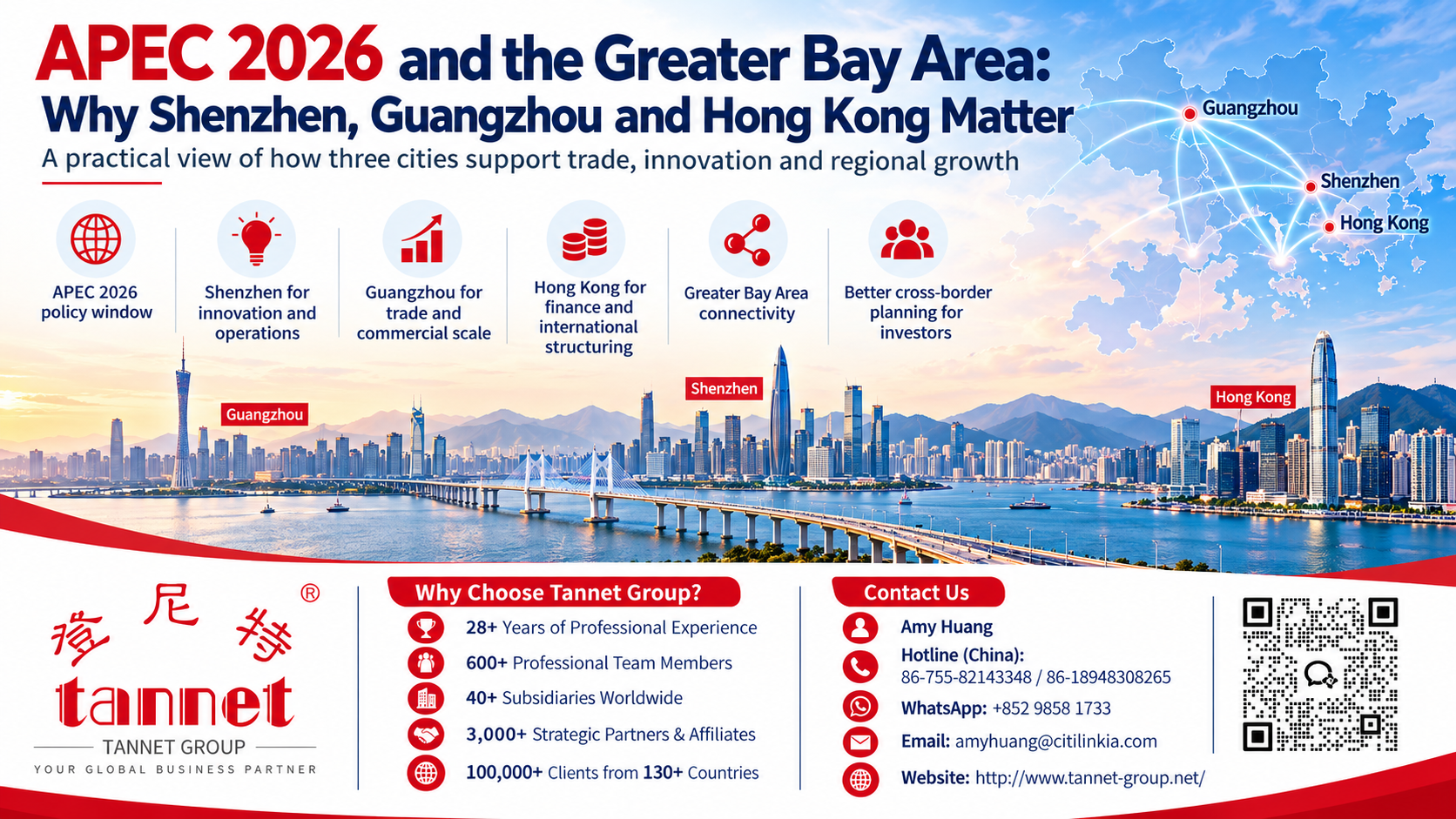
Shenzhen, Guangzhou and Hong Kong offer different functions within that region.
Shenzhen supports technology development, advanced manufacturing and product commercialization. Guangzhou provides broad industrial, trading, transport and consumer-market capabilities.
Hong Kong connects international capital, professional services, dispute resolution and cross-border finance. The practical decision is not which city is universally superior. It is which activities, contracts, people, assets and risks belong in each jurisdiction.
Investors must still assess market access, tax, customs, data, employment and licensing rules separately.
APEC 2026 puts a regional business system in view
China set “Building an Asia-Pacific Community to Prosper Together” as the APEC 2026 theme. The three priorities are openness, innovation and cooperation. These priorities guide discussion among 21 member economies. They do not amend Chinese law or grant a company preferential treatment by themselves.
The official calendar reveals a useful regional pattern. Guangzhou hosted the First Senior Officials’ Meeting in February and the Small and Medium Enterprises Ministerial Meeting in September. Hong Kong will host the Finance Ministers’ Meeting from 19 to 21 October. Shenzhen will host the Economic Leaders’ Meeting on 18 and 19 November.
This sequence is more than event geography. It reflects capabilities that businesses already use. Guangzhou is a commercial and transport centre. Hong Kong is an international financial centre. Shenzhen is an innovation and manufacturing centre. APEC provides a timely lens for examining how those functions connect.
The Greater Bay Area comprises Hong Kong, Macao and nine Guangdong cities. Its official portal reports more than 88 million residents and GDP above RMB15 trillion in 2025. That scale creates opportunity, but the region is not one legal, tax or customs territory.
Shenzhen is the commercialization and manufacturing engine
Shenzhen suits companies that need rapid engineering, electronics supply chains, digital infrastructure or access to technology partners. The city’s official Greater Bay Area profile describes it as an important base for high-technology research, development and manufacturing.
Its strength is the speed from prototype to production. A foreign business can place product development, supplier management, quality control and Mainland sales in Shenzhen. This model is relevant to hardware, robotics, medical devices, software-enabled equipment and clean technology.
However, a Shenzhen entity must have a defined business scope and appropriate licences. Importing equipment, processing personal information, hiring staff or receiving service fees may trigger separate customs, cybersecurity, employment, foreign-exchange and tax obligations.
Guangzhou provides scale, distribution and commercial depth
Guangzhou offers a different advantage. Its official development focus identifies the city as an international commerce and industry centre, integrated transport hub, and centre for technology, education and culture.
That profile fits consumer brands, trading companies, professional services, food businesses and companies that need access to a broad supplier and distribution network. Guangzhou also connects closely with manufacturing cities such as Foshan and Dongguan.
The APEC meetings held in Guangzhou reinforce this commercial role. The September SME ministerial discussions focused on digital adoption, access to markets and finance, standards, certification and participation in global supply chains. These issues are operational concerns for foreign-invested SMEs, not abstract conference language.
A Guangzhou company still needs its own compliance plan. Product registration, labelling, advertising, customs, VAT treatment and local permits depend on the activity. A distributor, representative office and foreign-invested company produce different control and tax outcomes.
Hong Kong connects the regional structure internationally
Hong Kong is useful when a group needs an international holding, financing, contracting or treasury platform. The official Greater Bay Area development plan positions Hong Kong as an international financial, transportation and trade centre, offshore renminbi hub, asset-management centre and legal and dispute-resolution centre.
For some investors, a Hong Kong parent can hold shares in a Mainland subsidiary, receive dividends, contract with overseas customers and coordinate regional cash. This can support governance and future fundraising. It does not automatically reduce tax.
Treaty benefits, withholding-tax treatment and offshore claims depend on detailed conditions. Authorities may examine beneficial ownership, commercial substance, decision-making, staff, premises, risks and actual functions. A paper company with no credible purpose creates more questions than value.
Hong Kong will host the APEC Finance Ministers’ Meeting in October. That placement supports the city’s financial role, but any policy statement must later be translated into legislation, regulatory guidance or market practice before companies change their structure.
The three cities form an innovation corridor
The Shenzhen-Hong Kong-Guangzhou cluster ranked first in WIPO’s 2025 global innovation-cluster ranking. WIPO used patent filings, scientific publications and venture-capital activity in its assessment.
The ranking matters because it measures connected inputs. Shenzhen contributes engineering and industrial application. Guangzhou adds universities, research capacity and commercial scale. Hong Kong contributes international finance, research institutions, intellectual-property services and global networks.
Investors should not treat the ranking as proof that every project will succeed. It indicates ecosystem density. Commercial results still depend on product-market fit, regulatory approval, ownership of intellectual property and disciplined execution.
A practical three-city structure
Step 1: assign functions before registering entities
List where management, sales, research, manufacturing, procurement and financing will occur. Do not register three companies merely because three cities appear attractive. Each entity should have a necessary function, accountable people and a realistic budget.
Step 2: map contracts and revenue
Identify which entity signs customers, employs staff, owns intellectual property and bears inventory risk. Contract flows should match real activity. Artificial service fees or royalties can create transfer-pricing, withholding-tax and foreign-exchange problems.
Step 3: test market access and licensing
China’s foreign-investment negative list and sector rules determine whether a proposed Mainland activity is permitted or restricted. Separate licences may apply to telecoms, education, healthcare, food, finance, transport and online services.
Step 4: plan tax and cash movements
Model corporate income tax, VAT, customs duties, dividend withholding tax and payroll costs. Examine how capital enters China and how lawful profits can later be distributed. Keep board approvals, audit records and tax documentation aligned.
Step 5: protect data and intellectual property
Decide where trademarks, patents, software and business data will be held. Cross-border data transfers and technology licensing require specific analysis. Registration in Hong Kong does not replace Mainland intellectual-property protection.
Common mistakes
- Assuming APEC announcements immediately change investment law.
- Using one city for every function without comparing operating needs.
- Creating a Hong Kong holding company without substance or governance.
- Letting contracts, invoices and actual work occur in different entities.
- Ignoring product, data or sector licences until after registration.
- Treating the Greater Bay Area as one tax and customs jurisdiction.
- Choosing locations for incentives before confirming eligibility and duration.
Frequently asked questions
Q1. Does APEC 2026 create new tax incentives in Shenzhen?
No. APEC is a policy forum. Incentives require separate laws, regulations or official local measures. Check the eligibility, effective period and filing procedure for any claimed benefit.
Q2. Should every foreign investor establish a Hong Kong holding company?
No. It may help with governance, finance or regional ownership, but it adds cost and compliance. The structure must have a business purpose and appropriate substance.
Q3. Is Shenzhen always preferable for technology companies?
Not always. Shenzhen is strong in commercialization and manufacturing. Guangzhou or Hong Kong may be better for particular research, market, finance or talent functions.
Q4. Can one company operate freely across all three cities?
No. Hong Kong and Mainland China have different company, tax, employment, currency and data regimes. Mainland branches or subsidiaries may be required for local operations.
Q5. Can profits move freely from a Mainland company to Hong Kong?
No. Dividends generally require after-tax profits, loss recovery, reserve allocations, corporate approvals, tax handling and bank documentation. Service payments need genuine contracts and supporting records.
Q6. What should investors do before APEC Leaders’ Week?
Use the event as a research and relationship-building window. Confirm access rules, avoid implying official endorsement, and base investment decisions on published law and due diligence.
Where Tannet can assist
Tannet is suitable for overseas businesses comparing Hong Kong and Mainland structures, establishing a China entity, reviewing corporate and tax compliance, or coordinating cross-border accounting and documentation. The appropriate scope depends on the sector, ownership chain, operating locations and planned transactions. Early coordination also helps management compare recurring compliance costs, reporting timelines and exit options before capital is committed across entities. Legal, tax and regulatory advice should be confirmed for the investor’s specific facts.
Official and High Credibility Sources
Written by: Tannet Business Services Team
Reviewed by: Consultant Amy Huang
First published: 24 Sep. 2026
Last reviewed: 24 Sep. 2026
————————————————Simplifying Business, Empowering Entrepreneurs————————————————