Malaysia remains an attractive destination for foreign investors and international companies seeking to expand their operations in Southeast Asia. With its strategic location, established infrastructure, and growing business opportunities, many foreign-owned companies choose Malaysia as a base for regional operations.
However, one common question among foreign investors is: Can a foreign-owned company hire expatriates in Malaysia?
The answer is yes. A 100% foreign-owned company may employ eligible foreign professionals in Malaysia, provided it meets the relevant company registration, immigration, and employment requirements.
One of the key steps is ESD Registration Malaysia, which allows eligible employers to apply for Employment Passes (EP) and other expatriate-related immigration passes.
This guide explains the ESD registration requirements in Malaysia for 2026, including company eligibility, paid-up capital, required documents, application procedures, and important considerations for foreign-owned businesses.
1. Can a 100% Foreign-Owned Company Hire Expatriates in Malaysia?
Yes. Foreign-owned companies registered in Malaysia may hire expatriates if they satisfy the applicable immigration and employer eligibility requirements.
These companies may include:
- Wholly foreign-owned private limited companies (Sdn. Bhd.)
- Malaysian subsidiaries of international corporations
- Foreign-invested manufacturing companies
- International trading and service companies
- Technology and engineering businesses
- Regional offices and multinational business operations
Foreign-owned businesses commonly recruit expatriates for positions requiring specialised expertise, international management experience, or technical capabilities.
Examples include foreign directors with qualifying employment arrangements, general managers, engineers, technical specialists, IT professionals, and senior executives.
However, registering a company in Malaysia does not automatically grant permission to employ foreign nationals.
The company must first satisfy the relevant employer registration requirements and obtain the appropriate immigration approvals for its foreign employees.
2. What Is ESD Registration in Malaysia?
The Expatriate Services Division (ESD) operates under the Immigration Department of Malaysia.
ESD provides an online platform through which eligible companies can register as employers and submit expatriate-related immigration applications.
ESD registration is generally required for companies applying for Employment Passes through the standard ESD system.
Once registered and activated, eligible companies may submit applications for:
- Employment Pass (EP)
- Dependant Pass (DP)
- Long-Term Social Visit Pass (LTSVP)
- Other supported expatriate-related immigration passes
The Employment Pass is the principal work authorisation for eligible foreign professionals employed by Malaysian companies.
Employers should note that ESD registration and Employment Pass approval are separate procedures.
An approved ESD employer registration does not guarantee approval of an individual expatriate’s Employment Pass application.
Certain industries and employers may also be subject to separate expatriate application channels or additional regulatory approvals.
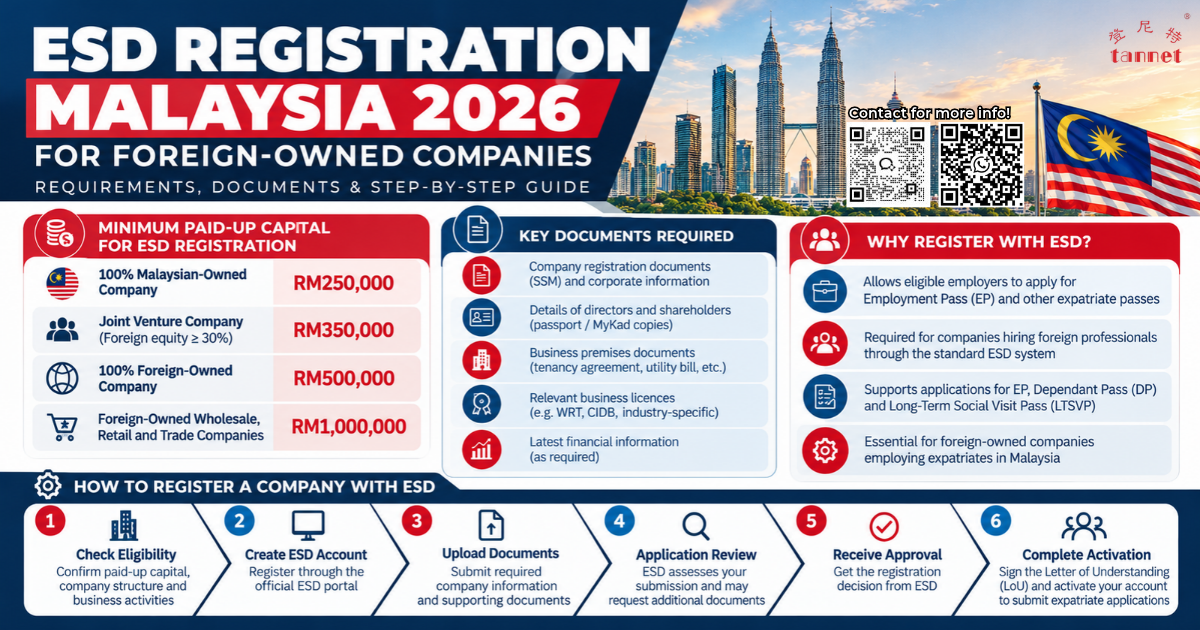
3. ESD Registration Malaysia: Minimum Paid-Up Capital Requirements
One of the most important considerations for foreign investors is the company’s paid-up capital.
According to the published ESD eligibility requirements, the minimum paid-up capital generally depends on the company’s ownership structure.
100% Malaysian-Owned Company
Minimum Paid-Up Capital: RM250,000
This category applies to companies wholly owned by Malaysian shareholders.
Joint Venture Company
Minimum Paid-Up Capital: RM350,000
This category generally applies to qualifying joint ventures involving Malaysian and foreign shareholders, where foreign equity is at least 30%.
100% Foreign-Owned Company
Minimum Paid-Up Capital: RM500,000
A wholly foreign-owned company generally needs at least RM500,000 in paid-up capital to meet the standard ESD registration threshold.
This is particularly relevant to foreign investors establishing Malaysian subsidiaries or companies with 100% overseas ownership.
Foreign-Owned Wholesale, Retail and Trade Companies
Minimum Paid-Up Capital: RM1,000,000
Foreign-owned businesses undertaking regulated wholesale, retail, and trade activities may be subject to a higher paid-up capital requirement.
Applicable Wholesale, Retail and Trade (WRT) approvals or licensing requirements must also be considered.
The precise regulatory requirements depend on the company’s actual business activities and applicable licensing framework.
Important: These are ESD employer eligibility thresholds. They should not be confused with the minimum capital required merely to incorporate a Malaysian Sdn. Bhd. or with separate requirements imposed by other regulatory authorities.
Meeting the paid-up capital threshold alone does not guarantee ESD registration or expatriate employment approval.
4. What Documents Are Required for ESD Registration in Malaysia?
Before applying for ESD registration, companies should prepare their corporate information and supporting documents.
The required documents may vary according to the company’s ownership structure, business activities, and registration status.
Commonly requested documents include:
Company Registration Documents
- Company registration information from the Companies Commission of Malaysia (SSM)
- Relevant corporate incorporation documents
- Company profile describing the business activities
- Details of company directors and shareholders
- Latest available financial information or reports, as applicable
Business Premises Documents
- Tenancy agreement or property ownership documents
- Company telephone bill or other requested premises evidence
- Relevant local authority business licences, where applicable
Directors and Corporate Information
- Passport or MyKad copies of company directors
- Relevant company ownership information
- Supporting corporate records requested through the ESD system
Industry-Specific Supporting Documents
Depending on the nature of the business, additional documentation may include:
- WRT approvals or licences
- Construction Industry Development Board (CIDB) registration
- Manufacturing-related approvals
- Other applicable business licences or regulatory documents
Companies should refer to the latest ESD document checklist before submitting an application.
For newly incorporated companies, certain financial records may not yet be available. Such cases should be assessed according to the current ESD requirements rather than assuming that unavailable documents are automatically waived.
5. How to Register a Company With ESD in Malaysia
The ESD registration process generally involves the following stages.
Step 1: Check Company Eligibility
Before registering, the employer should confirm that its company structure, paid-up capital, business activities, and supporting documentation meet the applicable ESD requirements.
Foreign-owned companies should pay particular attention to whether additional regulatory approvals are required for their industry.
Step 2: Create an ESD Online Account
The company begins registration through the official ESD portal.
The employer must provide the required company information and details of its authorised representatives.
Step 3: Upload the Required Documents
The company prepares and uploads the supporting documents requested by the ESD system.
These may include company registration documents, director identification records, business premises information, and relevant licences.
Step 4: Submit the Application for Review
After submission, the application is reviewed by the relevant immigration authorities.
Additional documents or clarification may be requested during the assessment.
Step 5: Receive the Registration Decision
The company receives notification of the registration outcome through the ESD system.
If approved, the company proceeds with the required registration activation formalities.
Step 6: Complete Company Activation
Approved employers must complete the applicable Letter of Understanding (LoU) and company activation procedures.
Once the account has been fully activated, the employer can access the relevant expatriate application services.
Step 7: Apply for the Employment Pass
After successful ESD registration, the employer may proceed with the applicable Employment Pass application procedures for eligible foreign employees.
The employer must still satisfy the relevant labour, immigration, and sector-specific requirements.
6. How Long Does ESD Registration Take in Malaysia?
The ESD Online Guidebook published in 2025 states a processing charter of five working days for the initial company registration decision, subject to complete documentation and any additional inspection requirements.
However, this processing period does not necessarily include the time required to complete company activation formalities or obtain additional regulatory approvals.
Actual processing times may vary depending on:
- Completeness of the application
- Accuracy of company information
- Additional document requests
- Business activity and regulatory requirements
- Verification or inspection procedures
Companies should also allow separate processing time for subsequent Employment Pass applications.
For businesses planning to relocate expatriate employees, early preparation is recommended.
7. Can a Newly Incorporated Malaysian Company Apply for ESD Registration?
A newly incorporated Malaysian company may be eligible to apply for ESD registration if it satisfies the applicable requirements.
However, incorporation alone is insufficient.
Before proceeding, the company should assess whether it has:
- The required paid-up capital
- Properly registered business activities
- Relevant company documentation
- Acceptable business premises information
- Applicable business licences and regulatory approvals
- A legitimate business need for expatriate employment
For foreign investors, the proposed company structure should be planned with future expatriate employment requirements in mind.
For example, a foreign investor may establish a Malaysian company with relatively low initial paid-up capital.
However, if the company subsequently intends to apply for ESD registration, it may need to increase its paid-up capital to satisfy the applicable employer eligibility threshold.
This is why company incorporation and expatriate employment planning should be considered together rather than treated as completely separate matters.
8. Additional Requirements Before Hiring Expatriates
Completing ESD registration is only one part of the expatriate hiring process.
Before submitting an Employment Pass application, employers may also need to complete additional procedures.
JTKSM Prior Approval
Under Section 60K of the Employment Act 1955, applicable employers in Peninsular Malaysia and Labuan must obtain prior approval before employing foreign nationals.
For relevant new Employment Pass applications, this procedure is facilitated through Xpats Gateway.
Certain exemptions apply, including specified renewal and internal position-change situations.
MYFutureJobs Requirements
Employers may need to comply with MYFutureJobs advertising requirements and obtain the relevant acknowledgement before applying for a new Employment Pass.
Exemptions may apply depending on the position or application type.
Regulatory Support Letters
Companies operating in certain industries may require support letters from the relevant approving agencies or regulatory bodies.
The requirement depends on the company’s business sector and applicable immigration route.
Employers should determine which preliminary approvals apply before submitting their expatriate applications.
9. Common ESD Registration Mistakes Foreign-Owned Companies Should Avoid
Foreign-owned companies may encounter registration delays if they overlook important requirements during the business establishment process.
Insufficient Paid-Up Capital
The company’s paid-up capital may not satisfy the applicable ESD eligibility threshold.
Incorrect Business Classification
The company’s registered activities may not accurately reflect its actual operations or the regulatory category under which it should apply.
Incomplete Company Documentation
Missing corporate records, business premises documents, or supporting licences may delay the review.
Overlooking Sector-Specific Requirements
Certain business activities require additional regulatory approvals before expatriate applications can proceed.
Assuming ESD Approval Guarantees an Employment Pass
ESD registration allows an eligible employer to access the expatriate application process, but each Employment Pass application is assessed separately.
By reviewing these requirements early, companies can reduce avoidable administrative complications.
10. How TANNET Can Assist With ESD Registration and Expatriate Hiring in Malaysia
Establishing a foreign-owned company in Malaysia involves more than completing the incorporation process.
Businesses planning to hire foreign professionals must also consider corporate structure, paid-up capital, employer registration, and immigration compliance.
TANNET provides corporate and business support services to foreign investors and companies expanding into Malaysia.
Our services can assist businesses with:
- Malaysia company incorporation
- Corporate structure and business establishment coordination
- ESD employer registration assistance
- Employment Pass application assistance
- Supporting documentation preparation
- Coordination of applicable corporate and immigration procedures
- Related corporate compliance and business advisory services
Whether your company is establishing a new Malaysian subsidiary or planning to hire expatriate professionals, understanding the requirements in advance can help support a more efficient business expansion process.
11. Planning to Hire Expatriates Through Your Malaysian Company?
Foreign-owned companies can hire expatriates in Malaysia, provided they satisfy the applicable employer registration, paid-up capital, employment, and immigration requirements.
For businesses planning to recruit overseas professionals, ESD registration is often an important preliminary step.
However, each company’s requirements may differ depending on its ownership structure, business activities, and proposed expatriate positions.
Need assistance with ESD registration in Malaysia?
Contact TANNET to discuss your company’s registration status, expatriate hiring plans, and applicable application requirements.
Our team can help you understand the relevant procedures and coordinate the next steps for establishing or expanding your business in Malaysia.
📞 Free 1-on-1 Consultation Now,
Official Service Hotline: +86-755-82148419
Cell: +86-13823131503;+60 19-309 2363
WeChat ID: 13823131503;
WhatsApp:+86-13823131503;+60 19-309 2363
Email: mytannet08@gmail.com; susiehu@citilinkia.com