Hong Kong remains a preferred destination for entrepreneurs and international businesses due to its business-friendly environment, established legal system, and competitive tax regime.
However, incorporating a Hong Kong company is only the beginning. Maintaining proper accounting records, arranging annual audits, and fulfilling tax filing obligations are equally important.
Many business owners mistakenly believe that a company with limited transactions, no employees, or no taxable profits has minimal compliance responsibilities.
In reality, Hong Kong company audit and tax filing requirements can apply even when a business is inactive or unprofitable.
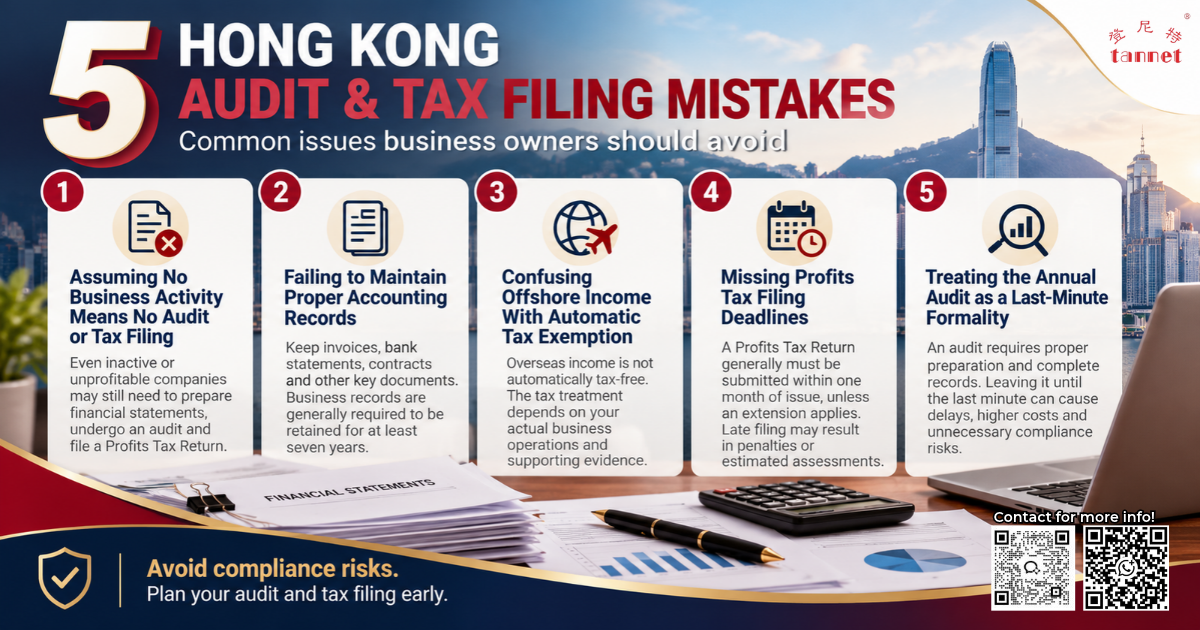
Here are five common mistakes that Hong Kong company owners should avoid.
Mistake 1: Assuming No Business Activity Means No Audit or Tax Filing
One of the most common misconceptions is that a Hong Kong company does not need an audit or tax filing simply because it has not generated revenue.
Under Hong Kong’s Companies Ordinance, companies generally need to prepare annual financial statements and have them audited, subject to applicable statutory exemptions.
An inactive company is not automatically exempt from these obligations.
A company formally qualifying for dormant status under the Companies Ordinance may benefit from certain reporting exemptions. However, merely having no sales or transactions does not establish that status.
Similarly, if the Inland Revenue Department (IRD) issues a Profits Tax Return, the company generally must respond within the prescribed deadline, even where it has no assessable profits.
Business takeaway: Before assuming that your company has no filing obligations, confirm its actual legal and tax compliance status.
Mistake 2: Failing to Maintain Proper Accounting Records
Some business owners only start collecting invoices, bank statements, and receipts when their accountant requests them for an annual audit.
This can create unnecessary complications.
Hong Kong companies are required to maintain sufficient accounting records to explain their transactions and financial position.
Important records may include:
-
Corporate bank statements and transaction histories
-
Sales invoices and purchase invoices
-
Contracts with customers and suppliers
-
Expense receipts and payment records
-
Loan agreements and related-party transactions
-
Supporting documents for cross-border payments
Under Hong Kong tax legislation, business records generally need to be retained for at least seven years, subject to applicable requirements and exceptions.
Incomplete records can delay the audit, increase professional fees, and make it harder to substantiate the company’s tax position.
Business takeaway: Maintain accounting records throughout the year instead of waiting until the annual audit begins.
Mistake 3: Confusing Offshore Income With Automatic Tax Exemption
Hong Kong generally applies a territorial basis of profits taxation.
This means that the source of profits is a key factor in determining whether profits are chargeable to Hong Kong Profits Tax.
However, a Hong Kong company receiving payments from overseas customers does not automatically qualify for offshore tax exemption.
The IRD may examine the operations and transactions that generated the profits, including where relevant profit-producing activities took place.
For certain multinational enterprise entities, Hong Kong’s foreign-sourced income exemption regime may also affect the tax treatment of specified foreign-sourced income.
Business owners should therefore avoid assuming that foreign customers, overseas bank transfers, or the absence of a physical Hong Kong office are sufficient to establish an offshore profits claim.
Business takeaway: Assess your company’s actual business operations and supporting documentation before adopting an offshore tax position.
Mistake 4: Missing Profits Tax Filing Deadlines
Another frequent mistake is assuming that every Hong Kong company follows the same annual tax filing schedule.
In practice, deadlines depend on factors such as when the Profits Tax Return is issued and whether an applicable filing extension has been granted.
Generally, a Profits Tax Return must be submitted within one month of its issue date unless an extension applies.
For newly established businesses, the first Profits Tax Return is generally issued approximately 18 months after business commencement or incorporation, although the actual timing may vary.
Missing a deadline can expose a company to penalties, estimated assessments, or enforcement action.
Business takeaway: Monitor correspondence from the IRD and coordinate with your accounting or tax service provider before deadlines approach.
Mistake 5: Treating the Annual Audit as a Last-Minute Formality
An annual audit is not simply a document prepared to satisfy a filing requirement.
For Hong Kong companies subject to statutory audit requirements, financial statements must be audited by an appropriately qualified auditor.
The audit process may involve reviewing accounting records, obtaining third-party confirmations, examining transactions, and assessing whether the financial statements comply with applicable reporting requirements.
Businesses that delay audit preparation may encounter problems such as missing invoices, unreconciled bank balances, incomplete intercompany records, or insufficient evidence for transactions.
These issues can become particularly significant for companies handling cross-border trading, service fees, commissions, or related-party payments.
Business takeaway: Begin preparing accounting records well before the company’s financial year-end and planned tax filing date.
Why Proper Audit and Tax Compliance Matters
Timely accounting, auditing, and tax filing help business owners maintain reliable financial records and reduce avoidable compliance risks.
For companies operating across Hong Kong, Mainland China, and international markets, accurate financial documentation also supports effective corporate governance and commercial decision-making.
Rather than treating audit and tax filing as isolated annual tasks, businesses should establish a consistent compliance process throughout the year.
How TANNET Can Assist
At TANNET, we support Hong Kong companies with ongoing corporate administration and compliance coordination, including:
-
Bookkeeping and accounting services
-
Annual statutory audit arrangements
-
Hong Kong Profits Tax Return preparation and filing support
-
Dormant company compliance assessment
-
Cross-border tax and corporate compliance consultation
Whether your company is newly incorporated, actively trading, or currently inactive, understanding your obligations early can help prevent unnecessary complications.
Need assistance with your Hong Kong company’s annual audit or tax filing?
Contact TANNET for a preliminary compliance review. Our team can help identify the services and documentation your company may require.
📞 Free 1-on-1 Consultation Now,
Official Service Hotline: +86-755-82148419
Cell: +86-13823131503;+60 19-309 2363
WeChat ID: 13823131503;
WhatsApp:+86-13823131503;+60 19-309 2363
Email: mytannet08@gmail.com; susiehu@citilinkia.com