Key Takeaway
A Hong Kong company may claim a reduced foreign withholding rate on technical service fees when an effective double taxation agreement covers the payment and every treaty condition is met. This is relevant to engineering, technology, consultancy, implementation, support, management, design, and specialist service providers paid from treaty jurisdictions.
The first task is classification. A fee may fall under a dedicated technical-services article, business profits, royalties, or another provision.
The main caution is that there is no universal Hong Kong treaty rate. Residence, beneficial ownership, permanent establishment exposure, contract wording, pricing, local forms, and filing deadlines must be tested for each payer country.
Why the invoice label is not decisive
Calling an invoice “technical services” does not determine the treaty result. Tax authorities review what the supplier actually performs, what the customer receives, where the work occurs, and whether intellectual property rights are transferred.
A software project may include implementation, configuration, a licence, training, maintenance, and hosted access. These elements can fall under different treaty articles.
There is no single treaty rule for technical fees
The Hong Kong Inland Revenue Department publishes a table of maximum treaty rates for dividends, interest, royalties, and technical fees. The technical-fee column contains rates for some partners and “NA” for many others.
“NA” does not automatically mean zero tax. It means the answer must be found in the operative treaty and source-country law.
Some treaties contain a dedicated fees-for-technical-services article. Others address services through business profits, permanent establishment rules, royalties, independent personal services, or domestic withholding provisions.
A practical example: the Hong Kong India DTA
Article 13 of the synthesised Hong Kong-India agreement covers managerial, technical, and consultancy services, including services supplied through technical or other personnel. It excludes specified independent and dependent personal services.
Where the Hong Kong recipient is the beneficial owner, source-country tax on qualifying technical fees is capped at 10% of the gross amount. This example cannot be applied to another treaty partner without checking that partner’s agreement.
The same article also changes the analysis where the payment is effectively connected with a permanent establishment or fixed base.
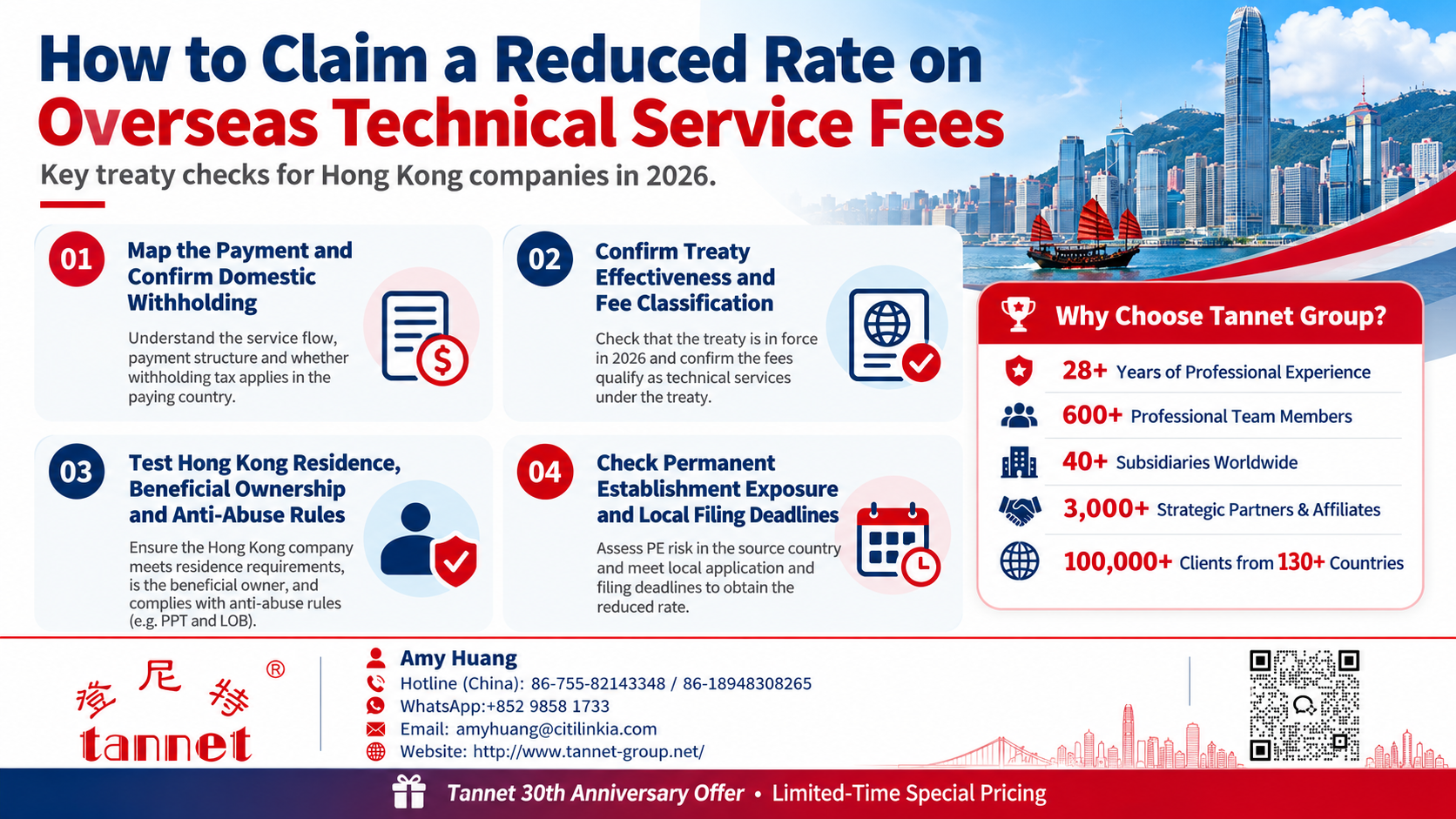
Step 1: map the payment and domestic charge
Identify the legal payer, source jurisdiction, service recipient, place of use, performance locations, payment date, gross amount, and proposed domestic withholding rate.
A treaty usually restricts a tax imposed under domestic law. It does not create the initial charge. Confirm whether the payer must withhold, self-assess, obtain clearance, or report the payment.
Step 2: confirm the treaty is effective
Use the IRD list of concluded agreements to confirm entry into force and the effective date for the relevant tax period.
Read the agreement, protocol, and any synthesised text reflecting Multilateral Instrument changes. A treaty that has been signed but is not yet effective cannot support the current claim.
Step 3: classify the service under the treaty
Ask four questions.
- Does the treaty contain a dedicated technical-services article?
- Does the service transfer a right to use software, copyright, know-how, equipment, or another protected asset?
- Does the service create a permanent establishment or service permanent establishment?
- If no specific article applies, does the fee fall under business profits?
Do not import a “make available” test from another treaty. Use it only where the operative wording and applicable interpretation require it.
Step 4: separate mixed contracts
Mixed contracts should be analysed component by component. Separate fees only when the legal rights, commercial functions, and pricing support the allocation.
For example, an implementation fee may be a service. A software licence may be a royalty. Reimbursed travel may follow another rule. Hardware may be a sale of goods.
Artificial splitting creates risk. A single composite supply may need one dominant classification under local law.
Step 5: establish Hong Kong treaty residence
The Hong Kong company must qualify as a resident under the relevant DTA. A foreign payer or authority may request a Certificate of Resident Status.
Corporate applicants use IR1313A for the Chinese Mainland and IR1313B for other treaty partners.
The IRD expressly states that a CoR does not guarantee treaty relief. The treaty partner makes the final decision.
Step 6: test beneficial ownership and purpose
A dedicated technical-fee article may require the Hong Kong company to be the beneficial owner. The recipient should control the fee and not be bound to pass it to another party.
Review subcontracting, automatic onward payments, narrow margins, back-to-back contracts, bank authority, risk allocation, and decision-making.
Also test the principal purpose rule and other anti-abuse provisions. The structure should have commercial reasons that remain credible without the treaty reduction.
Step 7: review permanent establishment exposure
On-site projects can create a fixed place, construction or installation presence, service permanent establishment, or dependent-agent exposure. Treaty definitions and time thresholds differ.
Track personnel by country, project, date, and activity. Include employees, directors, and subcontractors where the treaty or domestic rule requires aggregation.
Remote performance reduces some physical-presence risks but does not automatically eliminate source-country withholding.
Step 8: support the price
Related-party service charges should follow the arm’s-length principle. The file should explain the benefit received, provider functions, cost base, allocation keys, markup, comparable evidence, and exclusions for shareholder activity.
Some treaty articles limit the reduced rate to the arm’s-length amount. Any excess may remain taxable under domestic law.
Step 9: choose relief at source or refund
Relief at source applies the treaty rate before or when payment is made. It generally protects cash flow but may require pre-approval.
A refund route applies after tax is withheld at the domestic rate. The claimant may need the original withholding certificate, CoR, contract, invoices, bank proof, technical explanation, and certified translations.
Foreign deadlines can run from payment, withholding, assessment, or year-end. A CoR application does not necessarily suspend them.
Step 10: review Hong Kong tax separately
Lower foreign withholding does not determine Hong Kong profits tax. Review where the profit-producing operations occurred, whether the receipt is Hong Kong sourced, and whether the foreign-sourced income exemption regime is relevant.
Consider foreign tax credit or deduction rules only after confirming that the foreign tax was properly imposed and supported by official evidence.
Documents to prepare
- operative treaty, protocol, rate notes, and MLI position;
- service agreement and detailed statement of work;
- deliverables, acceptance records, time sheets, and travel logs;
- invoices, payment evidence, and withholding vouchers;
- CoR for the correct partner and period;
- beneficial ownership and commercial-purpose analysis;
- permanent establishment and transfer pricing review; and
- foreign relief forms, translations, correspondence, and deadline tracker.
Common mistakes
- assuming every technical fee has a reduced treaty rate;
- copying the Hong Kong-India rate into another country analysis;
- describing a licence as support or support as a licence;
- ignoring on-site days and subcontractor activity;
- requesting the CoR after the payer’s deadline;
- using one undivided price for commercially distinct elements; and
- treating foreign withholding as the final Hong Kong tax answer.
Frequently asked questions
Q1. Is the reduced rate always 10%?
No. Ten percent is relevant to certain treaties, including the Hong Kong-India technical-services article. Other agreements and domestic laws differ.
Q2. Can remote consulting qualify?
Possibly. Location affects permanent establishment and source analysis, but classification and local withholding rules still apply.
Q3. Does a CoR prove entitlement?
It proves the IRD’s residence position for the stated purpose. The foreign authority still tests all treaty conditions.
Q4. Are software implementation fees royalties?
Not automatically. Review whether the customer receives use rights, copyright rights, know-how, or only a service.
Q5. Can subcontracting defeat beneficial ownership?
Not by itself. Risk increases where the Hong Kong company has no discretion, capacity, or meaningful margin and must pass the fee onward.
Q6. What if tax was withheld at the domestic rate?
A refund may be available if the treaty applies and the local filing deadline is met.
Q7. What if the authorities disagree on classification?
Protect domestic objection rights and consider the treaty’s mutual agreement procedure. MAP does not automatically pause local deadlines.
When Tannet may assist
Tannet may assist with treaty screening, CoR applications, contract and evidence mapping, claim calendars, and coordination with advisers in the payer jurisdiction. Final classification, rate, and filing requirements should be confirmed under the relevant treaty and local law.
30th Anniversary Offer: To celebrate Tannet’s 30th anniversary, we are offering exclusive limited-time promotional pricing. Slots are limited and available on a first-come, first-served basis. Contact Consultant Amy Huang for details.
Written by: Tannet Business Services Team
Reviewed by: Consultant Amy Huang
First published: 16 Oct. 2026
Last reviewed: 16 Oct. 2026
————————————————Simplifying Business, Empowering Entrepreneurs————————————————