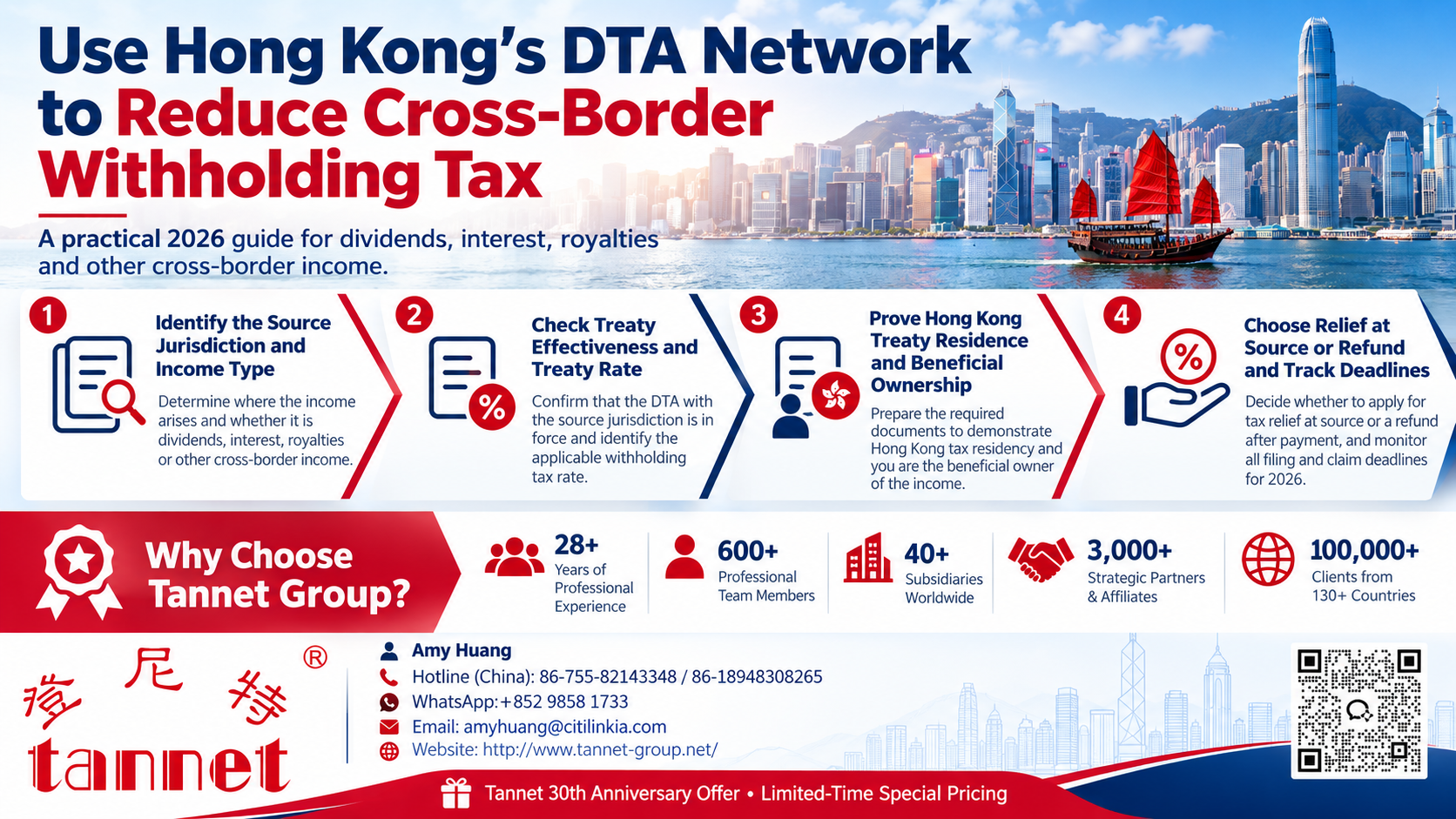
Key Takeaway
A Hong Kong company may use an effective double taxation agreement to reduce foreign withholding tax on qualifying dividends, interest, royalties, or certain fees. This is relevant to holding companies, treasury centres, intellectual property licensors, service groups, and businesses receiving income from overseas payers.
The company must identify the correct treaty, income article, rate, residence period, beneficial owner, and local filing route.
The main caution is that incorporation and a Hong Kong Certificate of Resident Status do not guarantee relief. Signed treaties may not yet be effective, anti-abuse rules can deny benefits, and Hong Kong tax consequences require a separate review.
What the Hong Kong DTA network does
A comprehensive double taxation agreement allocates taxing rights between Hong Kong and another jurisdiction. It can cap source-country tax, define permanent establishment exposure, provide double-tax relief, and offer a mutual agreement procedure.
The Financial Services and the Treasury Bureau reported that Hong Kong had signed CDTAs with 60 jurisdictions by September 2026.
A treaty that is signed but pending ratification cannot normally support current relief.
On 14 October 2026, the Hong Kong Government announced implementation orders for agreements with Barbados, Jordan, the Kyrgyz Republic, Maldives, Norway, and Rwanda. The orders are to be gazetted on 16 October. The agreements still require completion of the relevant ratification procedures before entering into force.
Step 1: identify the source jurisdiction
Withholding tax is imposed under the payer jurisdiction’s domestic law. Hong Kong does not control that tax collection process.
Identify the legal payer, place where the income arises, payment date, gross amount, currency, and domestic withholding rate. Confirm whether the relevant Hong Kong DTA was effective for that period.
Step 2: classify the income correctly
Different treaty articles apply to different returns. Dividends normally fall under Article 10. Interest generally falls under Article 11. Royalties generally fall under Article 12.
Business profits may be protected from source taxation unless the Hong Kong enterprise has a permanent establishment there. Employment, directors’ fees, capital gains, shipping, air transport, and property income follow different rules.
Labels are not decisive. Mixed contracts may be classified differently under each treaty and local law.
Step 3: compare domestic tax with the treaty limit
The IRD publishes a treaty-rate table for dividends, interest, royalties, and technical fees. It is a practical screening tool.
The table shows maximum source-country rates. Read its notes because conditions differ.
The signed agreement, later protocol, effective date, and any MLI modification control. Always compare the domestic rate with the treaty ceiling before calculating the expected saving.
Step 4: establish Hong Kong treaty residence
The Hong Kong recipient must be a resident within the residence article of the operative agreement. Incorporation is relevant, but the wording and facts still matter.
Foreign tax authorities often request a Certificate of Resident Status issued by the Hong Kong IRD. Use IR1313A for corporate applications involving the Chinese Mainland and IR1313B for other treaty partners.
The IRD expressly states that issuing a CoR does not guarantee foreign treaty benefits. The source authority decides whether all conditions are met.
Step 5: prove beneficial ownership
Reduced rates on dividends, interest, and royalties commonly require the Hong Kong company to be the beneficial owner. Legal receipt is not enough when the company must pass the income to another person.
Authorities may examine automatic onward payments, back-to-back loans or licences, narrow margins, restricted bank control, parent instructions, risk allocation, and whether the recipient can use and enjoy the income.
The evidence should show commercial purpose, decision authority, control of receipts, relevant assets, people, risk capacity, and a reasonable relationship between functions and reward.
Step 6: test anti-abuse rules
The OECD describes treaty shopping as obtaining treaty benefits indirectly through a person that was not intended to receive them. The principal purpose test can deny relief where obtaining the benefit was one of an arrangement’s principal purposes, unless relief accords with the treaty’s object and purpose.
Hong Kong’s IRD identifies agreements modified by the Multilateral Instrument and provides synthesised or consolidated texts where available. The original treaty should be read with those changes.
A company should have a commercial reason for its role beyond accessing a reduced rate. Substance must match the specific holding, financing, licensing, or service functions it performs.
Step 7: review ownership and pricing conditions
A dividend rate may depend on a direct ownership percentage and a minimum holding period. A reorganisation close to distribution can change the available rate.
Interest and royalty articles may limit relief to an arm’s-length amount when payer and recipient have a special relationship. Any excess may remain taxable under domestic law.
Related-party contracts should align with transfer pricing analysis. Record comparable terms, functions, assets, risks, pricing method, approvals, and actual conduct.
Step 8: check permanent establishment exposure
The withholding article may not apply when the asset or right producing income is effectively connected with a permanent establishment in the source jurisdiction.
The source country may then tax net business profits and require a local return. Offices, personnel, dependent agents, contract authority, installation activity, and recurring on-site work require review.
Step 9: choose relief at source or refund
Relief at source allows the payer to use the treaty rate when approved evidence is available before payment. This usually provides the better cash-flow result.
A refund route applies where domestic tax is withheld first and the Hong Kong company later claims the difference. Local forms, CoR, contracts, invoices, bank evidence, tax vouchers, translations, and certifications may be required.
Deadlines differ. Some run from payment, assessment, withholding, or the end of a tax year. Prepare the claim calendar before the transaction closes.
Step 10: reconcile foreign and Hong Kong tax
Foreign withholding relief does not decide the Hong Kong profits tax position. Hong Kong generally applies a territorial source principle, while the foreign-sourced income exemption regime can apply to specified foreign-sourced income received in Hong Kong by an MNE entity.
Review source, receipt, MNE status, economic substance or nexus requirements, participation conditions, foreign tax credit, deduction availability, and reporting. Do not assume all foreign tax is creditable.
Documents to retain
- operative treaty, protocols, MLI position, and rate notes;
- CoR for the correct treaty partner and claim period;
- ownership chart and holding-period evidence;
- contracts, invoices, payment schedules, and bank records;
- withholding certificates and foreign tax assessments;
- beneficial ownership and principal purpose analysis;
- transfer pricing and permanent establishment review; and
- relief forms, translations, correspondence, and refund tracking.
Common mistakes
- Using a treaty that is signed but not effective.
- Quoting a rate without checking ownership or recipient conditions.
- Treating incorporation or a CoR as automatic approval.
- Ignoring beneficial ownership and mandatory onward payments.
- Reading the original treaty without MLI modifications.
- Missing relief-at-source or refund deadlines.
- Assuming the foreign result settles Hong Kong tax.
Frequently asked questions
Q1. Does Hong Kong have one standard treaty withholding rate?
No. Rates differ by partner, income type, ownership, recipient category, and treaty wording.
Q2. Can a company claim under a newly signed DTA immediately?
Not usually. Check entry into force and the date from which each tax provision is effective.
Q3. Is a Hong Kong CoR sufficient by itself?
No. The foreign authority may also test beneficial ownership, anti-abuse rules, pricing, and procedure.
Q4. Must a separate CoR be obtained for each partner?
Applications are treaty-partner and claim-period specific. Confirm the current IRD form and payer-country requirement.
Q5. Can treaty relief cover service fees?
Possibly. Classification depends on the DTA, domestic law, technical-fee provisions, and permanent establishment facts.
Q6. What if the payer already withheld the domestic rate?
A refund or credit may be available if the filing deadline and treaty conditions are met.
Q7. What if two authorities apply the DTA differently?
Protect local remedies and consider the mutual agreement procedure. MAP does not automatically suspend domestic deadlines.
Confirm the agreement is effective for the income period, not merely signed or announced, and retain evidence.
When Tannet may assist
Tannet may assist with treaty screening, CoR applications, ownership and transaction document mapping, relief checklists, and coordination with advisers in the source jurisdiction. Final eligibility and foreign filing requirements should be confirmed under the relevant local law.
30th Anniversary Offer: To celebrate Tannet’s 30th anniversary, we are offering exclusive limited-time promotional pricing. Slots are limited and available on a first-come, first-served basis. Contact Consultant Amy Huang for details.
Written by: Tannet Business Services Team
Reviewed by: Consultant Amy Huang
First published: 16 Oct. 2026
Last reviewed: 16 Oct. 2026
————————————————Simplifying Business, Empowering Entrepreneurs————————————————