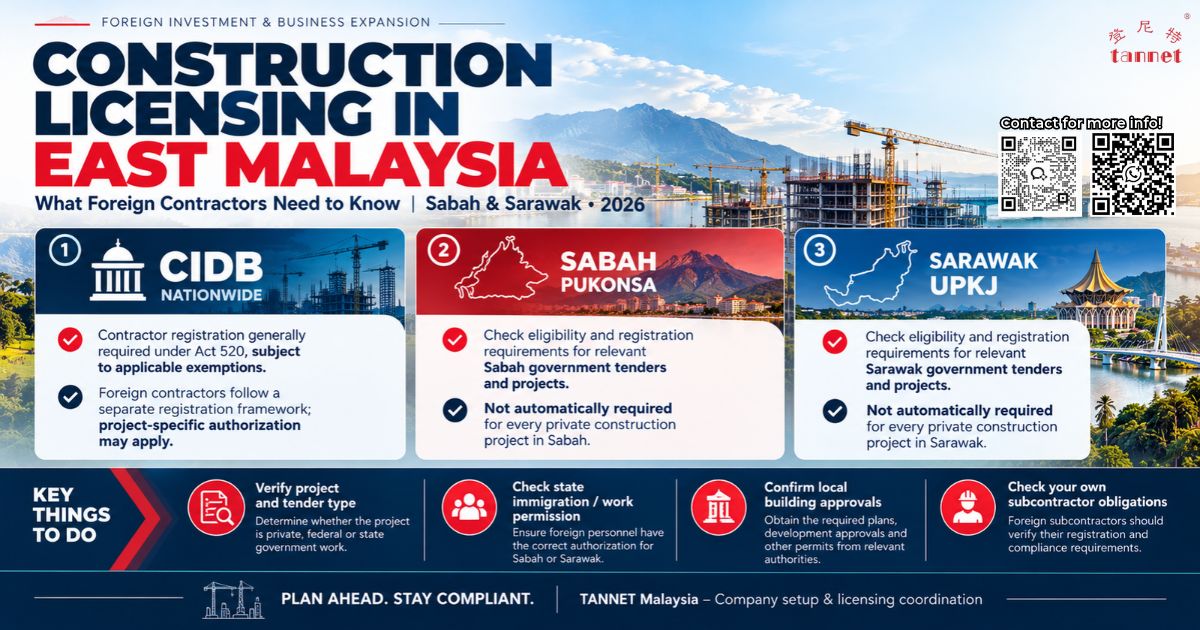
Malaysia’s construction industry continues to offer business opportunities for foreign investors, engineering companies, EPC contractors, and specialist construction service providers. In particular, East Malaysia, comprising Sabah and Sarawak, presents opportunities in infrastructure development, industrial construction, manufacturing facilities, and engineering projects.
However, East Malaysia construction license involves additional considerations compared with Peninsular Malaysia.
Although the Construction Industry Development Board (CIDB) regulates construction contractors nationwide, Sabah and Sarawak have their own state-level contractor registration systems, immigration arrangements, and local administrative requirements.
For foreign construction companies planning to undertake projects in East Malaysia, understanding these differences is essential to avoiding regulatory complications, project delays, and unnecessary costs.
This guide explains the key construction licensing requirements in Sabah and Sarawak, including CIDB registration, PUKONSA, UPKJ, immigration requirements, and important compliance considerations for foreign contractors.
1. Understanding Construction Licensing in East Malaysia
Construction activities in Malaysia are regulated under the Malaysian Construction Industry Development Board Act 1994 (Act 520).
Under this framework, contractors generally must register with CIDB before undertaking construction work, unless an applicable exemption exists.
However, CIDB registration is not necessarily the only requirement for construction projects in East Malaysia.
Depending on the nature and location of the project, contractors may need to consider additional requirements involving:
- Sabah state contractor registration (PUKONSA)
- Sarawak state contractor registration (UPKJ)
- State immigration and employment authorization
- Local authority building and development approvals
- Environmental and industry-specific permits
- Government procurement eligibility requirements
These requirements do not apply identically to every construction project.
For example, a private industrial construction project may have different registration requirements from a state government infrastructure project.
Foreign contractors should therefore assess the applicable requirements based on their project scope, ownership structure, contracting arrangements, and location.
2. CIDB Registration: The Federal Requirement for Construction Contractors
CIDB registration is one of the primary regulatory requirements for construction companies operating in Malaysia.
The requirement generally applies to contractors undertaking construction work in Peninsular Malaysia, Sabah, and Sarawak.
However, foreign contractors and Malaysian local contractors are subject to different registration frameworks.
Local contractors are generally classified under the G1 to G7 grading system, with different project value limits and registration conditions.
Foreign contractors are subject to CIDB’s foreign contractor registration requirements rather than automatically being classified under the local G1–G7 grading system.
Depending on the applicable registration route, foreign contractors may need to obtain preliminary registration and project-specific authorization.
Foreign companies should confirm their eligibility, required documentation, and applicable registration procedures directly with CIDB before bidding for or commencing construction work.
Importantly, a foreign contractor should not assume that authorization for one construction project automatically permits it to undertake unrelated projects.
3. Sabah Construction Licensing: What Is PUKONSA?
Sabah operates a state contractor registration system commonly known as PUKONSA, administered through the relevant Sabah state government registration unit.
PUKONSA registration is particularly relevant to contractors seeking to participate in specified Sabah state government construction projects and procurement activities.
Depending on the tender or procurement conditions, contractors may be required to hold an appropriate PUKONSA registration in addition to satisfying applicable CIDB requirements.
Is PUKONSA Mandatory for All Construction Projects in Sabah?
Not necessarily.
PUKONSA registration is not automatically mandatory for every private construction project in Sabah.
The requirement depends on factors such as:
- Whether the project is privately funded or government-funded
- The contracting or procurement authority
- The tender’s registration conditions
- The contractor’s eligibility and ownership structure
- The type and classification of construction work
Foreign construction companies should verify whether they are eligible for the relevant PUKONSA registration category before participating in state government tenders.
A company holding CIDB registration should not assume that it automatically qualifies for all Sabah government construction projects.
4. Sarawak Construction Licensing: Understanding UPKJ Registration
Sarawak operates a separate state contractor and consultant registration system known as UPKJ, or Unit Pendaftaran Kontraktor dan Juruperunding.
UPKJ registration is particularly relevant to contractors seeking to participate in specified Sarawak government procurement and construction projects.
Companies undertaking construction activities in Kuching, Miri, Bintulu, Sibu, and other parts of Sarawak should assess whether UPKJ registration is applicable to their projects.
Is UPKJ Required for Foreign Contractors?
The requirement depends on the nature of the construction project and the relevant procurement conditions.
For certain Sarawak government construction contracts, contractors may need the appropriate UPKJ registration and must satisfy the applicable eligibility requirements.
However, UPKJ registration is not automatically required for every private-sector construction project in Sarawak.
Foreign contractors should confirm whether their ownership structure, registration category, and proposed activities satisfy the requirements of the relevant authority.
UPKJ registration does not replace CIDB registration. Where both registrations are required, contractors must satisfy the applicable requirements separately.
5. Can Companies Registered in Peninsular Malaysia Undertake Construction Projects in Sabah and Sarawak?
Companies incorporated in Kuala Lumpur, Selangor, Johor, or other parts of Peninsular Malaysia may be able to undertake construction projects in East Malaysia.
However, incorporation with the Companies Commission of Malaysia (SSM) does not automatically authorize a company to perform all construction activities in Sabah or Sarawak.
Before accepting a project, companies should review several important considerations.
Company Registration and Business Structure
The company must have an appropriate legal structure for its proposed activities. Depending on the business model and project arrangements, additional registrations or local administrative requirements may apply.
Contractor Registration
The company must hold the applicable CIDB registration and any required project-specific authorization.
State Procurement Requirements
For relevant government projects, the company should verify whether PUKONSA or UPKJ registration is required and whether it meets the applicable eligibility conditions.
Immigration and Personnel Deployment
The company must ensure that its foreign employees and other personnel have the appropriate authorization to undertake their intended activities in Sabah or Sarawak.
Project Approvals
The company should confirm that the relevant building, development, environmental, and other project approvals have been obtained by the responsible parties.
These checks are particularly important for foreign-owned construction companies entering East Malaysia for the first time.
6. Immigration and Employment Pass Requirements in East Malaysia
One of the most important differences between East Malaysia and Peninsular Malaysia concerns immigration administration.
Sabah and Sarawak have special immigration arrangements that may affect the entry, residence, and employment of personnel from outside the respective states.
Foreign construction companies should not assume that an Employment Pass or other work authorization issued for Peninsular Malaysia automatically permits the holder to work in Sabah or Sarawak.
Depending on the project and personnel involved, additional state immigration approval or an appropriate employment authorization may be required.
This is particularly relevant for companies deploying:
- Foreign construction engineers
- Chinese technical specialists
- Project managers and site supervisors
- Mechanical and electrical installation teams
- Foreign construction workers
- Technical personnel transferred from Peninsular Malaysia
Before mobilizing personnel, employers should verify the applicable requirements with the relevant immigration and labour authorities.
Failure to obtain appropriate work authorization may expose employers and workers to enforcement action and project disruption.
7. Building Plan Approvals and Local Construction Permits
CIDB registration and building plan approval serve different regulatory purposes.
CIDB registration concerns the contractor’s eligibility to undertake construction work, while building and development approvals relate to the authorization of the specific project.
Depending on the nature and location of the construction activities, additional approvals may be required from relevant local authorities and regulatory agencies.
These may include:
- Planning and development approvals
- Building plan approvals
- Environmental approvals
- Earthworks and infrastructure-related approvals
- Fire safety requirements
- Industry-specific technical permits
For example, an industrial construction project in Bintulu may involve different approval authorities and technical requirements from a commercial development in Kota Kinabalu.
Foreign contractors should clarify which approvals are the responsibility of the project owner, developer, main contractor, or subcontractor.
Construction work should not commence until the necessary approvals applicable to that work have been obtained.
8. Can Foreign Construction Companies Undertake Subcontracting Work in East Malaysia?
Foreign construction companies may participate in subcontracting arrangements in Sabah and Sarawak, subject to applicable laws, registration requirements, and project conditions.
Common subcontracting activities include:
- Curtain wall installation
- Mechanical and electrical works
- Industrial equipment installation
- Structural steel installation
- Engineering and technical construction services
- Specialist infrastructure construction
However, being appointed as a subcontractor does not automatically exempt a foreign company from CIDB registration requirements.
Where the subcontracted activities constitute construction work under Act 520, the subcontractor should determine its own registration obligations.
Foreign subcontractors should also review the main contract’s requirements relating to insurance, safety, personnel qualifications, and other compliance matters.
A foreign subcontractor should not assume that the main contractor’s registrations or licences automatically cover its own activities.
9. Common Mistakes Foreign Contractors Should Avoid
Mistake 1: Assuming CIDB Registration Is Sufficient for Every Project
CIDB registration is a key federal requirement, but certain projects may involve additional state procurement, immigration, or local approval requirements.
Mistake 2: Confusing PUKONSA and UPKJ
PUKONSA relates to Sabah, while UPKJ relates to Sarawak. These are separate state contractor registration systems with different procedures and eligibility conditions.
Mistake 3: Assuming State Registration Is Mandatory for Every Private Project
PUKONSA and UPKJ are particularly relevant to specified government procurement activities. Their applicability to a particular project should be verified rather than assumed.
Mistake 4: Deploying Foreign Personnel Without Appropriate Authorization
Foreign engineers, technicians, supervisors, and construction workers must have the appropriate immigration and employment authorization for their intended activities in the relevant state.
Mistake 5: Using One Project Registration for Multiple Projects
Foreign contractor registration and project-specific authorization may restrict the construction activities or projects that a contractor is permitted to undertake.
Mistake 6: Starting Construction Before Obtaining Required Approvals
Contractors should verify that the necessary construction-related approvals are in place before commencing their respective scope of work.
10. How TANNET Malaysia Can Assist Foreign Construction Companies
Entering the construction market in East Malaysia requires careful planning, particularly for foreign-owned companies unfamiliar with Malaysia’s regulatory framework.
TANNET Malaysia provides corporate and business advisory support to international companies establishing or expanding their operations in Malaysia.
Our services include:
- Malaysia company incorporation and corporate structuring
- CIDB contractor registration assistance and coordination
- Sabah and Sarawak construction licensing requirement assessments
- Coordination with relevant local professional service providers
- Employment Pass and immigration application support
- Corporate secretarial and compliance services
- Accounting and tax-related business support
Whether your company plans to undertake an infrastructure project in Sabah, industrial construction in Sarawak, or specialist engineering subcontracting in East Malaysia, understanding the relevant requirements early can help reduce administrative delays and compliance risks.
Conclusion
Construction projects in East Malaysia involve important regulatory considerations that foreign contractors should understand before entering the market.
While CIDB registration provides the federal regulatory framework for construction contractors, Sabah and Sarawak maintain separate state contractor registration systems that may apply to specified government procurement opportunities.
Foreign companies must also consider state immigration arrangements, local authority approvals, and project-specific compliance obligations.
Planning a Construction Project in Sabah or Sarawak?
TANNET Malaysia can assist your company in assessing the relevant registration requirements, coordinating contractor licensing applications, and planning the corporate and compliance arrangements for your proposed construction activities.
Contact TANNET Malaysia today to discuss your construction project requirements in East Malaysia.
📞 Free 1-on-1 Consultation Now,
Official Service Hotline: +86-755-82148419
Cell: +86-13823131503;+60 19-309 2363
WeChat ID: 13823131503;
WhatsApp:+86-13823131503;+60 19-309 2363
Email: mytannet08@gmail.com; susiehu@citilinkia.com