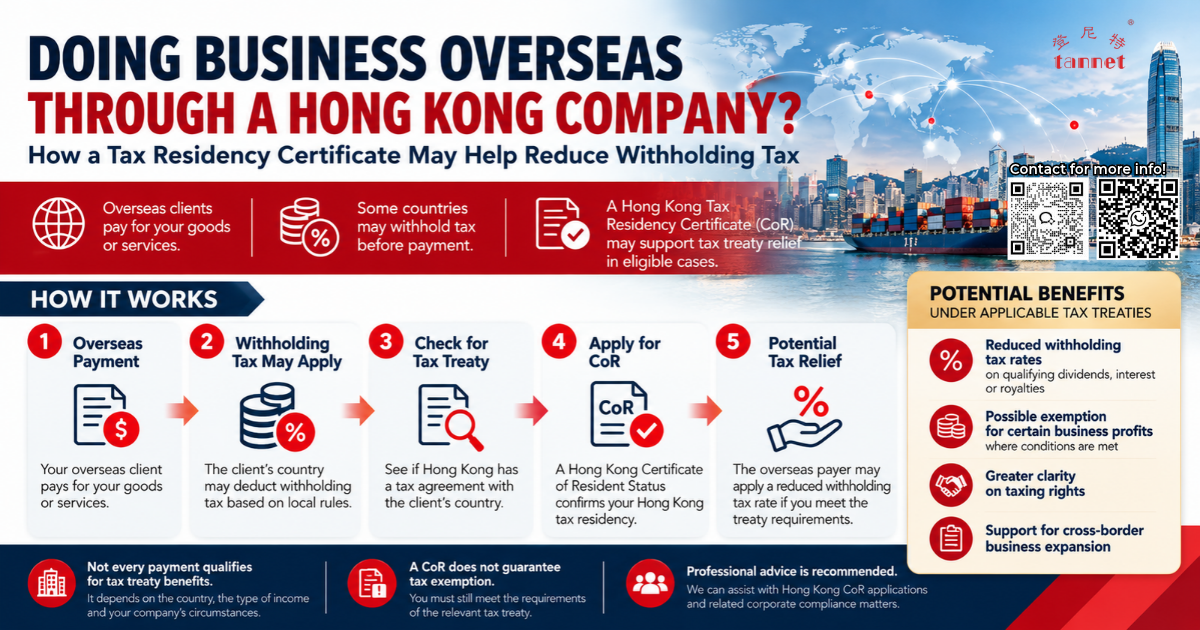
Doing Business Overseas Through a Hong Kong Company? How a Tax Residency Certificate May Help Reduce Withholding Tax
Your Hong Kong company has international clients. Business is growing, invoices are being issued, and overseas customers are making payments. But have you considered whether part of your income could be withheld for tax purposes before it reaches your bank account?
For Hong Kong companies providing services, licensing intellectual property, or conducting other cross-border business activities, foreign withholding tax can affect the amount ultimately received.
Depending on the country involved, the type of income, and the applicable tax treaty, a Hong Kong Certificate of Resident Status (CoR) may help support a claim for reduced withholding tax or other treaty benefits.
Understanding how this works can help international business owners manage their tax obligations more effectively.
1. Why Might Overseas Clients Withhold Tax?
When a Hong Kong company receives certain payments from an overseas customer, the country where the payment originates may impose withholding tax.
Withholding tax is generally collected by the payer, who deducts the required amount before transferring the remaining payment to the overseas recipient.
For example, a Hong Kong company provides consulting services to a business in another jurisdiction.
Depending on that jurisdiction’s domestic tax rules, the nature of the services, and where the activities are performed, the overseas customer may be required to withhold tax.
This means the Hong Kong company might receive less than the full invoiced amount.
However, withholding tax does not apply automatically to every international transaction. The applicable treatment must be assessed based on the relevant circumstances.
2. How Can Double Taxation Agreements Help?
Hong Kong has entered into Comprehensive Avoidance of Double Taxation Agreements (CDTAs) with various jurisdictions.
These agreements are designed to allocate taxing rights between contracting jurisdictions and provide mechanisms to reduce or eliminate double taxation in qualifying circumstances.
Depending on the agreement and income category, treaty benefits may include:
- Reduced withholding tax rates on qualifying dividends, interest, or royalties.
- Exemption or relief for certain business profits where treaty conditions are satisfied.
- Greater clarity regarding taxing rights and permanent establishment considerations.
- Mechanisms for resolving certain cross-border taxation issues.
Importantly, treaty relief is not universal.
Different agreements contain different provisions, and businesses must satisfy the relevant eligibility requirements.
3. What Is a Hong Kong Certificate of Resident Status?
A Certificate of Resident Status, commonly known as a CoR, is a document issued by the Hong Kong Inland Revenue Department (IRD).
It certifies a person’s or entity’s Hong Kong resident status for the purposes of an applicable tax agreement.
For companies conducting international business, a CoR can serve as supporting documentation when seeking tax treaty benefits in another jurisdiction.
For example, a Hong Kong company receiving qualifying income from an overseas customer may need to demonstrate its Hong Kong tax residency status.
The CoR can help establish that status for treaty purposes.
However, the certificate itself does not guarantee that the company qualifies for every benefit under the relevant agreement.
Other conditions, including beneficial ownership, permanent establishment provisions, anti-abuse rules, and the classification of income, may still need to be considered.
4. Example: A Hong Kong Company Providing Services to an Overseas Customer
Consider a Hong Kong company that provides professional services to a corporate customer in Indonesia.
The Indonesian company pays the Hong Kong company for the services provided.
Before making payment, the Indonesian customer must assess whether Indonesian withholding tax applies.
If withholding tax is applicable, the Hong Kong company may wish to determine whether the Hong Kong–Indonesia tax agreement provides any relevant relief.
The process may involve:
Step 1: Identify the income category
Determine whether the payment represents business profits, royalties, technical service income, or another category under the relevant domestic law and treaty.
Step 2: Review the applicable tax agreement
Examine the relevant treaty provisions and determine whether relief may be available.
Step 3: Assess Hong Kong tax residency
Confirm whether the Hong Kong company meets the applicable residency criteria.
Step 4: Apply for a Certificate of Resident Status
Where appropriate, the Hong Kong company may submit a CoR application to the IRD with the necessary supporting information.
Step 5: Complete the overseas jurisdiction’s treaty procedures
The Hong Kong company may provide the CoR to its overseas customer or relevant tax authority, together with any other required forms or documentation.
The overseas payer may then use the documentation when assessing the applicable withholding tax treatment.
Actual eligibility and procedural requirements depend on the jurisdiction and transaction. In Indonesia, additional prescribed tax-residency documentation and administrative requirements may apply.
5. Does Every Hong Kong Company Qualify for a CoR?
Not necessarily.
A company must meet the relevant Hong Kong residency requirements.
For a company incorporated in Hong Kong, incorporation is generally an important basis for determining residence under Hong Kong’s tax agreements, subject to applicable treaty provisions and requirements.
For a company incorporated outside Hong Kong, the location of its normal management or control may be relevant.
The IRD may request information about the company’s business activities, management, ownership, and other relevant circumstances.
In addition, obtaining a CoR and qualifying for a particular treaty benefit are separate matters.
Companies should not assume that incorporation in Hong Kong automatically entitles them to reduced overseas taxes.
6. What Documents May Be Required?
The supporting documentation depends on the applicant’s circumstances and the applicable treaty.
Relevant information may include:
- Hong Kong company registration details.
- Business activities and operating arrangements.
- Information about directors, shareholders, and management.
- Details of the overseas income and relevant transactions.
- The overseas jurisdiction where treaty benefits are being sought.
- Supporting contracts, invoices, or other transaction documents where requested.
The IRD may request further information during its assessment.
Preparing consistent and accurate documentation can help avoid unnecessary delays.
7. Common Misconceptions About Hong Kong Tax Residency Certificates
Misconception 1: A Hong Kong company automatically pays no overseas withholding tax.
In reality, withholding tax depends on the overseas jurisdiction’s rules and any applicable treaty relief.
Misconception 2: A CoR guarantees a tax exemption.
A CoR confirms residency status for treaty purposes. It does not independently establish entitlement to every treaty benefit.
Misconception 3: Only large multinational companies need a CoR.
Small and medium-sized Hong Kong businesses may also need to establish their residency status when claiming applicable treaty benefits.
Misconception 4: The Hong Kong company always applies for the overseas tax reduction directly.
Procedures vary. In some jurisdictions, the overseas payer is responsible for applying the appropriate withholding treatment based on the documents provided by the Hong Kong recipient.
Misconception 5: A CoR means the company has no Hong Kong tax obligations.
Hong Kong profits tax obligations and eligibility for foreign treaty benefits are separate issues.
8. When Should Business Owners Consider Reviewing Their Tax Residency Position?
A review may be particularly relevant when a Hong Kong company:
- Receives consulting or professional service fees from overseas clients.
- Earns royalties or other cross-border income.
- Conducts business with customers in jurisdictions that impose withholding tax.
- Is asked by an overseas customer to provide tax residency documentation.
- Plans to expand its international business operations.
- Wants to assess whether an applicable tax agreement offers potential relief.
Ideally, the applicable withholding tax position should be reviewed before the overseas customer makes payment.
9. How TANNET Can Assist
For Hong Kong companies conducting international business, understanding cross-border tax obligations is an important part of financial and corporate planning.
TANNET provides corporate services and can assist businesses with matters relating to Hong Kong tax residency documentation and cross-border compliance coordination.
Our relevant services include:
- Hong Kong Certificate of Resident Status application assistance.
- Corporate documentation preparation and coordination.
- Hong Kong accounting and tax compliance support.
- Cross-border corporate structuring and business advisory coordination.
Does your Hong Kong company receive payments from overseas customers?
Before assuming that overseas withholding tax is unavoidable, review whether an applicable tax treaty may provide relief and what documentation is required.
Contact TANNET to discuss your Hong Kong company’s tax residency documentation and cross-border business requirements.
📞 Free 1-on-1 Consultation Now,
Official Service Hotline: +86-755-82148419
Cell: +86-13823131503;+60 19-309 2363
WeChat ID: 13823131503;
WhatsApp:+86-13823131503;+60 19-309 2363
Email: mytannet08@gmail.com; susiehu@citilinkia.com