Key Takeaway
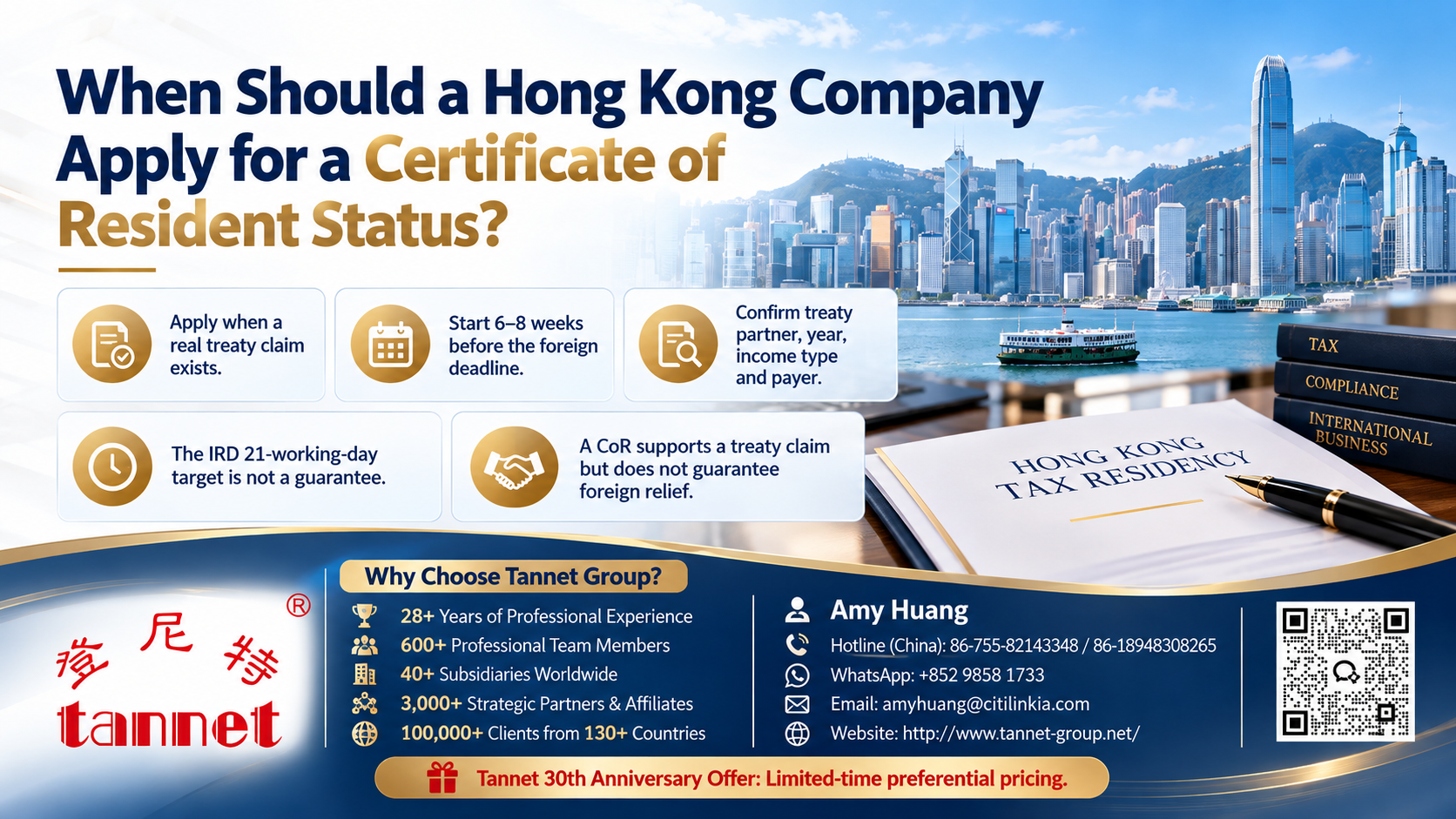
A Hong Kong company should apply for a Certificate of Resident Status when it has a specific claim under an effective double taxation agreement and before the foreign payer or tax authority’s document deadline.
The certificate is commonly relevant to dividends, interest, royalties, technical fees, capital gains, or other treaty claims. A practical planning rule is to start six to eight weeks before the foreign filing or payment deadline, although this is not a statutory IRD deadline.
The main caution is that the IRD’s 21-working-day processing target applies only to a properly completed application, and the treaty partner still decides whether the underlying tax benefit is available.
What the certificate is for
The Hong Kong Inland Revenue Department defines a Certificate of Resident Status, or CoR, as proof of Hong Kong resident status for claiming benefits under a comprehensive DTA.
It is not a general certificate of incorporation, tax compliance, business substance, or bank-account status. The IRD states that it will not issue a CoR merely for a non-treaty purpose.
The relevant DTA must already be effective. If Hong Kong has no effective DTA with the jurisdiction concerned, the IRD will not issue a CoR for that jurisdiction.
Apply when a real treaty claim is expected
The strongest trigger is a known transaction or foreign filing that requires proof of Hong Kong residence.
Examples include a dividend distribution, interest payment, royalty payment, technical-service fee, disposal gain, permanent-establishment position, shipping income claim, or another item covered by the relevant DTA.
Identify the payer, source jurisdiction, income type, payment date, claimed treaty article, domestic rate, expected treaty treatment, and local filing method before the application is prepared.
Apply before relief at source is due
Relief at source allows the payer to apply a reduced rate or exemption before paying the income. It usually produces a better cash-flow result than paying full tax and seeking a refund.
The source jurisdiction may require the CoR before payment, before a pre-clearance date, or with a payer declaration. These dates are controlled by foreign law, not by the Hong Kong IRD.
Start from the foreign deadline and work backwards. A six-to-eight-week lead time is a practical buffer for the IRD target, supplementary questions, local review, translation, certification, and delivery.
Apply before a refund limitation period expires
If full withholding tax has already been deducted, a CoR may support a refund claim. The company should not wait until the final weeks of the local limitation period.
Confirm whether the deadline runs from payment, withholding, assessment, the end of a calendar year, or another event. Obtain the tax voucher and payer confirmation early.
A CoR issued later may support evidence of residence for the relevant year, but it does not automatically extend a foreign refund deadline.
Allow for the IRD processing target
The IRD targets issuing the certificate, requesting more information, or notifying the applicant of a decision within 21 working days after receiving a properly completed application.
This is a service target, not a guaranteed approval period. An incomplete form, unclear treaty purpose, inconsistent information, or supplementary enquiry can extend the practical timetable.
Do not schedule a payment exactly 21 working days after submission. Add time for internal approval, the foreign payer’s review, postal delivery where relevant, and corrections.
Choose the correct treaty partner and year
The IRD generally issues only one CoR for each DTA for each year.
Its FAQ states that one application may cover up to three calendar years of claim for the same jurisdiction.[2] Select only the years connected with the intended treaty claims.
Do not use a certificate for one treaty partner as if it were issued for another. Each DTA has its own residence article, benefit conditions, effective dates, and source-country procedure.
Understand the Chinese Mainland arrangement
For the DTA with the Chinese Mainland, the company uses Form IR1313A. For other jurisdictions, it uses Form IR1313B.
Under the special administrative arrangement, a certificate issued for a particular calendar year generally serves as residence proof for that year and the following two calendar years.
That treatment depends on circumstances remaining relevant. If the company’s circumstances change so that treaty conditions are no longer met, the earlier certificate does not continue to prove residence after the change.
Apply when the evidence is ready
Timing should not be driven by the foreign deadline alone. The application facts should be complete and consistent.
Check the legal name, business registration number, incorporation status, accounting period, treaty partner, claim years, business activities, management arrangements, and transaction description.
The IRD’s 2023 approach generally removed the need for a Hong Kong-incorporated entity to provide full establishment and business-activity details in the standard form. The IRD can still ask for information needed to decide residence.
Newly incorporated companies should not apply speculatively
A new company does not necessarily need to wait for a completed audit before considering a CoR. However, it should have an identifiable treaty claim and credible records supporting the application.
Prepare incorporation documents, business registration, ownership information, board decisions, contracts, bank or funding arrangements, premises or service records, and transaction evidence where relevant.
Do not create a dormant shell and request certificates for multiple jurisdictions without real claims. The treaty partner may examine beneficial ownership, commercial purpose, and anti-abuse rules separately.
Coordinate the Hong Kong and foreign procedures
A company or its appointed service agent can submit online through the Business Tax Portal or Tax Representative Portal. Postal and in-person submission also remain available.
For Chinese Mainland treaty claims, successful applicants generally receive a digital CoR through the relevant tax portal. For other treaty partners, the IRD generally issues a paper certificate by post.
The foreign payer or adviser should confirm whether an original, copy, translation, apostille, local form, or electronic verification is required.
Do not treat the certificate as approval of the benefit
The IRD expressly states that issuing a CoR does not guarantee a successful treaty claim. The treaty partner decides whether all conditions are satisfied.
Residence is only one element. The foreign authority may review beneficial ownership, shareholding period, income classification, permanent establishment, principal purpose, substance, or other anti-abuse conditions.
Where relief is denied contrary to the DTA, protect foreign domestic remedies and consider whether the Mutual Agreement Procedure is available.
Common mistakes
- Applying without identifying a specific DTA claim.
- Starting only a few days before a foreign deadline.
- Selecting the wrong treaty partner or calendar year.
- Assuming the 21-working-day target guarantees approval.
- Reusing one partner’s certificate for another jurisdiction.
- Ignoring ownership, control, or transaction changes.
- Treating the CoR as proof of beneficial ownership.
Frequently asked questions
Q1. How early should a company apply?
There is no universal statutory lead time. Six to eight weeks before the foreign deadline is a prudent operational buffer, not an IRD rule.
Q2. Can the company apply before income is paid?
Yes, when a genuine treaty claim is expected and the relevant partner, year, transaction, and foreign procedure are identifiable.
Q3. Can one application cover several years?
Yes. three calendar years for Mainland China claims, subject to unchanged residence facts. One calendar year for other jurisdictions — subject to the relevant tax authority’s requirements.
Q4. Is a separate application needed for every treaty partner?
Yes. A CoR is linked to a specified DTA and claim period.
Q5. Must a new company complete its first audit?
Not as a universal condition stated by the IRD. The applicant still needs a genuine claim and sufficient, consistent facts.
Q6. What if the IRD requests more information?
Reply promptly through the supplementary-information function or permitted submission channel. Recheck the foreign deadline at the same time.
Q7. Does the CoR guarantee the reduced rate?
No. The treaty partner makes the final decision on the benefit.
Work backwards from the foreign payer’s relief-at-source date, not merely from the payment date shown in the commercial contract.
Plan the timing.
When Tannet may assist
Tannet may assist with the application timetable, DTA and year mapping, IR1313A or IR1313B preparation, supporting-document checks, portal coordination, and liaison with qualified advisers in the source jurisdiction. Foreign treaty entitlement, withholding procedures, refunds, objections, and disputes should be confirmed by appropriately licensed local professionals.
30th Anniversary Offer: To celebrate Tannet’s 30th anniversary, we are offering exclusive limited-time promotional pricing. Slots are limited and available on a first-come, first-served basis. Contact Consultant Amy Huang for details.
Written by: Tannet Business Services Team
Reviewed by: Consultant Amy Huang
First published: 20 Oct. 2026
Last reviewed: 20 Oct. 2026
————————————————Simplifying Business, Empowering Entrepreneurs————————————————