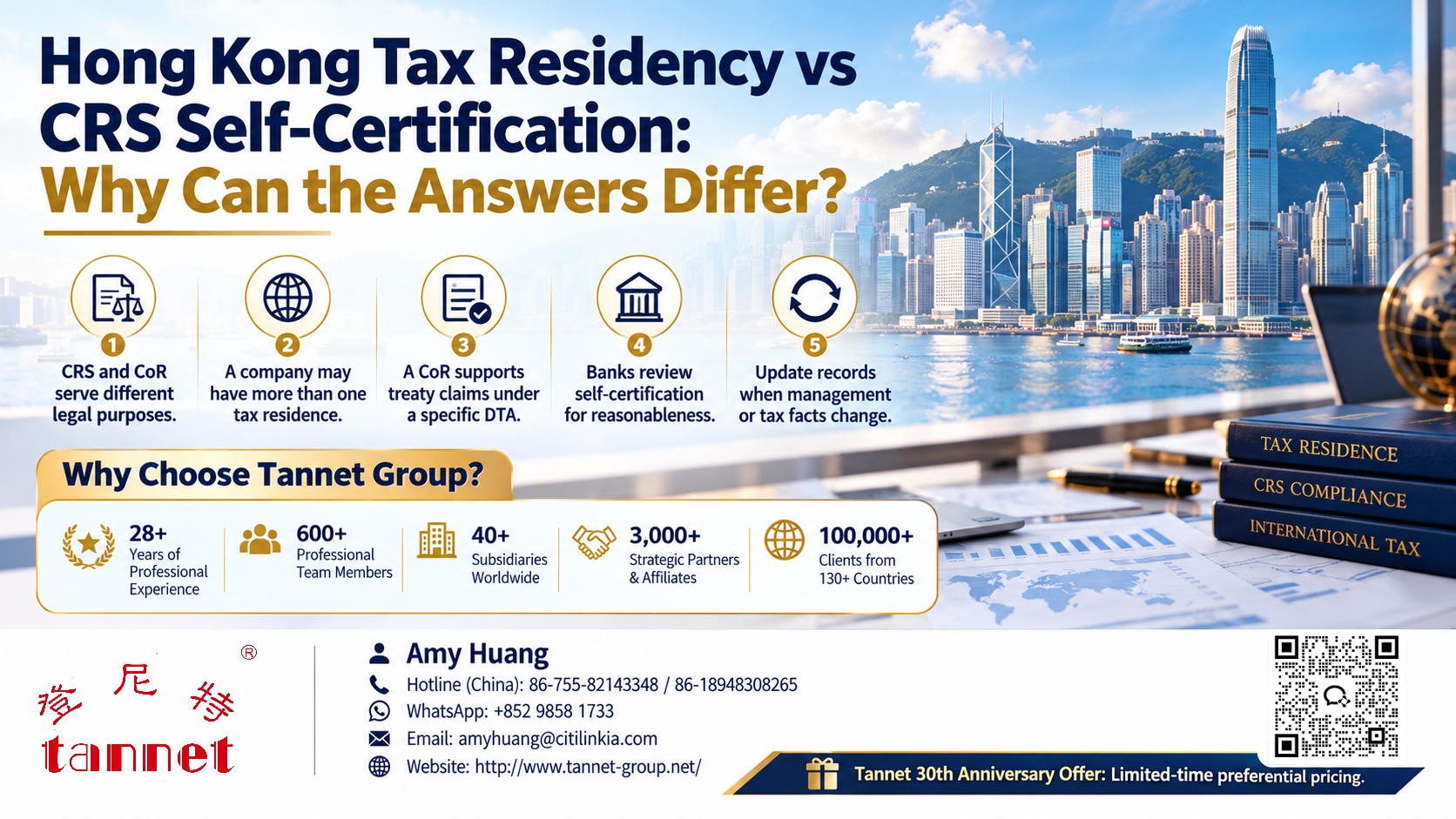
Key Takeaway
Hong Kong tax residency, treaty residence, and CRS self-certification are related but not identical.
A Hong Kong-incorporated company may report Hong Kong as a tax residence for CRS, while also disclosing another jurisdiction if that jurisdiction’s domestic rules treat it as resident.
A Certificate of Resident Status is different. It is issued for claiming benefits under a specific double taxation agreement, and the treaty partner decides whether relief applies.
This matters to Hong Kong companies opening bank accounts, receiving cross-border income, or operating through overseas directors. The main caution is to identify which legal test each form asks for and keep every answer consistent with documented facts.
Three questions that are often confused
The first question is whether an entity is resident for Hong Kong AEOI and CRS purposes. Hong Kong IRD guidance says a Hong Kong-incorporated company is regarded as a Hong Kong tax resident for AEOI purposes.
The second question is whether the company is resident under a particular double taxation agreement. That answer comes from the residence article and protocol of the relevant DTA, not from a bank form alone.
The third question is what a reporting financial institution must report. It collects a self-certification, classifies the entity, tests the answer for reasonableness, and may identify controlling persons of a passive NFE.
What a CRS self-certification does
A CRS self-certification is a formal declaration made by an account holder about its tax residence. Hong Kong reporting financial institutions request it for new accounts and may request an updated form when circumstances change.
The form is part of due diligence under the Inland Revenue Ordinance. It is not an approval issued by the IRD. It does not grant a treaty rate or confirm that the company satisfies every foreign tax rule.
The IRD sample entity form asks for the entity’s classification, all jurisdictions of residence, and a TIN for each jurisdiction. A Hong Kong tax resident generally uses its business registration number as its Hong Kong TIN.
What a Certificate of Resident Status does
A Certificate of Resident Status is issued by the Hong Kong competent authority to support a claim for benefits under an effective DTA. The application identifies the treaty partner and the relevant claim year.
The certificate is not a general company credential. The IRD generally issues one certificate for each DTA for each year. It also warns that issuance does not guarantee foreign relief.
The treaty partner may still examine beneficial ownership, limitation provisions, the principal purpose test, permanent establishment issues, filing deadlines, and domestic procedures.
Why the answers can differ
Different legal purposes
CRS supports automatic exchange of financial account information. A CoR supports a bilateral treaty claim. Hong Kong profits tax determines liability under Hong Kong’s territorial system. Each regime asks a different question.
Multiple domestic residences can exist
Another jurisdiction may treat a Hong Kong company as resident because its central management, effective management, headquarters, or other connecting factor is located there.
The OECD explains that an entity can be resident in more than one jurisdiction. For CRS, all jurisdictions of tax residence may need to be declared.
Treaty tie-breakers have a narrower role
A DTA may contain a rule or competent-authority process for resolving dual residence for treaty purposes. That conclusion applies within that treaty. It does not necessarily erase residence arising under domestic law or every CRS disclosure obligation.
Entity status is separate from residence
The bank must also determine whether the account holder is a financial institution, active NFE, or passive NFE. A company can be Hong Kong resident yet be classified as a passive NFE.
If it is a passive NFE, the bank may need self-certifications from controlling persons. Their personal tax residences are separate from the entity’s residence.
Timing can produce a temporary mismatch
A company may relocate management, appoint overseas directors, redomicile, or become resident elsewhere during a reporting period. A previously correct bank form can become outdated.
The entity should tell the financial institution when a change affects its tax residence. It should also review whether an existing CoR remains relevant for the treaty year and facts concerned.
Example one: Hong Kong incorporation and overseas management
Assume a Hong Kong-incorporated trading company opens a Hong Kong bank account. Under Hong Kong’s published AEOI definition, incorporation supports reporting Hong Kong as a residence.
Its directors make strategic decisions in Country A. Country A’s domestic law may also treat the company as resident. The CRS answer may therefore include Hong Kong and Country A, subject to confirmed local advice.
For treaty relief from Country B, the company must separately examine the Hong Kong-Country B DTA. A Hong Kong CoR may support the claim, but it does not decide every condition.
Example two: a passive investment holding company
A Hong Kong holding company earns mainly dividends and interest. It may be a passive NFE for CRS even though it is Hong Kong resident.
The bank may request information about its controlling persons and their personal tax residences. Reporting a shareholder’s foreign residence does not mean the company has ceased to be a Hong Kong resident.
This distinction is frequently missed when clients read a CRS form as if every field described the company itself.
Documents to align before signing
Review the following evidence:
- certificate of incorporation and business registration;
- articles, ownership chart, and entity classification;
- board minutes and records of strategic decisions;
- directors’ locations and authority;
- Hong Kong and foreign tax registrations;
- prior CRS forms and bank correspondence;
- Certificate of Resident Status applications;
- treaty claim forms and withholding records; and
- controlling person self-certifications, where required.
The objective is not to force identical wording into every document. It is to make each answer correct for its purpose and explain any difference.
Common mistakes
- Treating incorporation as the only residence test worldwide.
- Listing only one residence when another jurisdiction also treats the company as resident.
- Using a CoR as a substitute for a CRS self-certification.
- Assuming a bank’s acceptance guarantees treaty benefits.
- Confusing the residence of a passive NFE with the residence of its controlling persons.
- Failing to update the bank after management moves.
- Giving different facts to the bank and tax authorities without an explanation.
Frequently asked questions
Q1. Can a Hong Kong company be tax resident in two jurisdictions?
Yes. Domestic rules can overlap. The OECD states that all tax residences may need to be disclosed for CRS purposes.
Q2. Does a Hong Kong CoR prove the CRS answer?
It is relevant evidence, but the documents serve different purposes. The self-certification must answer the bank’s CRS questions fully.
Q3. Can the bank ask for more than the CoR?
Yes. It may review addresses, management, tax registrations, TINs, entity classification, controlling persons, and other account-opening information.
Q4. Must a passive NFE disclose its owners?
The institution generally identifies controlling persons and may obtain separate self-certifications for them.
Q5. What happens if the company changes management location?
Review all residence positions and notify the bank if the previous self-certification is no longer accurate.
Q6. Is a CRS mismatch automatically wrongdoing?
No. A difference can be legitimate. It becomes risky when it is inaccurate, unexplained, or not updated.
Q7. Can a false self-certification create a penalty?
Yes. The IRD states that knowingly or recklessly providing materially misleading, false, or incorrect information is an offence and may attract a level 3 fine.
When Tannet may assist
Tannet may assist with residence fact mapping, CoR applications, CRS document reviews, entity classification coordination, records organization, and liaison with advisers in relevant jurisdictions. Legal and tax conclusions should be confirmed for each company, treaty partner, account, and reporting period.
Practical review points
Record the legal rule used for each answer, because incorporation, management, treaty residence, account classification, and controlling person residence answer different questions.
Keep the signed self certification, supporting explanation, board records, tax registrations, organizational chart, and correspondence in one review file.
A financial institution performs a reasonableness review against information obtained through account opening and anti money laundering procedures.
Document the relevant facts, dates, decisions, filings, records, explanations, supporting evidence, corrections, bank notifications, and changes carefully.
30th Anniversary Offer: To celebrate Tannet’s 30th anniversary, we are offering exclusive limited-time promotional pricing. Slots are limited and available on a first-come, first-served basis. Contact Consultant Amy Huang for details.
Written by: Tannet Business Services Team
Reviewed by: Consultant Amy Huang
First published: 20 Oct. 2026
Last reviewed: 20 Oct. 2026
————————————————Simplifying Business, Empowering Entrepreneurs————————————————