Hong Kong remains a popular destination for international entrepreneurs seeking to establish businesses, manage overseas investments, and expand their operations across Asia.
Its established legal framework, international business environment, and extensive network of double taxation agreements make Hong Kong an attractive jurisdiction for cross-border business activities.
However, establishing a Hong Kong company does not automatically mean that every business owner qualifies as a Hong Kong tax resident.
For entrepreneurs seeking to obtain a Hong Kong Certificate of Resident Status (CoR), understanding the application requirements and preparing the relevant information is essential.
So, what does the Hong Kong Inland Revenue Department (IRD) actually examine?
1. What Is a Hong Kong Certificate of Resident Status?
A Certificate of Resident Status is an official document issued by the competent authority of Hong Kong to confirm an applicant’s Hong Kong resident status for the purposes of a relevant Comprehensive Double Taxation Agreement or Arrangement (DTA).
The certificate may help eligible individuals and companies claim tax treaty benefits when receiving income from another jurisdiction.
For example, a Hong Kong company receiving certain types of income from a treaty-partner jurisdiction may need to provide a CoR to support a claim for applicable treaty relief.
However, obtaining a CoR does not automatically guarantee reduced taxation or a tax exemption.
The final entitlement to treaty benefits depends on the relevant agreement, the nature of the income, applicable eligibility conditions, and the requirements of the jurisdiction where the benefits are claimed.
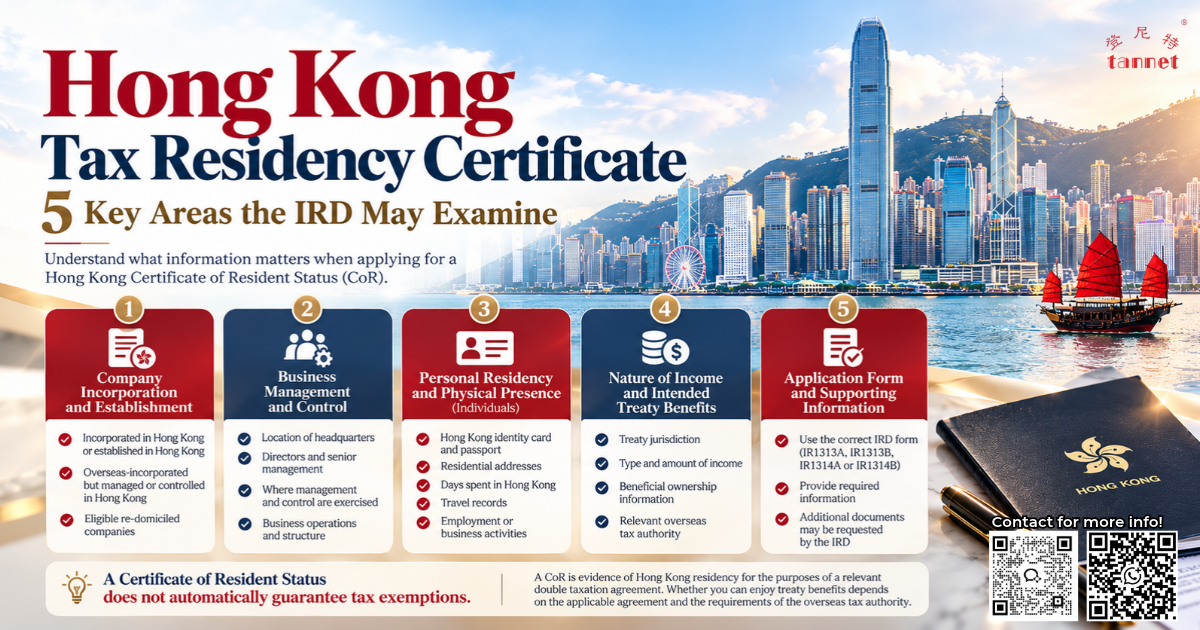
2. Company Incorporation and Business Establishment
For corporate applicants, one of the first considerations is where the company was incorporated or established.
Under the relevant treaty definitions, qualifying entities may include:
- Companies incorporated or established in Hong Kong.
- Companies incorporated outside Hong Kong but managed or controlled in Hong Kong.
- Eligible re-domiciled companies.
An important distinction is that a company incorporated in Hong Kong is generally not required to provide extensive information about its establishment and business activities in the standard application form.
However, the IRD may request additional information when necessary.
For entrepreneurs operating through overseas-incorporated entities, the location of management and control may become particularly relevant when establishing eligibility.
3. Business Management and Control
For companies incorporated outside Hong Kong that seek recognition as Hong Kong residents, management and control are important considerations.
The IRD may examine information concerning:
- The location of the company’s headquarters.
- The location of directors and senior management.
- Where business management and control are exercised.
- The company’s business operations and organisational structure.
These considerations help establish whether an overseas-incorporated entity meets the applicable Hong Kong residency definition.
For example, an entrepreneur may own a company incorporated outside Hong Kong while conducting management activities through Hong Kong.
Whether that company qualifies as a Hong Kong resident depends on the relevant facts and treaty provisions.
Business owners should therefore ensure that their application information accurately reflects their actual corporate arrangements.
4. Personal Residency and Physical Presence
For individual applicants, the assessment is different from that of companies.
Depending on the applicable DTA, the relevant criteria may include ordinary residence in Hong Kong or physical presence during specified periods.
The IRD’s application forms may request information such as:
- Hong Kong identity card and passport particulars.
- Permanent and other residential addresses.
- Whether the applicant ordinarily resides in Hong Kong.
- The number of days spent in Hong Kong during specified periods.
- Travel documents supporting the declared periods of stay.
- Employment or business activities in Hong Kong, where applicable.
Holding a Hong Kong identity card or an immigration visa does not, by itself, establish tax residency under every applicable treaty.
Entrepreneurs who travel frequently between Hong Kong, Mainland China, Malaysia, Singapore, and other jurisdictions should understand which residency criteria apply to their circumstances.
5. Nature of Income and Intended Tax Treaty Benefits
Another important part of the application is identifying the tax treaty under which the applicant intends to claim benefits.
For example, an entrepreneur may operate a Hong Kong company that receives income from clients or business partners in another jurisdiction.
Depending on the relevant agreement, certain types of income may qualify for reduced withholding tax rates or other forms of treaty relief.
The application may require information about:
- The jurisdiction in which treaty benefits are sought.
- The relevant year or years of claim.
- The nature and amount of income.
- The identity of the income’s beneficial owner, where relevant.
- Information concerning the overseas tax authority, where applicable.
These details are particularly important for businesses receiving dividends, royalties, interest, or cross-border service income.
Not all income automatically qualifies for treaty relief, and the applicable treatment varies by jurisdiction and income category.
6. Which Application Form Should You Use?
The IRD provides different application forms depending on whether the applicant is an individual or an entity, and whether the application concerns Mainland China or another treaty jurisdiction.
| Applicant |
Mainland China |
Other jurisdictions |
| Company or other entity |
IR1313A |
IR1313B |
| Individual |
IR1314A |
IR1314B |
Selecting the appropriate form is an important part of preparing an application.
Applicants should also check whether additional information or supporting documentation is required based on their specific circumstances.
7. How Long Does the Application Take?
According to the Hong Kong IRD, its target is to issue a Certificate of Resident Status or provide a decision notification within 21 working days after receiving a properly completed application.
The notification may request further information or advise that the application cannot be accepted.
Applicants may submit their applications through the relevant electronic tax portals or by post or in person.
The actual processing time may vary depending on the completeness and complexity of the application.
Entrepreneurs intending to claim treaty benefits should consider preparing their applications ahead of relevant tax filing or payment deadlines.
8. Does a Hong Kong Tax Residency Certificate Guarantee Tax Savings?
No.
A Certificate of Resident Status serves as evidence of Hong Kong residency for the purposes of a relevant DTA.
It does not automatically exempt a company or individual from taxation in another jurisdiction.
The overseas tax authority may still examine whether the applicant satisfies other treaty conditions, including beneficial ownership requirements or applicable anti-abuse provisions.
For businesses operating across multiple jurisdictions, the certificate should therefore be considered one component of broader cross-border tax compliance planning.
9. How Can TANNET Assist?
Applying for Hong Kong tax residency may involve more than completing an application form, particularly for entrepreneurs with complex international business arrangements.
TANNET provides business support services for entrepreneurs and companies seeking to establish and manage their operations in Hong Kong.
Our team can assist with:
- Preliminary assessment of Hong Kong tax residency application requirements.
- Guidance on the relevant Certificate of Resident Status application process.
- Preparation and coordination of application information and supporting documents.
- Hong Kong company incorporation and corporate secretarial services.
- Related corporate compliance and tax administration support.
Whether you operate a Hong Kong company, manage overseas investments, or conduct business across multiple jurisdictions, understanding your residency position is an important step towards effective international tax planning.
Planning to Apply for a Hong Kong Tax Residency Certificate?
Contact TANNET to discuss your business structure, application requirements, and available corporate support services.
📞 Free 1-on-1 Consultation Now,
Official Service Hotline: +86-755-82148419
Cell: +86-13823131503;+60 19-309 2363
WeChat ID: 13823131503;
WhatsApp:+86-13823131503;+60 19-309 2363
Email: mytannet08@gmail.com; susiehu@citilinkia.com