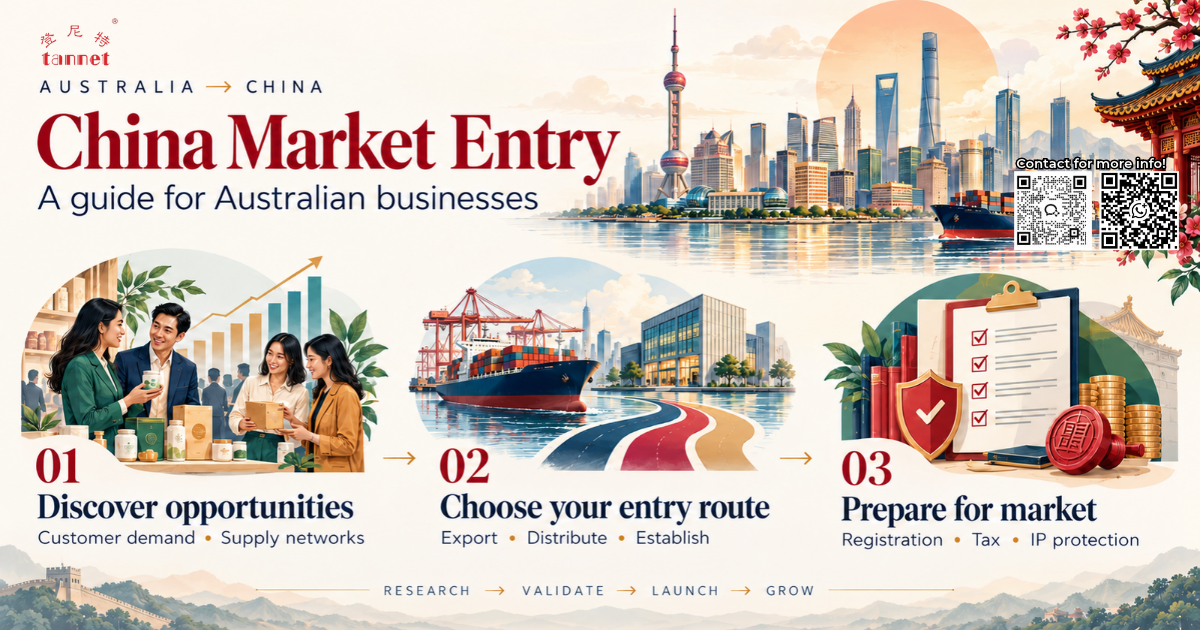
Entering the Chinese market can help Australian businesses reach new customers, establish local partnerships and expand their operations. Before investing, you need to understand whether your business activities are permitted, which approvals apply and how you will sell profitably.
This China market entry guide for Australian Businesses explains the key decisions for Australian investors entering mainland China, from choosing an entry model to assessing compliance, costs and local partners.
How Can an Australian Business Enter the Chinese Market?
Australian businesses can enter China through exporting, appointing a distributor, establishing a local company or forming a joint venture. The appropriate route depends on your industry, commercial objectives, budget and the rules governing your intended activities.
Selling to Chinese customers and establishing a business in China involve different commitments. Decide first whether you need a local operating presence or can serve the market from Australia.
Exporting from Australia
Exporting can help you test demand before establishing a local operation. You will need to assess import requirements, delivery costs, distribution arrangements and customer support.
Appointing a Local Distributor or Agent
A distributor or agent can provide access to established sales relationships and local market knowledge. Evaluate the partner’s capabilities, margins and contractual terms before committing.
Establishing a Local Company
A local company can support a direct operating presence. Before proceeding, confirm foreign investment access, registration requirements and ongoing obligations for your intended activities.
Forming a Joint Venture
A joint venture can combine your resources with those of a local partner. Agree on governance, ownership, profit sharing, intellectual property and exit arrangements before investing.
Why Consider China for Business Expansion?
Reach a Defined Customer Market
China offers opportunities across consumer and business markets. The opportunity for your business depends on identifying customers whose needs match your offering.
Customer needs vary between locations and segments. Compare demand, competition, purchasing behaviour and the cost of serving each target market.
Connect with Manufacturing and Supply Networks
Businesses considering production, sourcing or industrial partnerships can assess China’s supplier and manufacturing networks. The commercial case should account for quality control, logistics, intellectual property, lead times and supplier concentration.
Assess Trade Benefits Under ChAFTA
The China–Australia Free Trade Agreement provides preferential tariff treatment for eligible goods. Your business must check the applicable tariff classification, rules of origin and supporting documentation before including tariff savings in its pricing model.
Preferential tariffs do not replace product approvals or import compliance requirements.
Build a Distinctive Australian Offer
Australian origin can form part of your positioning, but customers still need a clear reason to buy.
Depending on your industry, your strongest selling points may include traceability, technical expertise, verified quality, product performance or dependable service. Support each claim with evidence and explain its practical value to the customer.
What Are the Requirements for Entering the Chinese Market?
There is no single set of requirements covering every Australian business. Your obligations depend on what you sell, how you operate and where you establish a presence.
1. Foreign Investment Access
Before establishing or acquiring a business, confirm whether your intended activities are open to foreign investment.
China’s foreign investment negative list identifies restricted and prohibited areas. Industry-specific rules may also affect your proposed structure or activities. Check the current requirements before signing investment agreements or committing capital.
2. Business Registration and Licences
If you need a local entity, assess:
- The appropriate company structure and ownership arrangements.
- The registered business scope.
- Registered address and capital requirements.
- Registration, reporting and tax procedures.
- Additional sector-specific licences or approvals.
Confirm that the proposed entity can legally conduct every activity in your operating plan.
3. Product Standards and Import Requirements
Before accepting orders or shipping goods, identify the requirements for your particular product.
These may include customs classification, importer arrangements, product registration, testing, certification, Chinese labelling and supporting documentation. Assign responsibility for each requirement between your business, importer and distribution partners.
4. Tax, Banking and Cross-Border Payments
Assess how your proposed structure will handle customer payments, supplier payments, invoicing, taxes and transfers between Australia and China.
Your financial model should reflect the proposed transaction flows. An export arrangement and a local operating company can create different obligations and administrative costs.
5. Intellectual Property Protection
Review protection for your brand, Chinese name, trademarks, designs and technology before launch.
Partner and supplier agreements should define ownership, permitted use, confidentiality and what happens when the relationship ends. Include control of digital accounts and brand assets in your planning.
6. Employment and Data Requirements
Hiring staff or collecting customer information introduces additional considerations. Assess the employment, privacy, cybersecurity and cross-border data rules relevant to your activities before putting systems and contracts in place.
How Much Does It Cost to Enter the Chinese Market?
A useful China market entry budget separates initial setup costs from ongoing operating costs. The required investment varies substantially by sector and entry model.
Include the following categories in your budget:
- Market validation: Research, customer interviews, competitor analysis and pilot activity.
- Professional support: Legal, tax, accounting and registration advice.
- Product compliance: Testing, certification, registration and labelling.
- Market launch: Translation, packaging, sales materials and channel setup.
- Distribution: Freight, warehousing, duties, taxes and partner margins.
- Local operations: Staff, premises, systems, administration and customer service.
- Working capital: Inventory, payment delays, returns and operating reserves.
Calculate your expected margin after all channel costs. A product that appears profitable at the Australian selling price may produce a different result after delivery, distribution, promotion and after-sales expenses.
How to Choose a Chinese Distributor or Business Partner
A suitable partner should have the capabilities and relationships needed for your specific product and target customers.
Before signing an agreement:
- Verify the company’s legal identity, ownership and relevant licences.
- Check its experience with comparable products or services.
- Request references and evidence of distribution capability.
- Understand its competing brands and commercial priorities.
- Agree on payment terms, reporting and performance expectations.
- Define territory, exclusivity, intellectual property and termination rights.
If offering exclusivity, connect it to measurable obligations and review points. A limited pilot can help you assess performance before making a broader commitment.
How to Sell Successfully in China
Localise Your Customer Proposition
Translate the value of your offer as carefully as the words. Explain the customer problem you solve, why your solution is credible and what support buyers can expect.
Review your Chinese brand name, product descriptions, packaging and customer service materials for clarity and suitability.
Choose Channels Based on Customer Behaviour
Select sales channels according to where your target customers research, compare and purchase. Depending on your business, this may involve distributors, direct business sales, retail or online channels.
Evaluate each channel’s eligibility requirements, fees, operating demands and access to customer information before committing.
Provide Evidence and Reliable Service
Use relevant certifications, product information, demonstrations and customer results to support your claims. Establish clear processes for enquiries, delivery, complaints, returns and after-sales support.
Launch with a Focused Pilot
Start with a manageable product range, customer segment or location. Set clear measures for demand, acquisition costs, margins, repeat purchases and partner performance.
Use the results to decide whether to expand, adjust the offer or reconsider the entry model.
China Market Entry Checklist for Australian Businesses
Before committing significant capital, confirm that you can answer these questions:
- Who is your target customer, and what evidence demonstrates demand?
- Is your proposed activity permitted under the applicable investment rules?
- Which entry model supports your objectives and budget?
- What licences, product approvals or registrations are required?
- Have you assessed brand and intellectual property protection?
- Have you verified your proposed partners?
- Does your pricing cover the full cost of selling and servicing customers?
- Who is responsible for compliance, payments and customer support?
- What results must the pilot achieve before you expand?
Frequently Asked Questions
Can an Australian Business Operate in China Without a Local Partner?
This depends on the proposed business activities and applicable foreign investment rules. Confirm whether your industry permits full foreign ownership or requires a different structure before choosing your operating model.
Do I Need a Chinese Company to Sell Products in China?
Not necessarily. Exporting through an appropriate importer or distributor may provide an entry route without establishing your own local entity. The arrangement must still satisfy the relevant product, import, tax and sales requirements.
Does ChAFTA Remove All Tariffs and Market Entry Requirements?
No. Preferential treatment depends on the goods and compliance with the agreement’s conditions. ChAFTA does not remove the need to meet applicable product standards, customs procedures or operating approvals.
What Should I Do Before Investing in China?
Validate customer demand, confirm investment access, compare entry structures and build a complete financial model. Verify prospective partners and resolve the requirements affecting your launch before making substantial commitments.
Plan Your China Market Entry
A successful entry starts with a clear customer opportunity and a workable operating model. For Australian businesses, the next step is to assess market demand, regulatory requirements, partners and costs together.
Prepare a market entry brief covering your product or service, target customers, preferred locations, budget and proposed sales channels. Use it to obtain tailored market, legal and tax advice and define a practical launch plan.
Planning your China market entry? Contact TANNET to discuss your business setup, compliance requirements and next steps.
📞 Free 1-on-1 Consultation Now,
Official Service Hotline: +86-755-82148419
Cell: +86-13823131503;+60 19-309 2363
WeChat ID: 13823131503;
WhatsApp:+86-13823131503;+60 19-309 2363
Email: mytannet08@gmail.com; susiehu@citilinkia.com