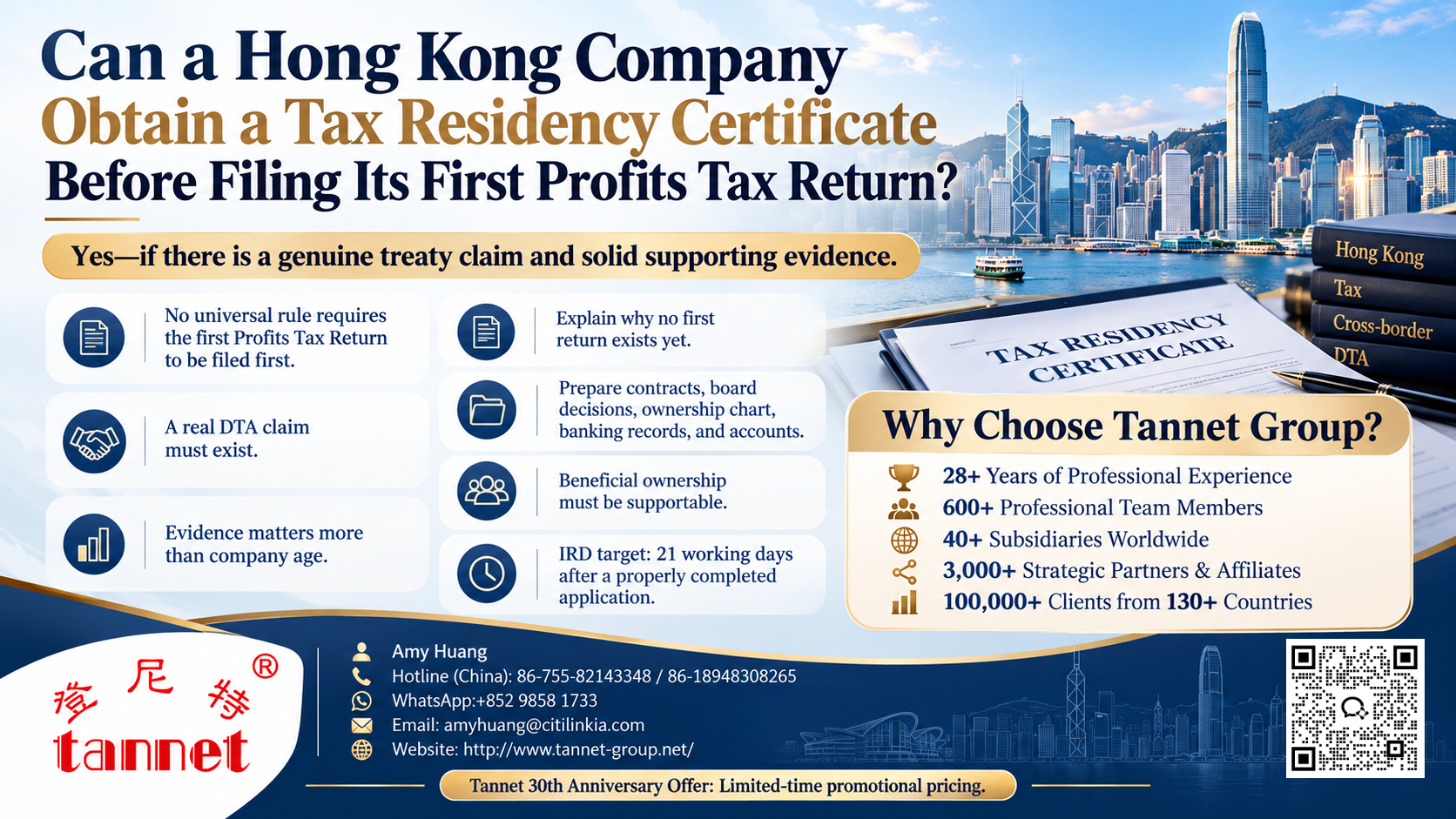
Key Takeaway
Yes, a Hong Kong company may apply for a Certificate of Resident Status before filing its first Profits Tax Return.
The Inland Revenue Department’s current company application forms do not state that a filed first return or profits tax assessment is a universal prerequisite. The application must instead support a genuine claim under an effective double taxation agreement.
This route suits a new company expecting treaty-covered dividends, interest, royalties, or other income. The main caution is evidence. Incorporation alone is insufficient.
The company should explain why no return exists, identify the payer and claim year, document beneficial ownership, and prepare for further IRD questions.
The direct answer
A first Profits Tax Return and a Certificate of Resident Status serve different purposes.
The profits tax return reports assessable profits and claims under Hong Kong’s domestic tax system. A Certificate of Resident Status, commonly called a CoR, supports a request for benefits under a comprehensive double taxation agreement or arrangement.
Current IRD guidance identifies a company incorporated in Hong Kong as an eligible applicant. Form IR1313A and Form IR1313B require incorporation, business, claim, and ownership information. Neither form states that the company must first submit a Profits Tax Return.
Accordingly, the absence of a first return does not automatically prevent an application. This conclusion is based on the published procedure and forms.
Why a company may need the certificate early
A new company may receive foreign-source income before its first Hong Kong reporting cycle is complete.
Examples include a dividend from an overseas subsidiary, interest under an intragroup loan, royalties under a licence, or fees affected by the business-profits article of a treaty.
The payer’s jurisdiction may request residence evidence before applying a reduced withholding rate. It may instead withhold at the domestic rate and require the recipient to seek a refund later.
Waiting for a first Hong Kong profits tax filing could therefore miss a foreign relief-at-source deadline. The timing should be driven by the real payment and local procedure, not by an assumed rule that a tax return must come first.
What the IRD actually reviews
The IRD states that a CoR is issued for claiming benefits under an effective DTA. It will not issue one where no relevant agreement is in force or where the certificate is wanted only for a non-treaty purpose.
For a claim involving the Chinese Mainland, the applicant uses Form IR1313A. For another treaty jurisdiction, it generally uses Form IR1313B.
The forms ask for the treaty partner, calendar year of claim, nature and amount of income, and beneficial owner. They also request incorporation details, Hong Kong addresses, headquarters, branches, directors, management, staff, and business operations for the claim period.
The company must attach its certificate of incorporation. If its name changed, the relevant certificate should also be supplied.
How to explain the missing first tax return
Do not hide the absence of a first return. Explain it in a short chronology.
Record the incorporation date, business commencement date, first accounting period, transaction date, expected payment date, and current profits tax filing status.
If the IRD has not issued the first return, say so. If a return has been issued but is not yet due, record the issue and deadline. If an extension applies, keep evidence of it.
The explanation should match company secretarial records, accounting records, contracts, and any information submitted to the foreign payer.
Evidence that can replace unavailable filing history
A new company may have no assessment, filed return, or completed audit. It should still have contemporaneous commercial records.
Useful evidence can include the incorporation certificate, business registration record, articles, ownership chart, contracts, invoices, board papers, bank statements, funding records, management accounts, payroll data, and service-provider agreements.
The applicant should explain who negotiated and approved the transaction. It should show why the Hong Kong company is entitled to the income and whether it may use and enjoy the funds.
Documents should reflect the claim year. A later-created narrative is weaker than records produced when the transaction was planned and implemented.
Beneficial ownership is a separate test
A company can be incorporated in Hong Kong and still face questions about beneficial ownership.
The IRD forms state that a recipient subject to a contractual or legal obligation to pass income to another person is not the beneficial owner. Agents, nominees, and conduit arrangements require particular care.
Review upstream and downstream payments. Check whether the company has discretion over the income, bears relevant risks, controls its bank account, and makes its own commercial decisions.
A first profits tax filing would not cure a weak beneficial ownership position. This analysis must be completed separately.
The treaty partner makes the final decision
The IRD expressly notes that issuing a CoR does not guarantee treaty benefits.
The foreign tax authority may test holding periods, ownership thresholds, beneficial ownership, permanent establishment, income classification, limitation provisions, or a principal purpose test.
The company should obtain source-country procedural advice. Confirm whether relief is granted before payment, through a refund application, or in a local tax return.
Also confirm whether the authority needs an original, a digital certificate, a local form, a translation, or electronic verification.
When to apply
Apply when the treaty partner, income, payer, claim year, and filing route are sufficiently clear.
Do not file only because the company has been incorporated. A speculative request with no real treaty claim may be premature.
The IRD’s stated target is 21 working days after receiving a properly completed application. Within that period, it may issue a certificate, ask for further information, or notify the applicant of its decision.
The target is not a guaranteed completion date. Allow time for questions and for the source jurisdiction’s deadline.
A practical filing sequence
- Confirm that an effective Hong Kong DTA covers the relevant jurisdiction.
- Identify the income and the treaty article relied upon.
- Confirm the calendar year and the foreign filing deadline.
- Select IR1313A for the Chinese Mainland or IR1313B for another treaty jurisdiction.
- Explain why the first Profits Tax Return has not been filed.
- Organise legal, commercial, management, banking, and accounting evidence.
- File through the available IRD channel and retain the submission record.
- Coordinate the certificate with the payer or foreign adviser.
Common mistakes
- Treating incorporation as automatic tax residency approval.
- Applying for banking or general compliance rather than a treaty claim.
- Waiting for the first return without checking the foreign deadline.
- Filing before the payer, income, or claim year is known.
- Submitting forecasts as though they were completed operations.
- Ignoring beneficial ownership and anti-abuse rules.
- Assuming that a CoR forces the foreign authority to grant relief.
Frequently asked questions
Q1. Must a Hong Kong company file its first Profits Tax Return before applying?
The current IRD forms do not state this as a universal prerequisite. The company still needs a genuine DTA claim and supportable facts.
Q2. Is a profits tax assessment required?
No published universal requirement says an assessment must exist first. The IRD may request financial or tax information relevant to the application.
Q3. Can a company apply before earning the income?
Potentially, where a real payment and treaty claim are sufficiently defined. A hypothetical request with no identified transaction may be premature.
Q4. Is the incorporation certificate enough?
No. It is a required attachment, but the forms also request claim, income, beneficial owner, and operational information.
Q5. How long does the process take?
The IRD targets 21 working days after a properly completed application to issue the certificate, seek information, or notify a decision.
Q6. Does the certificate guarantee a reduced foreign tax rate?
No. The treaty partner decides whether all substantive and procedural conditions are met.
Q7. Can a service provider submit the application?
Yes. An authorised company secretary or tax representative may use the relevant online service. The applicant remains responsible for accuracy throughout.
When Tannet may assist
Tannet may assist a new Hong Kong company with treaty scoping, form selection, the no-return chronology, evidence organisation, online submission, IRD follow-up, and coordination with a source-country adviser. The result depends on the DTA, the company’s facts, and the foreign authority’s review.
30th Anniversary Offer: To celebrate Tannet’s 30th anniversary, we are offering exclusive limited-time promotional pricing. Slots are limited and available on a first-come, first-served basis. Contact Consultant Amy Huang for details.
Written by: Tannet Business Services Team
Reviewed by: Consultant Amy Huang
First published: 21 Oct. 2026
Last reviewed: 21 Oct. 2026
————————————————Simplifying Business, Empowering Entrepreneurs————————————————