Key Takeaway
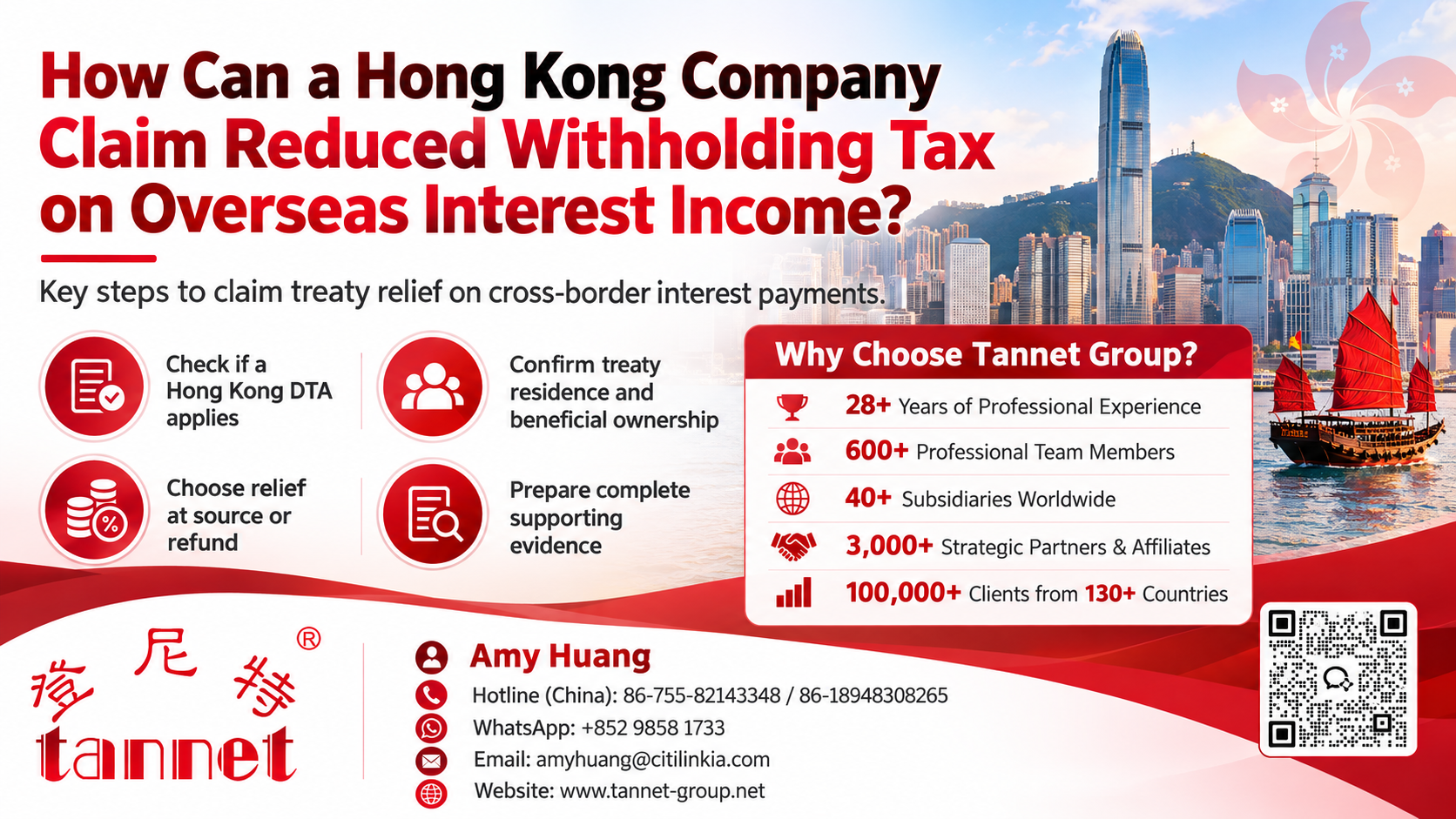
A Hong Kong company receiving interest from an overseas borrower may claim a lower source-country withholding tax rate when an effective Hong Kong double taxation agreement covers the payment.
The claimant normally needs Hong Kong treaty residence, beneficial ownership of the interest, a genuine debt arrangement, and compliance with the payer jurisdiction’s relief procedure.
This is relevant to group treasury companies, financing vehicles, lenders, and trading businesses extending credit abroad.
The main caution is that a Hong Kong Certificate of Resident Status does not guarantee relief. The exact treaty, domestic law, anti-abuse rules, payment date, and Hong Kong tax treatment must all be reviewed separately.
Start with the source jurisdiction
Withholding tax is normally imposed by the jurisdiction where the interest arises. The payer deducts tax from the gross payment and remits it to the local tax authority.
The domestic rate applies unless an exemption, a tax treaty, or another local rule reduces it. Hong Kong cannot unilaterally change the foreign withholding rate.
The first question is therefore not whether the recipient is incorporated in Hong Kong. It is whether the payer jurisdiction has an effective DTA with Hong Kong for the relevant payment period.
Confirm that the payment is treaty interest
Most treaties contain an interest article based broadly on Article 11 of the OECD Model Tax Convention. It generally covers income from debt claims.
The operative Hong Kong DTA may define interest differently. It may address government debt, bonds, debentures, premiums, prizes, penalty charges, financial institutions, or credit sales separately.
A payment labelled interest in a contract may be treated differently for tax purposes. Guarantee fees, arrangement fees, late-payment charges, profit-participating returns, and Islamic finance returns require separate classification.
Compare the domestic rate and treaty cap
The Hong Kong IRD publishes a table of maximum treaty rates for dividends, interest, royalties, and technical fees. The figures vary by treaty and sometimes by recipient type.
Establish Hong Kong treaty residence
The recipient usually needs to be a resident of Hong Kong under the residence article of the relevant DTA. A Hong Kong-incorporated company often falls within that treaty definition, subject to the actual wording.
Foreign tax authorities commonly request a Hong Kong Certificate of Resident Status. The IRD issues a CoR for claiming benefits under a specified DTA and for specified calendar years.
The IRD states that a CoR does not guarantee a successful treaty claim. The source jurisdiction decides whether every condition for relief is satisfied.
Prove beneficial ownership of the interest
Treaty interest caps commonly apply only when the Hong Kong recipient is the beneficial owner. Legal receipt alone may not be enough.
The current IRD CoR form explains that a recipient is not the beneficial owner when its right to use and enjoy the income is constrained by a contractual or legal obligation to pass the payment to another person. An agent, nominee, or conduit is not treated as beneficial owner.
Tax authorities may review back-to-back funding, matching payment dates, narrow margins, automatic onward transfers, guarantees, cash control, and whether the Hong Kong company bears genuine credit and currency risks.
A treasury company should document why it made the loan, who approved it, how it funded it, who monitors the borrower, and how it can retain or redeploy the interest.
Check treaty anti-abuse rules
Treaty residence and beneficial ownership do not end the analysis. A principal purpose test may deny a benefit when obtaining that benefit was one of the principal purposes of an arrangement, unless granting it accords with the treaty’s object and purpose.
The OECD explains that Action 6 targets treaty shopping. Hong Kong’s IRD also identifies which DTAs are modified by the MLI and provides synthesised texts for convenience.
Commercial rationale matters. A newly inserted Hong Kong lender with no financing function, authority, people, or risk capacity may face closer review.
Review the special relationship rule
The interest article normally caps tax on an arm’s-length amount. If a special relationship between payer and recipient causes excessive interest, the excess may remain taxable under domestic law.
Related-party loans should therefore be supported by transfer pricing analysis. Review principal, rate, currency, maturity, security, subordination, borrower credit, guarantees, repayment rights, and realistic alternatives.
Check the permanent establishment exception
The interest article may not apply when the debt claim is effectively connected with the Hong Kong lender’s permanent establishment in the payer jurisdiction.
In that case, the business profits article and local net-basis taxation may apply instead of a gross withholding cap. The outcome can be better or worse depending on deductible expenses and local compliance.
An overseas office, dependent agent, lending team, or fixed place involved with the loan should be reviewed before filing the treaty claim.
Choose relief at source or a refund
Some jurisdictions allow the payer to apply the treaty rate immediately after receiving prescribed documents. This is relief at source and usually offers the strongest cash-flow result.
Other jurisdictions require withholding at the domestic rate followed by a refund application. The claimant may need a CoR, local form, loan agreement, payment proof, tax voucher, beneficial ownership statement, bank details, translation, notarisation, or legalisation.
Deadlines vary. Some are calculated from payment, withholding, assessment, or the end of the calendar year. Obtain local procedural advice before interest is paid.
Keep a complete evidence file
The claim file should include:
- the current treaty, protocol, and MLI synthesised text;
- the Hong Kong CoR for the correct jurisdiction and year;
- the executed loan agreement and amendments;
- drawdown, repayment, and interest calculations;
- bank records and withholding certificates;
- beneficial ownership and anti-abuse analysis;
- transfer pricing support; and
- local relief forms, receipts, and correspondence.
The file should reconcile the accounting records to the amount claimed. Inconsistencies can delay relief or trigger wider questions.
Separate foreign withholding from Hong Kong tax
A reduced foreign withholding rate does not decide whether the interest is taxable in Hong Kong. Hong Kong generally applies a territorial source principle.
The IRD also operates a foreign-sourced income exemption regime. Foreign-sourced interest received in Hong Kong by an MNE entity may be within that regime unless an exception, including the economic substance requirement, applies.
The Hong Kong analysis should cover source, receipt, MNE status, economic substance, exemption conditions, foreign tax credit or deduction, and reporting. Do not assume that foreign tax withheld will always be fully creditable.
Common mistakes
- Quoting a treaty rate without confirming that the DTA is effective.
- Treating a CoR as automatic approval by the foreign authority.
- Ignoring beneficial ownership because the Hong Kong company signed the loan.
- Filing after the source jurisdiction’s refund deadline.
- Using a conduit lender with automatic onward payment obligations.
- Ignoring transfer pricing and excessive-interest provisions.
- Mixing foreign withholding relief with Hong Kong FSIE analysis.
Frequently asked questions
Q1. Does every Hong Kong company qualify for a reduced interest rate?
No. The company must satisfy the relevant treaty and the payer jurisdiction’s procedural rules.
Q2. Is a Certificate of Resident Status always required?
It is commonly required, but the exact evidence depends on the source jurisdiction and claim method.
Q3. Can the payer apply the treaty rate before payment?
Sometimes. Relief at source may require advance filing or pre-clearance. Otherwise, a refund route may apply.
Q4. Can a newly incorporated finance company claim?
Possibly, but limited operating history, weak substance, or conduit features may require stronger evidence.
Q5. What if the Hong Kong company passes the interest to its parent?
An obligation to pass it onward can undermine beneficial ownership. The contracts and actual cash control must be reviewed.
Q6. What if tax was withheld above the treaty rate?
The company may pursue a local refund, credit, objection, or other remedy within the applicable deadline.
Q7. Can MAP help if the foreign authority denies treaty relief?
MAP may assist when taxation is not in accordance with the DTA. Domestic remedies and deadlines should still be protected.
Keep complete evidence for each relevant cross-border interest payment.
When Tannet may assist
Tannet may assist with treaty screening, Hong Kong CoR preparation, document checklists, governance and substance records, loan-document coordination, and liaison with qualified advisers in the payer jurisdiction. Foreign legal conclusions, relief filings, and disputed claims should be confirmed by appropriately licensed local professionals.
30th Anniversary Offer: To celebrate Tannet’s 30th anniversary, we are offering exclusive limited-time promotional pricing. Slots are limited and available on a first-come, first-served basis. Contact Consultant Amy Huang for details.
Written by: Tannet Business Services Team
Reviewed by: Consultant Amy Huang
First published: 15 Oct. 2026
Last reviewed: 15 Oct. 2026
————————————————Simplifying Business, Empowering Entrepreneurs————————————————